Political Ideology Atlas · All people · Take the test
Europe · born 1688, historical
Friedrich Wilhelm I of Prussia
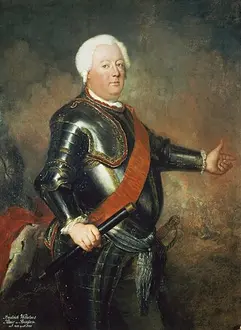
King in Prussia and Elector of Brandenburg (1713–1740)
Frederick William I centralized royal administration and expanded Prussia’s standing army. His rule combined protectionist economic development and Protestant piety with selective religious toleration and coercive social discipline.
Closest ideologies
Based on the 31 statements where Friedrich Wilhelm I of Prussia has a known position.
- Emperor-system fascism (91% match)
- Neo-Legionarism (89% match)
- Pan-Germanism (88% match)
- Italian fascism (88% match)
- Christian fascism (87% match)
Similar people
- Charlemagne (92% alike)
- Henry VIII of England (91% alike)
- Louis XIV of France (91% alike)
- Rudolf Hess (90% alike)
- Paul von Hindenburg (89% alike)
Known positions
- Strongly: A state may force a minority it sees as hostile to leave the country.
- Strongly: Art, poetry and stories that harm people's moral character should be censored.
- Strongly: Someone who actually governs a state may hand that power on to their own child, whether as a king or as a republic's leader.
- Strongly: A minority group is working in secret to harm the nation.
- Strongly: The right to govern traces back to God, even when people confer it on their leaders.
- Strongly: Many political decisions should rest with national or wider authorities, even where a smaller community could handle them.
- Strongly: Governments should limit how money and investment can be moved across borders.
- Strongly: Real authority to command the military should rest with the head of state.
- Strongly: Taxes on imports should shield domestic producers from foreign competition.
- Strongly: State schools may teach pupils a religious faith, for example through lessons in its beliefs and practice.
- Strongly: When national priorities conflict with working together internationally, my country should choose its own priorities.
- Strongly: The worst crimes can be punished by death.
- Strongly: The government should be able to require citizens to serve in the military.
- Strongly: The government should steer investment into industries it sees as key to the country's future.
- Strongly: Defense should not rest with armed ordinary citizens in place of a standing force.
- Strongly: A country can miss out on lasting gains when barriers to international commerce come down.
- Strongly: Religious values and institutions should shape laws, schools and public life.
- Strongly: Collecting taxes does not in itself amount to stealing people's money.
- Strongly: State schools need not steer pupils away from belief in God.
- Strongly: Final authority over a state's laws need not belong to its most senior religious scholars.
- Leans: People farming an estate should lack the legal freedom to leave that estate.
- Leans: The ruler should not be bound by the country's laws, including those made by that ruler and by earlier ones.
- Leans: A powerful country should bring more land within its borders.
- Leans: Universal social programmes should give way to programmes restricted to the poorest people, with eligibility based on financial need.
- Leans: The government should have authority over religious institutions' internal affairs.
- Leans: The country may allow more immigration than strict limits would permit.
- Leans: New oil and gas wells and coal mines should be permitted.
- Leans: Property should belong to many people in small holdings.
- Leans: Officials decide what gets made and who gets it at least as well as prices and competition do.
- Leans: Individual farms should not give way to joint cultivation by groups of farmers.