Political Ideology Atlas · All people · Take the test
Latin America & Caribbean · born 1959
Evo Morales
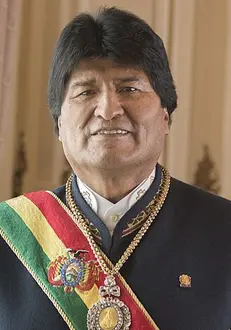
President of Bolivia (2006–2019)
Evo Morales rose to national office through Bolivia’s coca growers’ unions and the Movement Toward Socialism. His presidency expanded public control of strategic industries and social provision and pursued a plurinational constitution recognizing Indigenous self-government. He sought a further presidential term after voters rejected a change to the consecutive-term limit.
Key figure of
Closest ideologies
Based on the 94 statements where Evo Morales has a known position.
- Chavismo (90% match)
- Irish republican legitimism (90% match)
- African socialism (90% match)
- Ba'athism (89% match)
- Bolivarianism (89% match)
Similar people
- Maximilien Robespierre (87% alike)
- Aurobindo Ghosh (87% alike)
- Subhas Chandra Bose (87% alike)
- Julius Malema (87% alike)
- Hugo Chávez (87% alike)
Known positions
- Strongly: A country can move toward socialism by winning elections and governing through parliament.
- Strongly: Voters themselves should elect the head of state, without an intermediary body selecting the officeholder.
- Strongly: Transgender people's legal gender should match their gender identity.
- Strongly: Political change should replace the existing administrative and coercive institutions with new forms of organization, rather than put new leaders in charge of the old apparatus.
- Strongly: Government should maintain a strict institutional separation from religion.
- Strongly: Major laws should be decided by citizens voting on them themselves.
- Strongly: New oil and gas wells and coal mines should be permitted.
- Strongly: An assembly elected by the people for that purpose should draft the constitution.
- Strongly: A country should press its neighbour to give back land taken from it in an old war.
- Strongly: Lack of full certainty is no reason to delay protective action.
- Strongly: The state should be barred from executing people convicted of the gravest crimes, such as terrorism.
- Strongly: Government should be bound by written guarantees of basic rights protected against easy amendment by ordinary majorities.
- Strongly: A national minority should run its own schools, language and cultural institutions inside the state it lives in.
- Strongly: The farmers who work large estates should take ownership from the landowners, with the transfer compulsory if owners refuse.
- Strongly: The government should steer investment into industries it sees as key to the country's future.
- Strongly: Governments should encourage contact between cultural groups.
- Strongly: Industries such as energy, rail and utilities should be owned by the state or public bodies, not private companies.
- Strongly: A country can miss out on lasting gains when barriers to international commerce come down.
- Strongly: People should want as few material things as possible.
- Strongly: Governments need to make sweeping changes to deal with global warming.
- Strongly: An electorate should choose the head of state, either directly or through elected representatives.
- Strongly: The state should not make one language the only common language of government, schooling and public life at the cost of limiting others.
- Strongly: Society should take active steps to make up for the harm done by past racial injustices.
- Strongly: Countries should start from a policy of staying out of other countries' internal affairs.
- Strongly: Public institutions should help minority languages be used in public life, for example through teaching or services in those languages.
- Strongly: A society is able to become socialist without an armed revolution.
- Strongly: Indigenous peoples should control their traditional territories.
- Strongly: Countries that feel dominated by Western powers should band together to resist them.
- Strongly: Nature matters for its own sake, not only because it is useful to people.
- Strongly: Society should use modern technology together with revived values inherited from its ancestors.
- Strongly: The state should guarantee health care to everyone, whether it runs the services itself or pays for them.
- Strongly: People should have a direct role in making decisions where they work, live and study, rather than having those decisions made entirely for them.
- Strongly: There should be a central bank.
- Strongly: People should have a way to vote an officeholder out between regular elections.
- Strongly: State ownership should stop short of covering all land.
- Strongly: Armed conflict does not generally make a people stronger in character.
- Strongly: Constantly seeking additional possessions is harmful overall, despite any benefits it brings.
- Strongly: Owning things privately is justified only if it benefits society as a whole.
- Strongly: Trade, finance and debt rules should be changed to give poorer countries a fairer share.
- Strongly: Torture should be subject to a blanket legal ban.
- Strongly: Groups have rights of their own.
- Strongly: Foreign armies should not be based on the country's territory.
- Strongly: Elected governments need not leave monetary policy to central banks acting on their own.
- Strongly: Daughters and widows should inherit and own land on the same terms as sons and husbands.
- Strongly: We have a duty to leave the planet in good condition for those who come after us.
- Strongly: Central banks should keep a role in controlling the money supply.
- Strongly: Keeping a nation's inherited culture alive, including its language, customs and traditions, matters.
- Strongly: No society has the right to rule another for its supposed improvement, however advanced it is.
- Strongly: Society needs government of some kind.
- Strongly: Women should be able to vote and stand for office on the same terms as men.
- Strongly: Private owners' choice of whom they deal with should be subject to some restrictions.
- Strongly: Each country should hold ultimate authority over its natural resources, without foreign interests controlling them.
- Strongly: Voting should not be limited to members of one ethnic group.
- Strongly: Public spaces such as schools and facilities should not be separated by race under the law.
- Strongly: Government should have other tasks besides protecting people from physical violence.
- Strongly: Courts need not be handed over to private businesses.
- Strongly: People without property should also have the right to vote.
- Leans: Legal limits on how far prices, including pay, may rise are a good way to fight inflation.
- Leans: The military should have a political role in protecting the constitution and public order, stepping in when they are threatened.
- Leans: Long-term residents without citizenship have a say in the places where they live.
- Leans: Speech that attacks groups for who they are can be punished by law.
- Leans: Real authority to command the military should rest with the head of state.
- Leans: A party with a fifth of the votes should get about a fifth of the seats.
- Leans: Elected representatives may serve out their terms without voters being able to remove them early.
- Leans: A president should be free to stand for re-election as many times as they like.
- Leans: State schools may teach pupils a religious faith, for example through lessons in its beliefs and practice.
- Leans: Besides its directly elected parliament, a legislature should have a second chamber, such as a senate.
- Leans: Political power should be split among separate branches and levels that can each limit the others.
- Leans: Recreational drugs should be illegal for adults.
- Leans: Either spouse can leave a marriage without showing wrongdoing by the other.
- Leans: The government should be able to require citizens to serve in the military.
- Leans: Workers should form a party of their own, separate from the parties already in place.
- Leans: Trade unions should control their own affairs without state direction.
- Leans: Direct action does not have to take the place of elections and parliament as the way to achieve political change.
- Leans: Areas where an ethnic minority makes up most of the population should be able to run many of their own affairs within the state.
- Leans: A country's constitution should prevail when it conflicts with international legal obligations.
- Leans: Government should take sides on how people live, backing the ways of life it judges good.
- Leans: A nation can be made up of several ethnic groups with none forming most of its people.
- Leans: Political representation should not come through social bodies such as families, local communities and occupational associations instead of political parties.
- Leans: Students should pay no tuition to attend public higher education institutions.
- Leans: In law, a country's traditional national church should rank no higher than other religious bodies.
- Leans: Citizens should have a legal right to see government information.
- Leans: Marriage should retain legal recognition.
- Leans: The goods people consume should mainly come from nearby producers.
- Leans: Laws, institutions and customs still favor men over women.
- Leans: Workers are better off for having labor unions.
- Leans: No party's ideology should give it an exclusive right to lead the state.
- Leans: A wife should be able to end the marriage even when her husband refuses.
- Leans: Descendants of settlers need not be led politically by the country's original peoples.
- Leans: Meeting poor people's needs should be the first consideration in public policy.
- Leans: Lending money at interest should be legal.
- Leans: Political power may rest on something other than workplace-elected councils.
- Leans: Belonging to the nation does not go with sharing its religion.
- Leans: The law should treat everyone as an equal, whatever their birth, sex, race or status.