Political Ideology Atlas · All people · Take the test
Latin America & Caribbean · born 1954, historical
Hugo Chávez
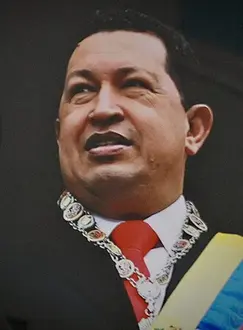
President of Venezuela (1999–2013)
Chávez promoted Bolivarian socialism through public control of strategic resources, social programmes and communal participation. He combined competitive elections and recall mechanisms with concentrated executive power, and pursued Latin American cooperation and a multipolar international order.
Closest ideologies
Based on the 68 statements where Hugo Chávez has a known position.
- Bolivarian Socialism (88% match)
- Chavismo (87% match)
- Madurismo (84% match)
- Chinese New Left (84% match)
- Sankarism (83% match)
Similar people
- Nicolás Maduro (88% alike)
- Subhas Chandra Bose (88% alike)
- Julius Malema (87% alike)
- Fidel Castro (85% alike)
- Thomas Sankara (84% alike)
Known positions
- Strongly: Strict legal limits should apply to owning a gun.
- Strongly: Currency trades and similar international financial deals should carry a small tax of their own.
- Strongly: Voters themselves should elect the head of state, without an intermediary body selecting the officeholder.
- Strongly: The country would benefit from a strong leader with the power to act despite deadlock among its political institutions.
- Strongly: A party with a fifth of the votes should get about a fifth of the seats.
- Strongly: An assembly elected by the people for that purpose should draft the constitution.
- Strongly: Real authority to command the military should rest with the head of state.
- Strongly: A president should be free to stand for re-election as many times as they like.
- Strongly: Only the state's armed forces and police should have permission to carry weapons.
- Strongly: The state should be barred from executing people convicted of the gravest crimes, such as terrorism.
- Strongly: New oil and gas wells and coal mines should be permitted.
- Strongly: Employees should have voting rights in the management of large companies.
- Strongly: A country should seek closer ties with China than with the United States.
- Strongly: Businesses should belong to the people who work in them, for example as cooperatives.
- Strongly: Trade unions may be subject to state direction of their affairs.
- Strongly: Prisons should mainly help offenders rejoin society.
- Strongly: Full-time work at the legal wage floor should pay enough to meet basic living costs.
- Strongly: The global economic system keeps poorer countries poor by directing their wealth toward richer countries.
- Strongly: The state should limit or screen money that foreign donors give to charities, campaign groups, the press and universities.
- Strongly: Industries such as energy, rail and utilities should be owned by the state or public bodies, not private companies.
- Strongly: Countries that feel dominated by Western powers should band together to resist them.
- Strongly: The state should treat all streams and interpretations of a religion equally under the law.
- Strongly: Indigenous peoples should control their traditional territories.
- Strongly: The government should steer investment into industries it sees as key to the country's future.
- Strongly: Students should pay no tuition to attend public higher education institutions.
- Strongly: One worker's pay should cover the living needs of that worker's family, including the worker.
- Strongly: Climate change calls for drastic action by governments.
- Strongly: Government should impose strict rules on how corporations operate.
- Strongly: Free trade does not benefit everyone in the long run.
- Strongly: Public institutions should help minority languages be used in public life, for example through teaching or services in those languages.
- Strongly: Religious minorities should not be exempt from general laws that burden their practice.
- Strongly: Voters should be able to remove elected officials before their terms end.
- Strongly: Elected politicians should be able to serve any number of terms in any office.
- Strongly: An electorate should choose the head of state, either directly or through elected representatives.
- Strongly: A country should not be ready to use military force abroad without UN Security Council authorization.
- Strongly: Officials decide what gets made and who gets it at least as well as prices and competition do.
- Strongly: People should have a direct role in making decisions where they work, live and study, rather than having those decisions made entirely for them.
- Strongly: Constantly seeking additional possessions is harmful overall, despite any benefits it brings.
- Strongly: The state should guarantee health care to everyone, whether it runs the services itself or pays for them.
- Strongly: Rulers have a right to rule only because the people they rule have agreed to it.
- Strongly: Trade, finance and debt rules should be changed to give poorer countries a fairer share.
- Strongly: Foreign armies should not be based on the country's territory.
- Strongly: World power should be distributed among several independent major powers, without one dominant power.
- Strongly: Whatever their circumstances, everyone should be able to count on the state for enough to live decently, through benefits, pensions or public services.
- Strongly: Political violence is sometimes justified.
- Strongly: A people with a shared national identity is entitled to its own self-governing state.
- Strongly: In an economy with common ownership of productive assets, people should still own their personal belongings.
- Strongly: Looking after your own interests is not a moral good in itself.
- Strongly: At least some revolutions have been justified.
- Strongly: We have a duty to leave the planet in good condition for those who come after us.
- Strongly: Each country should hold ultimate authority over its natural resources, without foreign interests controlling them.
- Strongly: Women should be able to vote and stand for office on the same terms as men.
- Leans: The people in power should decide what the country's news media publish.
- Leans: Farms, factories and utilities belong to the town or city that uses them.
- Leans: The government should stop its political opponents from organising, speaking or competing for power.
- Leans: Protecting nature can mean accepting less economic growth.
- Leans: An economy whose production is directed by a central plan is capable of working better than an economy directed by market exchange.
- Leans: People should live and work in communities that own land and goods together and govern themselves.
- Leans: Owners' profit is value taken from workers' labor.
- Leans: People should work mainly out of responsibility to society and a shared purpose, with personal material rewards playing a secondary role.
- Leans: Speech that attacks groups for who they are can be punished by law.
- Leans: A country can move toward socialism by winning elections and governing through parliament.
- Leans: Major laws should be decided by citizens voting on them themselves.
- Leans: Distance and nationality do not weaken the duty of the rich to help the poor abroad.
- Leans: Taxes on imports should shield domestic producers from foreign competition.
- Leans: Political power may be concentrated in one body.
- Leans: No party's ideology should give it an exclusive right to lead the state.
- Leans: A government needs more than fair elections to be democratic.