Political Ideology Atlas · All people · Take the test
Europe · born 1758, historical
Maximilien Robespierre
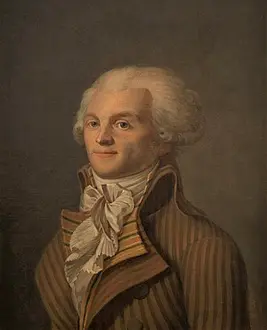
French revolutionary; Jacobin leader and member of the Committee of Public Safety (1793-1794)
Robespierre defended popular sovereignty, equal political rights and a limited, socially bound right of property, and he opposed the death penalty and the war of 1792 before leading the Terror in 1793-94. He opposed atheism and promoted a state cult of the Supreme Being. The sources searched cover his rights, constitutional and religious positions far better than his economic or social ones.
Closest ideologies
Based on the 49 statements where Maximilien Robespierre has a known position.
- Marhaenism (92% match)
- African nationalism (91% match)
- Sandinista ideology (91% match)
- African Socialism (90% match)
- Ujamaa (90% match)
Similar people
- Frederick Douglass (89% alike)
- George Orwell (89% alike)
- Frantz Fanon (89% alike)
- Patrice Lumumba (89% alike)
- Rajiv Gandhi (89% alike)
Known positions
- Strongly: A national emergency sometimes justifies temporarily withdrawing normal legal safeguards against people the government regards as internal enemies, such as protections against detention without trial.
- Strongly: Political power may be concentrated in one body.
- Strongly: The directly elected parliament should be a legislature's only chamber.
- Strongly: A law imposes no moral duty to obey it if the law is unjust.
- Strongly: Citizens should have a legal right to see government information.
- Strongly: Human rights come from the nature that all human beings share.
- Strongly: Voters should be able to remove elected officials before their terms end.
- Strongly: A national church need not be ruled by its bishops.
- Strongly: Some things are right or wrong for everyone, in every culture and era.
- Strongly: People are entitled to resist a ruler's unconstitutional exercise of power.
- Strongly: Recruitment to the civil service should not depend on competitive examinations.
- Strongly: An electorate should choose the head of state, either directly or through elected representatives.
- Strongly: The best constitution does not combine rule by the few with rule by the many.
- Strongly: Private charity does not help people in poverty better than government programs do.
- Strongly: Nobody should hold a special rank by birth, such as a noble title, a hereditary crown or a caste position, or the special rights attached to one.
- Strongly: Meeting poor people's needs should be the first consideration in public policy.
- Strongly: Rulers have a right to rule only because the people they rule have agreed to it.
- Strongly: Even a purely ceremonial head of state should not hold the position by birth.
- Strongly: Private ownership is legitimate only insofar as it benefits society.
- Strongly: Very large concentrations of wealth threaten a free society.
- Strongly: Whatever their circumstances, everyone should be able to count on the state for enough to live decently, through benefits, pensions or public services.
- Strongly: Political violence is sometimes justified.
- Strongly: The law should treat everyone as an equal, whatever their birth, sex, race or status.
- Strongly: Someone who actually governs a state should not hand that power on to their own child.
- Strongly: At least some revolutions have been justified.
- Strongly: Publicly insulting a religion's sacred beliefs should be left outside the criminal law.
- Strongly: The ruler should be subject to the country's laws.
- Strongly: Voting should not be limited to members of one ethnic group.
- Strongly: The holder of the highest state office need not be treated as holy.
- Strongly: People without property should also have the right to vote.
- Strongly: State schools need not steer pupils away from belief in God.
- Leans: The government should stop its political opponents from organising, speaking or competing for power.
- Leans: Choices that harm no one else should never be crimes.
- Leans: Working together internationally should count at least as much as my country's own priorities.
- Leans: The state should offer public work to anyone who wants a job and cannot find one.
- Leans: Rich people have an obligation to help those worse off than they are.
- Leans: Allies are bound to defend one another against armed attack.
- Leans: Politics should prioritise a single common good identified by reasoning over compromises among organised interests.
- Leans: The worst crimes can be punished by death.
- Leans: Some institutional ties between government and religion are acceptable.
- Leans: Government should serve people's good while respecting each person as more than an instrument of the state or community.
- Leans: Democracy is best even when voters make poor choices.
- Leans: Owners' rights to their property need not be protected against being overridden for public goals.
- Leans: Owning a gun should not face strict legal limits.
- Leans: Where they conflict, religious faith should count for at least as much as evidence and reasoning.
- Leans: Being free requires having the practical resources to act on one's choices, such as an adequate livelihood.
- Leans: Being the law gives a rule a moral claim to be obeyed.
- Leans: Politics should support people's spiritual well-being.