Political Ideology Atlas · All people · Take the test
Russia & Central Asia · born 1964
Vladislav Surkov
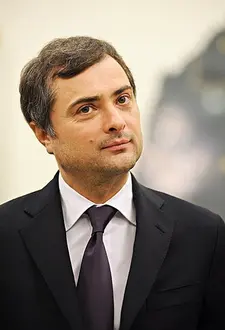
Russian presidential aide, political strategist and deputy prime minister (1999–2020)
Surkov advocates culturally specific, highly centralised Russian government and an expanding sphere of Russian power. His earlier sovereign-democracy programme combines national economic modernisation with social protection; later writing more openly defends political closure and expansion abroad.
Closest ideologies
Based on the 41 statements where Vladislav Surkov has a known position.
- Pahlavism (87% match)
- Russian imperialism (87% match)
- Chiangism (87% match)
- Ilminism (87% match)
- German nationalism (87% match)
Similar people
- Alexander I of Yugoslavia (90% alike)
- Mohammed bin Salman Al Saud (88% alike)
- Bashar al-Assad (88% alike)
- Oliver Cromwell (87% alike)
- Vladimir Putin (87% alike)
Known positions
- Strongly: The leader should bypass parties and organised interest groups in dealing with the people.
- Strongly: A powerful country should bring more land within its borders.
- Strongly: The presence of people belonging to the same nation gives a state a legitimate territorial claim outside its borders.
- Strongly: A former empire may keep a special relationship with its old territories.
- Strongly: The country would benefit from a strong leader with the power to act despite deadlock among its political institutions.
- Strongly: A country should press its neighbour to give back land taken from it in an old war.
- Strongly: Judge policies by what they achieve, independently of whether they match an ideology.
- Strongly: Many political decisions should rest with national or wider authorities, even where a smaller community could handle them.
- Strongly: Only the state's armed forces and police should have permission to carry weapons.
- Strongly: Political power may be concentrated in one body.
- Strongly: Foreign powers sometimes have a right to intervene in a country's internal affairs.
- Strongly: Armed forces may sometimes be used for purposes beyond defending the country against attack.
- Strongly: The government should steer investment into industries it sees as key to the country's future.
- Strongly: A country's constitution should prevail when it conflicts with international legal obligations.
- Strongly: Political institutions developed in the West are not a suitable model for every civilization.
- Strongly: A nation does not need one main ethnic group: it can be made up of people of many ancestries.
- Strongly: World power should be distributed among several independent major powers, without one dominant power.
- Strongly: Whatever their circumstances, everyone should be able to count on the state for enough to live decently, through benefits, pensions or public services.
- Strongly: A government needs more than fair elections to be democratic.
- Strongly: Keeping a nation's inherited culture alive, including its language, customs and traditions, matters.
- Strongly: Each country should hold ultimate authority over its natural resources, without foreign interests controlling them.
- Strongly: Society needs government of some kind.
- Strongly: Courts need not be handed over to private businesses.
- Leans: The people in power should decide what the country's news media publish.
- Leans: The government should stop its political opponents from organising, speaking or competing for power.
- Leans: Most people in political office look after the public at least as much as themselves.
- Leans: Peoples who share an ethnic heritage, such as the Slavic, Arab or Turkic peoples, should come together in one state, even across present borders.
- Leans: Countries within one civilization should unite politically.
- Leans: Changes to society should be introduced a little at a time.
- Leans: Private businesses and markets should run most of the economy, while the government supports people who cannot meet their basic needs.
- Leans: Democracy is not the best form of government when voters choose badly.
- Leans: Governments should be able to keep some international agreements secret.
- Leans: A president should be free to stand for re-election as many times as they like.
- Leans: Elected politicians should be able to serve any number of terms in any office.
- Leans: Today's nation is the same people as its ancient and medieval forebears.
- Leans: Ethnic diversity does not weaken a society's ability to hold together.
- Leans: Where they conflict, religious faith should count for at least as much as evidence and reasoning.
- Leans: A country may keep all its decisions in its own hands rather than pooling them with other nations.
- Leans: Belonging to the nation does not go with sharing its religion.
- Leans: Businesses gain too much influence over government policy from their lobbying.