Political Ideology Atlas · All people · Take the test
Europe · born 1893, historical
Alfred Rosenberg
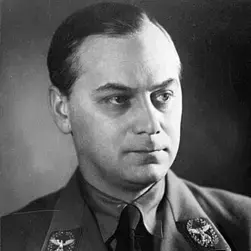
Nazi Party chief ideologue, head of its Foreign Affairs Office (1933-45) and Reich Minister for the Occupied Eastern Territories (1941-45); executed 1946
Alfred Rosenberg, the Nazi Party's leading ideologist and author of The Myth of the Twentieth Century, set out a racial, anti-Jewish, anti-Christian and anti-parliamentary programme of Leader rule and a German national church, and as Reich Minister for the Occupied Eastern Territories oversaw plunder, ghettoisation and forced labour.
Closest ideologies
Based on the 83 statements where Alfred Rosenberg has a known position.
- Italian fascism (90% match)
- Fascism in Europe (89% match)
- Militarism (89% match)
- Nazism (89% match)
- Fascism (88% match)
Similar people
- Heinrich Himmler (91% alike)
- Reinhard Heydrich (91% alike)
- Joseph Goebbels (89% alike)
- Paul von Hindenburg (89% alike)
- Louis XIV of France (89% alike)
Known positions
- Strongly: Law should require people of different races to use separate public spaces, such as schools and public facilities.
- Strongly: Women's political rights may differ from men's.
- Strongly: Public policy, such as sterilization or incentives, should reduce the passing on of inherited disabilities.
- Strongly: A person's sex should affect the public roles legally assigned to them.
- Strongly: People of different races should be discouraged from forming a family together, whether through marriage or having children.
- Strongly: The law may treat people differently according to such things as birth, sex, race and status.
- Strongly: Competition or conflict among peoples has done more to improve human life than any other influence.
- Strongly: Inherited traits are the main explanation for gaps in average ability across racial groups.
- Strongly: A minority group is working in secret to harm the nation.
- Strongly: A powerful country should bring more land within its borders.
- Strongly: Laws, institutions and customs today do not systematically favor men over women.
- Strongly: People of each race should organize politically as a group to stand up for concerns specific to them.
- Strongly: No moral truths hold across all cultures.
- Strongly: The government should have authority over religious institutions' internal affairs.
- Strongly: A country should limit who may immigrate according to their race.
- Strongly: Most of the people who make up a nation should belong to the same ethnic group.
- Strongly: A society holds together less well when its members belong to different ethnic groups.
- Strongly: The head of state should not have to be chosen by election.
- Strongly: Having a human nature in common is not what gives people their rights.
- Strongly: Innate nature shapes a person's character at least as much as their environment does.
- Strongly: Workers' solidarity with their own nation should take priority over solidarity with workers across borders.
- Strongly: Real authority to command the military should rest with the head of state.
- Strongly: The country would benefit from a strong leader with the power to act despite deadlock among its political institutions.
- Strongly: The political goal should be victory over communism ahead of accommodation with it.
- Strongly: Political power may be concentrated in one body.
- Strongly: When national priorities conflict with working together internationally, my country should choose its own priorities.
- Strongly: Prisons should focus at least as much on punishment as on rehabilitation.
- Strongly: The worst crimes can be punished by death.
- Strongly: Democracy is not the best form of government when voters choose badly.
- Strongly: Ideas of what men and women are like do not come mostly from culture.
- Strongly: Society should follow a third course beyond capitalism and communism.
- Strongly: Major laws should not be decided by direct votes of citizens.
- Strongly: Some institutional ties between government and religion are acceptable.
- Strongly: A country can miss out on lasting gains when barriers to international commerce come down.
- Strongly: What you owe your community matters more than your personal rights.
- Strongly: Living in the countryside does more for a person's moral wellbeing than living in a city.
- Strongly: Seats may be allocated in ways that do not follow parties' shares of the vote closely.
- Strongly: Employers and workers should treat each other as partners whose cooperation comes before conflict, even where their interests differ.
- Strongly: A country should use its armed forces to advance policy goals beyond national self-defence.
- Strongly: The nation has decayed and must be reborn.
- Strongly: A country may keep all its decisions in its own hands rather than pooling them with other nations.
- Strongly: Some cultures are superior to others.
- Strongly: Another body may have the final say over what the legislature passes.
- Strongly: Rules need not set equal numbers of women and men on public bodies.
- Strongly: Schools should cultivate patriotic feeling: loyalty to and pride in the nation, expressed for example through respect for its flag and anthem.
- Strongly: At least one other factor explains as much of history as changes in how economies are organized do.
- Strongly: The head of state should not be elected directly by the voters.
- Strongly: At least one other influence has shaped history as much as conflict between economic classes has.
- Strongly: To work for your country's interests is to work for the interests of its workers.
- Strongly: The state may restrict what adults do for reasons other than preventing harm to others.
- Strongly: Member states should keep the final decision on whether to follow UN decisions.
- Strongly: People who give their lives for the nation deserve to be remembered as martyrs, with reverence beyond ordinary thanks.
- Strongly: Racial categories are not merely social constructs without a scientific basis.
- Strongly: Public schooling money may go straight to schools instead of to parents as vouchers.
- Strongly: Laws should not be required to follow religious texts.
- Strongly: Countries may keep controls on who enters and settles, even in the long run.
- Strongly: Owning things privately is justified only if it benefits society as a whole.
- Strongly: The holy scripture of one's faith is not God's own error-free word.
- Strongly: It is legitimate to take pride in the racial group one belongs to.
- Strongly: Soldiers and conscripts need not refuse to fight when their state goes to war.
- Strongly: A people's connection to its ancestral land is spiritual, beyond practical interests or ordinary affection.
- Strongly: School history should mostly tell the story of the student's own nation.
- Strongly: Groups have rights of their own.
- Strongly: A workers' state does not need to suppress the old ruling class, even for a time.
- Strongly: Looking after your own interests is not a moral good in itself.
- Strongly: In a war between great powers, workers need not seek their own government's defeat.
- Strongly: Marriage should retain legal recognition.
- Strongly: Society needs government of some kind.
- Strongly: Countries should keep their armed forces.
- Strongly: Public school science classes may teach evolution on its own.
- Strongly: Government should have other tasks besides protecting people from physical violence.
- Strongly: Final authority over a state's laws need not belong to its most senior religious scholars.
- Leans: Having a shared national identity does not by itself entitle a people to its own self-governing state.
- Leans: Becoming a capable ruler requires a natural talent for the job.
- Leans: A society can thrive without relying on conventional family arrangements as its bedrock.
- Leans: People should gain political representation through social bodies such as families, local communities and occupational associations instead of political parties.
- Leans: The Soviet economy was capitalist under state ownership, with the state taking the place of private capitalists.
- Leans: A business owner can earn a profit without taking unfair advantage of employees.
- Leans: The state has no single leading function, or its leading function is something other than preserving the ruling class's power.
- Leans: Property should belong to many people in small holdings.
- Leans: The country should impose strict limits on immigration.
- Leans: Keeping a nation's inherited culture alive, including its language, customs and traditions, matters.
- Leans: Most people in political office look after themselves first and the public second.