Political Ideology Atlas · All people · Take the test
Europe · born 1897, historical
Joseph Goebbels
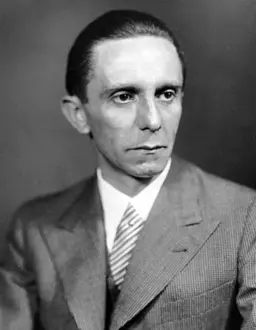
Nazi Gauleiter of Berlin and Reich Minister of Propaganda (1933-1945)
Goebbels was a leading Nazi propagandist who, after an early period close to the party's Strasser wing, became a loyal follower of Hitler. His mature positions combine a one-party, leader-centred authoritarian state, extreme racial nationalism and violent antisemitism, hostility to liberalism, democracy and communism, and total mobilisation of society for war. He controlled press, radio, film and the arts and called for a 'people's community' in which class conflict gave way to national duty.
Closest ideologies
Based on the 160 statements where Joseph Goebbels has a known position.
- Positive Christianity (90% match)
- Aryanism (90% match)
- Reactionary modernism (90% match)
- Palingenetic ultranationalism (90% match)
- Italian fascism (88% match)
Similar people
- Hermann Göring (93% alike)
- Reinhard Heydrich (92% alike)
- Heinrich Himmler (92% alike)
- Adolf Hitler (91% alike)
- Benito Mussolini (89% alike)
Known positions
- Strongly: Law should require people of different races to use separate public spaces, such as schools and public facilities.
- Strongly: The person holding the highest state office should be treated as holy.
- Strongly: Only members of one racial or ethnic group should have the right to vote.
- Strongly: A lord's political authority should be grounded in the personal loyalty sworn by followers.
- Strongly: Shoppers should choose to stay away from shops whose owners belong to a particular religious minority.
- Strongly: Women's political rights may differ from men's.
- Strongly: Temporary rule by a more developed society is justified when it helps the ruled to progress.
- Strongly: Every part of life should be subject to state direction.
- Strongly: A state may force a minority it sees as hostile to leave the country.
- Strongly: One ideologically correct party should hold state leadership without competing parties having a right to replace it.
- Strongly: The people in power should decide what the country's news media publish.
- Strongly: A minority group is working in secret to harm the nation.
- Strongly: The law may treat people differently according to such things as birth, sex, race and status.
- Strongly: The government should stop its political opponents from organising, speaking or competing for power.
- Strongly: A powerful country should bring more land within its borders.
- Strongly: War develops virtues in a nation, such as courage and discipline.
- Strongly: The country's majority national group should have the leading role in controlling economic life.
- Strongly: A person's sex should affect the public roles legally assigned to them.
- Strongly: Rivalry and conflict between nations or peoples do more than anything else to drive humanity forward.
- Strongly: The presence of people belonging to the same nation gives a state a legitimate territorial claim outside its borders.
- Strongly: Some people are better suited by nature to govern.
- Strongly: It is acceptable to praise a national leader openly as the one who stands for the whole nation.
- Strongly: Young people should belong to uniformed, drilled organisations that prepare them to serve the nation.
- Strongly: A nation should be mainly one ethnic people.
- Strongly: At its core, politics is a struggle between spiritual good and evil.
- Strongly: People do not need a direct role in making decisions where they work, live and study.
- Strongly: The government should have authority over religious institutions' internal affairs.
- Strongly: A country should be ready to use military force abroad on its own judgment, even if the UN Security Council has not authorized it.
- Strongly: A free, fair society can be reached through methods that fall short of being free and fair.
- Strongly: Land that a state declares its own against its people's will is not illegally occupied by that state.
- Strongly: The country would benefit from a strong leader with the power to act despite deadlock among its political institutions.
- Strongly: Women should have different military draft obligations from men.
- Strongly: A national emergency sometimes justifies temporarily withdrawing normal legal safeguards against people the government regards as internal enemies, such as protections against detention without trial.
- Strongly: Workers' solidarity with their own nation should take priority over solidarity with workers across borders.
- Strongly: Having a human nature in common is not what gives people their rights.
- Strongly: Society may deal with racial discrimination as it arises today without programs aimed at past wrongs.
- Strongly: Real authority to command the military should rest with the head of state.
- Strongly: A country should press its neighbour to give back land taken from it in an old war.
- Strongly: Whether citizens may see government information can be left to the government to decide.
- Strongly: Democracy is not the best form of government when voters choose badly.
- Strongly: Capitalism did not build the productive power and wealth that a better society can rest on.
- Strongly: My country may join a military alliance led by one of the great powers.
- Strongly: Many political decisions should rest with national or wider authorities, even where a smaller community could handle them.
- Strongly: Collective goals can justify treating a person merely as a tool.
- Strongly: The political goal should be victory over communism ahead of accommodation with it.
- Strongly: My country's military strength should exceed that of its rivals.
- Strongly: Laws, institutions and customs today do not systematically favor men over women.
- Strongly: A country has the right to stop a region becoming independent by using its military.
- Strongly: Armaments need not be limited to the minimum needed for national safety.
- Strongly: Trade unions may be subject to state direction of their affairs.
- Strongly: Living in the countryside does more for a person's moral wellbeing than living in a city.
- Strongly: Society should follow a third course beyond capitalism and communism.
- Strongly: When national priorities conflict with working together internationally, my country should choose its own priorities.
- Strongly: The worst crimes can be punished by death.
- Strongly: The nation has decayed and must be reborn.
- Strongly: Communist one-party states should not receive the same condemnation as fascist states.
- Strongly: People able to work should get welfare benefits only in return for some work, such as a job or a work scheme.
- Strongly: Countries that feel dominated by Western powers should band together to resist them.
- Strongly: The government should be able to require citizens to serve in the military.
- Strongly: Belonging to the nation ties a person's life to a sacred community that goes on after their death.
- Strongly: Armed forces may sometimes be used for purposes beyond defending the country against attack.
- Strongly: What you owe your community matters more than your personal rights.
- Strongly: A country may join permanent military alliances.
- Strongly: Workers may be represented through the parties already in place.
- Strongly: A democratic constitution need not be founded on an explicit rejection of fascism.
- Strongly: Society may be changed in large, rapid steps.
- Strongly: A country's constitution should prevail when it conflicts with international legal obligations.
- Strongly: Advancing gender equality need not be the specific job of any government body.
- Strongly: Another body may have the final say over what the legislature passes.
- Strongly: Some things are right or wrong for everyone, in every culture and era.
- Strongly: Hate speech should be legal.
- Strongly: Some cultures are superior to others.
- Strongly: Employers and workers should treat each other as partners whose cooperation comes before conflict, even where their interests differ.
- Strongly: Deeply divided societies should not guarantee every major community a share of executive power.
- Strongly: Racial categories are not merely social constructs without a scientific basis.
- Strongly: People who give their lives for the nation deserve to be remembered as martyrs, with reverence beyond ordinary thanks.
- Strongly: A healthy society depends on the traditional family, such as a married mother and father raising their children.
- Strongly: Rules need not set equal numbers of women and men on public bodies.
- Strongly: A country may keep a region that wants to leave.
- Strongly: A country may keep all its decisions in its own hands rather than pooling them with other nations.
- Strongly: Schools should cultivate patriotic feeling: loyalty to and pride in the nation, expressed for example through respect for its flag and anthem.
- Strongly: The nation's cause and the cause of its ordinary working people are one and the same.
- Strongly: It is legitimate to take pride in the racial group one belongs to.
- Strongly: A people split by an imposed border should be brought together in a single state.
- Strongly: A state should take responsibility for the welfare of its national communities across neighbouring borders.
- Strongly: National policy should give priority to preventing outside powers from splitting the country territorially.
- Strongly: Governments are under no obligation to fund media that decide their own editorial content.
- Strongly: Being the law gives a rule a moral claim to be obeyed.
- Strongly: Equality of outcomes should not be society's goal.
- Strongly: Restoring a lost social order does not matter more than pursuing progress.
- Strongly: Population growth may be left to run its course.
- Strongly: Other forces move history at least as much as conflict between classes does.
- Strongly: Most people in political office look after themselves first and the public second.
- Strongly: Member states should keep the final decision on whether to follow UN decisions.
- Strongly: Politics should support people's spiritual well-being.
- Strongly: Political violence is sometimes justified.
- Strongly: A people's connection to its ancestral land is spiritual, beyond practical interests or ordinary affection.
- Strongly: Groups have rights of their own.
- Strongly: Religion does not offer illusory comfort for material suffering.
- Strongly: Looking after your own interests is not a moral good in itself.
- Strongly: Soldiers and conscripts need not refuse to fight when their state goes to war.
- Strongly: At least some revolutions have been justified.
- Strongly: Countries may keep controls on who enters and settles, even in the long run.
- Strongly: Keeping a nation's inherited culture alive, including its language, customs and traditions, matters.
- Strongly: In a war between great powers, workers need not seek their own government's defeat.
- Strongly: A workers' state does not need to suppress the old ruling class, even for a time.
- Strongly: Public offices may be filled by methods other than drawing lots.
- Strongly: Police forces should continue to exist.
- Strongly: Society needs government of some kind.
- Strongly: Countries should keep their armed forces.
- Strongly: Government should have other tasks besides protecting people from physical violence.
- Strongly: Killing another person can be right in self-defence or in defence of others.
- Strongly: State schools need not steer pupils away from belief in God.
- Strongly: Final authority over a state's laws need not belong to its most senior religious scholars.
- Strongly: The Holocaust happened as historians describe it.
- Strongly: Museums, libraries and other inherited culture should not be destroyed, even when they stand in the way of new creation.
- Leans: The ruler should not be bound by the country's laws, including those made by that ruler and by earlier ones.
- Leans: Most of the average difference in ability between racial groups comes from genes.
- Leans: The leader should bypass parties and organised interest groups in dealing with the people.
- Leans: Having a shared national identity does not by itself entitle a people to its own self-governing state.
- Leans: An economy whose production is directed by a central plan is capable of working better than an economy directed by market exchange.
- Leans: Members of every racial group should organise politically around interests specific to their group.
- Leans: Art, poetry and stories that harm people's moral character should be censored.
- Leans: Choices that harm no one else should never be crimes.
- Leans: People should be encouraged to live in ways that differ from social custom.
- Leans: Rulers are not bound to act only under lasting, publicly known laws administered by recognised courts.
- Leans: Wars between great powers are an unavoidable consequence of capitalism.
- Leans: Labor unions do not necessarily make workers better off.
- Leans: Owners' profit is value taken from workers' labor.
- Leans: Owners' rights to their property should almost never be overridden, even for public goals.
- Leans: Innate nature shapes a person's character at least as much as their environment does.
- Leans: People with advanced schooling are cut off from how ordinary people live and work.
- Leans: Countries that had colonies should compensate the countries they colonized.
- Leans: Countries within one civilization should unite politically.
- Leans: The people who run the press, universities and other cultural institutions have more real power than the people voters elect.
- Leans: Housework and care at home should not be paid with wages.
- Leans: Rich people have an obligation to help those worse off than they are.
- Leans: Some race-based affirmative action should continue.
- Leans: Politics should prioritise a single common good identified by reasoning over compromises among organised interests.
- Leans: High earners and the very rich should pay tax at a much higher rate than everyone else.
- Leans: Industries such as energy, rail and utilities should be owned by the state or public bodies, not private companies.
- Leans: People should want as few material things as possible.
- Leans: Formal press freedom is hollow when wealth decides who can actually be heard.
- Leans: The government should steer investment into industries it sees as key to the country's future.
- Leans: A poor country should develop mainly with its own resources.
- Leans: One worker's pay should cover the living needs of that worker's family, including the worker.
- Leans: Women may go out in public without any legal duty to cover fully.
- Leans: Society should use modern technology together with revived values inherited from its ancestors.
- Leans: Officials decide what gets made and who gets it at least as well as prices and competition do.
- Leans: Where they conflict, religious faith should count for at least as much as evidence and reasoning.
- Leans: Each country should hold ultimate authority over its natural resources, without foreign interests controlling them.
- Leans: The state should guarantee health care to everyone, whether it runs the services itself or pays for them.
- Leans: Private ownership is legitimate only insofar as it benefits society.
- Leans: Very large concentrations of wealth threaten a free society.
- Leans: Businesses gain too much influence over government policy from their lobbying.