Political Ideology Atlas · All ideologies · Take the test
Ariosophy
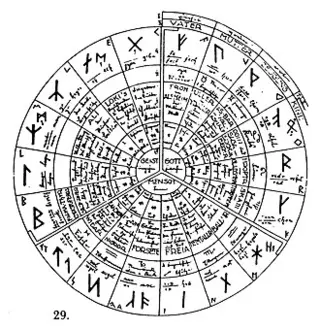
Ariosophy is the Austro-German occult-racist current of c. 1890-1930 that fused Theosophy-style esotericism with völkisch nationalism. It holds that a god-descended Aryan-Germanic elite once ruled as priest-kings and should again, ruling over 'lower' races kept apart by selective breeding. It is monarchist, anti-democratic, antisemitic and anti-socialist, and expects a violent regeneration of an Ario-German empire.
What it stands for
- Law should require people of different races to use separate public spaces, such as schools and public facilities.
- The person holding the highest state office should be treated as holy.
- Only members of one racial or ethnic group should have the right to vote.
- Public policy, such as sterilization or incentives, should reduce the passing on of inherited disabilities.
- People of different races should be discouraged from forming a family together, whether through marriage or having children.
- Most of the average difference in ability between racial groups comes from genes.
Key figures
- Guido von List: Founder of Armanism and Wotanism, the Ario-Germanic racial religion
- Jörg Lanz von Liebenfels: Author of Theozoologie, founder of the Order of the New Templars and coiner of 'Ariosophy'
Closest ideologies
- Kahanism (89% match)
- Aryanism (87% match)
- Positive Christianity (87% match)
- Lebensraum (87% match)
- Rexism (86% match)
People closest to it
- Rudolf Hess (86% alike)
- Charlemagne (85% alike)
- Nicholas II of Russia (85% alike)
- Reinhard Heydrich (84% alike)
- Heinrich Himmler (84% alike)
Key positions
- Strongly: Law should require people of different races to use separate public spaces, such as schools and public facilities.
- Strongly: The person holding the highest state office should be treated as holy.
- Strongly: Only members of one racial or ethnic group should have the right to vote.
- Strongly: Public policy, such as sterilization or incentives, should reduce the passing on of inherited disabilities.
- Strongly: People of different races should be discouraged from forming a family together, whether through marriage or having children.
- Strongly: Same-sex relations between consenting adults should be punishable by law.
- Strongly: Most of the average difference in ability between racial groups comes from genes.
- Strongly: The law may treat people differently according to such things as birth, sex, race and status.
- Strongly: God is the ultimate source of the right to exercise political authority.
- Strongly: The government should stop its political opponents from organising, speaking or competing for power.
- Strongly: A powerful country should bring more land within its borders.
- Strongly: Members of every racial group should organise politically around interests specific to their group.
- Strongly: A person's sex should affect the public roles legally assigned to them.
- Strongly: Consent of the governed is not the only basis of legitimate political authority.
- Strongly: Recovering how society used to be matters more than moving forward.
- Strongly: The presence of people belonging to the same nation gives a state a legitimate territorial claim outside its borders.
- Strongly: Some people are better suited by nature to govern.
- Strongly: Public policy need not put the needs of the poor ahead of other concerns.
- Strongly: A nation should be mainly one ethnic people.
- Strongly: Special ranks held by birth, such as noble titles and hereditary crowns, may continue to exist.
- Strongly: Peoples who share an ethnic heritage, such as the Slavic, Arab or Turkic peoples, should come together in one state, even across present borders.
- Strongly: At its core, politics is a struggle between spiritual good and evil.
- Strongly: A wife should not be able to end the marriage when her husband refuses.
- Strongly: People do not need a direct role in making decisions where they work, live and study.
- Strongly: A society holds together less well when its members belong to different ethnic groups.
- Strongly: The head of state should not have to be chosen by election.
- Strongly: Innate nature shapes a person's character at least as much as their environment does.
- Strongly: The government may spend public money without first getting its budget approved by an elected legislature.
- Strongly: Unused arbitrary power over a person does not itself reduce that person's freedom.
- Strongly: The country would benefit from a strong leader with the power to act despite deadlock among its political institutions.
- Strongly: Having a human nature in common is not what gives people their rights.
- Strongly: Society may deal with racial discrimination as it arises today without programs aimed at past wrongs.
- Strongly: Real authority to command the military should rest with the head of state.
- Strongly: Democracy is not the best form of government when voters choose badly.
- Strongly: Collective goals can justify treating a person merely as a tool.
- Strongly: Areas where an ethnic minority is the majority may be governed in the same way as the rest of the state.
- Strongly: Only children of citizens should be citizens at birth: being born in the country should not be enough.
- Strongly: People do not have full ownership of their own bodies.
- Strongly: Government should not be bound by a written bill of rights protected against easy amendment by ordinary majorities.
- Strongly: Wealthy countries have no duty to give substantial aid to the world's poor abroad.
- Strongly: Workers should not have democratic voting rights in the management of large companies.
- Strongly: The nation has decayed and must be reborn.
- Strongly: Foreign powers sometimes have a right to intervene in a country's internal affairs.
- Strongly: Belonging to the nation ties a person's life to a sacred community that goes on after their death.
- Strongly: Armed forces may sometimes be used for purposes beyond defending the country against attack.
- Strongly: Major laws should not be decided by direct votes of citizens.
- Strongly: A constitution does not have to be drafted by an assembly elected for that purpose.
- Strongly: A democratic constitution need not be founded on an explicit rejection of fascism.
- Strongly: Seats may be allocated in ways that do not follow parties' shares of the vote closely.
- Strongly: Another body may have the final say over what the legislature passes.
- Strongly: Elected representatives may serve out their terms without voters being able to remove them early.
- Strongly: Some cultures are superior to others.
- Strongly: The head of state should not be elected directly by the voters.
- Strongly: Today's nation is the same people as its ancient and medieval forebears.
- Strongly: In the society we should aim for, a person's share of goods may depend on things besides their needs.
- Strongly: Racial categories are not merely social constructs without a scientific basis.
- Strongly: Profit made from owning businesses does not come from exploiting the workers who produce it.
- Strongly: Where they conflict, religious faith should count for at least as much as evidence and reasoning.
- Strongly: The subordination of women and human mastery over nature can be understood as separate matters.
- Strongly: Conclusions from groups of citizens chosen at random should not contribute to decisions on major public issues.
- Strongly: The people who own the economy and hold power are not the ones the state mainly serves.
- Strongly: Rules need not set equal numbers of women and men on public bodies.
- Strongly: It is legitimate to take pride in the racial group one belongs to.
- Strongly: Spreading democracy does not bring peace.
- Strongly: A state should take responsibility for the welfare of its national communities across neighbouring borders.
- Strongly: Society need not promote ways of living that differ from custom.
- Strongly: Historical change does not come mainly from changes in how society produces and exchanges goods.
- Strongly: The state may restrict what adults do for reasons other than preventing harm to others.
- Strongly: Equality of outcomes should not be society's goal.
- Strongly: Politics should support people's spiritual well-being.
- Strongly: The political left should give cultural identity issues at least as much attention as workers' material interests.
- Strongly: Unequal results between racial groups do not by themselves make a policy discriminatory.
- Strongly: Political violence is sometimes justified.
- Strongly: Descendants of settlers need not be led politically by the country's original peoples.
- Strongly: A people's connection to its ancestral land is spiritual, beyond practical interests or ordinary affection.
- Strongly: Groups have rights of their own.
- Strongly: Individual farms should not give way to joint cultivation by groups of farmers.
- Strongly: Being the first to use force can be right, depending on what it is meant to achieve.
- Strongly: Religion does not offer illusory comfort for material suffering.
- Strongly: Political power may rest on something other than workplace-elected councils.
- Strongly: Countries may keep controls on who enters and settles, even in the long run.
- Strongly: A state with a state-owned planned economy should not be defended against capitalist restoration under a ruling bureaucracy.
- Strongly: Keeping a nation's inherited culture alive, including its language, customs and traditions, matters.
- Strongly: Small, informal, trust-based groups should not take the place of lasting parties, unions and federations in political action.
- Strongly: In a war between great powers, workers need not seek their own government's defeat.
- Strongly: Work may stay divided into separate specialized jobs held by different people.
- Strongly: The vote keeps a government in check at least as well as being able to leave the country does.
- Strongly: A market economy is incompatible with socialism under communist-party leadership.
- Strongly: A workers' state does not need to suppress the old ruling class, even for a time.
- Strongly: Public offices may be filled by methods other than drawing lots.
- Strongly: Society needs government of some kind.
- Strongly: Countries should keep their armed forces.
- Strongly: The state should not be managed the way a well-run business is.
- Strongly: Government should have other tasks besides protecting people from physical violence.
- Strongly: Killing another person can be right in self-defence or in defence of others.
- Strongly: Courts need not be handed over to private businesses.
- Strongly: Museums, libraries and other inherited culture should not be destroyed, even when they stand in the way of new creation.
- Strongly: Humanity would gain nothing by going back to living off hunting and gathering.
- Leans: People farming an estate should lack the legal freedom to leave that estate.
- Leans: The most senior religious scholars should have the highest authority over the state and its laws.
- Leans: Every part of life should be subject to state direction.
- Leans: Laws may give daughters and widows different land rights from sons and husbands.
- Leans: War develops virtues in a nation, such as courage and discipline.
- Leans: The state should not promise everyone enough to live decently.
- Leans: Art, poetry and stories that harm people's moral character should be censored.
- Leans: Rivalry and conflict between nations or peoples do more than anything else to drive humanity forward.
- Leans: Specialists should have more weight in decisions than public opinion.
- Leans: People should gain political representation through social bodies such as families, local communities and occupational associations instead of political parties.
- Leans: Freedom does not require the material means to exercise it.
- Leans: Labor unions do not necessarily make workers better off.
- Leans: Government should depend more on leaders setting a good example than on enforcing laws with penalties.
- Leans: A free, fair society can be reached through methods that fall short of being free and fair.
- Leans: No moral truths hold across all cultures.
- Leans: Elected officials should serve out their full terms.
- Leans: Public institutions do not need to help minority languages be used in public life.
- Leans: Workers' solidarity with their own nation should take priority over solidarity with workers across borders.
- Leans: Countries within one civilization should unite politically.
- Leans: Only citizens should be eligible for welfare benefits, including immigrants who have become citizens.
- Leans: Decisions about indigenous peoples' traditional lands may rest with the wider state, not with those peoples.
- Leans: Marriage, inheritance and family law may differ between religious communities.
- Leans: Countries that feel dominated by Western powers may handle their relations with them separately.
- Leans: Prisons should focus at least as much on punishment as on rehabilitation.
- Leans: Political power may be concentrated in one body.
- Leans: Property should belong to many people in small holdings.
- Leans: A state founded by settlers who displaced the existing population need not be counted as a colonial project.
- Leans: Religious values and institutions should shape laws, schools and public life.
- Leans: When national priorities conflict with working together internationally, my country should choose its own priorities.
- Leans: Some institutional ties between government and religion are acceptable.
- Leans: People able to work should get welfare benefits only in return for some work, such as a job or a work scheme.
- Leans: Adults may use technology to improve their bodies and minds.
- Leans: Heirs to large fortunes may keep most of what they inherit.
- Leans: The law should limit the making or sale of pornography.
- Leans: What you owe your community matters more than your personal rights.
- Leans: A country may join permanent military alliances.
- Leans: A national language that people no longer use every day should be brought back as the state's official language.
- Leans: Some knowledge is neutral.
- Leans: Sex work between consenting adults should be illegal.
- Leans: Society may be changed in large, rapid steps.
- Leans: Immigrants should not be expected to replace their original culture with the national culture.
- Leans: Religious language may speak of God in male terms alone, as many traditions do.
- Leans: A national church need not be ruled by its bishops.
- Leans: Nature matters for its own sake, not only because it is useful to people.
- Leans: Firms in a market economy need not be owned by the people who work in them.
- Leans: Collecting taxes does not in itself amount to stealing people's money.
- Leans: Capitalism does not inevitably cause wars between great powers.
- Leans: There should be no regular state payment that every adult gets whether or not they work.
- Leans: A healthy society depends on the traditional family, such as a married mother and father raising their children.
- Leans: A country may keep all its decisions in its own hands rather than pooling them with other nations.
- Leans: A people split by an imposed border should be brought together in a single state.
- Leans: Lasting socialism in one country does not require socialist revolutions abroad.
- Leans: Other forces move history at least as much as conflict between classes does.
- Leans: At least some revolutions have been justified.
- Leans: A people with a shared national identity is entitled to its own self-governing state.