Political Ideology Atlas · All ideologies · Take the test
Lebensraum
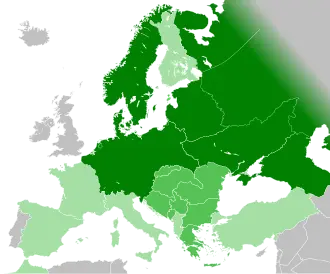
Lebensraum (living space) is the doctrine that a nation's survival depends on holding enough land of its own to feed it, and that a growing people may therefore take territory by force. In Hitler's form it called for conquering Russia and the border states, settling them with Germans, and removing or subjecting the existing peoples, with rearmament, war and racial hierarchy as its means.
What it stands for
- Law should require people of different races to use separate public spaces, such as schools and public facilities.
- A state may force a minority it sees as hostile to leave the country.
- People of different races should be discouraged from forming a family together, whether through marriage or having children.
- The state should encourage people of the majority group to move into areas where minority groups are in the majority.
- A minority group is working in secret to harm the nation.
- Most of the average difference in ability between racial groups comes from genes.
Key figures
- Friedrich Ratzel: Geographer who coined the term in 1901.
- Adolf Hitler: Author of Mein Kampf and leader who made Lebensraum the aim of Nazi foreign policy.
- Heinrich Himmler: SS chief who drew up the racial settlement policy for the East.
Closest ideologies
- Supremacism (88% match)
- Pan-Germanism (87% match)
- Ariosophy (87% match)
- Integral nationalism (86% match)
- Kahanism (86% match)
People closest to it
- Nicholas II of Russia (87% alike)
- Stephen Miller (86% alike)
- Augustus (86% alike)
- Jorge Rafael Videla (85% alike)
- Jair Bolsonaro (85% alike)
Key positions
- Strongly: Law should require people of different races to use separate public spaces, such as schools and public facilities.
- Strongly: A state may force a minority it sees as hostile to leave the country.
- Strongly: People of different races should be discouraged from forming a family together, whether through marriage or having children.
- Strongly: The state should encourage people of the majority group to move into areas where minority groups are in the majority.
- Strongly: A minority group is working in secret to harm the nation.
- Strongly: Most of the average difference in ability between racial groups comes from genes.
- Strongly: The law may treat people differently according to such things as birth, sex, race and status.
- Strongly: A powerful country should bring more land within its borders.
- Strongly: Having a shared national identity does not by itself entitle a people to its own self-governing state.
- Strongly: War develops virtues in a nation, such as courage and discipline.
- Strongly: Members of every racial group should organise politically around interests specific to their group.
- Strongly: Consent of the governed is not the only basis of legitimate political authority.
- Strongly: Rivalry and conflict between nations or peoples do more than anything else to drive humanity forward.
- Strongly: The presence of people belonging to the same nation gives a state a legitimate territorial claim outside its borders.
- Strongly: A nation should be mainly one ethnic people.
- Strongly: A country should be ready to use military force abroad on its own judgment, even if the UN Security Council has not authorized it.
- Strongly: Which country a disputed territory belongs to may be settled without a vote of its inhabitants.
- Strongly: Land that a state declares its own against its people's will is not illegally occupied by that state.
- Strongly: A people's historical tie to a land does not give it a stronger claim than other peoples living there now.
- Strongly: Decisions about indigenous peoples' traditional lands may rest with the wider state, not with those peoples.
- Strongly: My country may join a military alliance led by one of the great powers.
- Strongly: The political goal should be victory over communism ahead of accommodation with it.
- Strongly: My country's military strength should exceed that of its rivals.
- Strongly: Armaments need not be limited to the minimum needed for national safety.
- Strongly: When national priorities conflict with working together internationally, my country should choose its own priorities.
- Strongly: Foreign powers sometimes have a right to intervene in a country's internal affairs.
- Strongly: The government should be able to require citizens to serve in the military.
- Strongly: Armed forces may sometimes be used for purposes beyond defending the country against attack.
- Strongly: A country may accept its present border with a neighbour even if it lost land in an old war.
- Strongly: Authorities need not limit outsiders settling in regions that were originally majority indigenous.
- Strongly: Some cultures are superior to others.
- Strongly: Racial categories are not merely social constructs without a scientific basis.
- Strongly: National policy should give priority to preventing outside powers from splitting the country territorially.
- Strongly: Population growth may be left to run its course.
- Strongly: Member states should keep the final decision on whether to follow UN decisions.
- Strongly: Political violence is sometimes justified.
- Strongly: Being the first to use force can be right, depending on what it is meant to achieve.
- Strongly: Soldiers and conscripts need not refuse to fight when their state goes to war.
- Strongly: No society has the right to rule another for its supposed improvement, however advanced it is.
- Strongly: Society needs government of some kind.
- Strongly: Countries should keep their armed forces.
- Leans: Political power may be concentrated in one body.
- Leans: Property should belong to many people in small holdings.
- Leans: Living in the countryside does more for a person's moral wellbeing than living in a city.
- Leans: Descendants of settlers need not be led politically by the country's original peoples.