Political Ideology Atlas · All people · Take the test
North America · born 1865, historical
Warren G. Harding
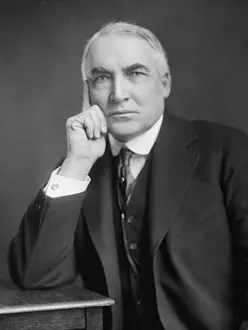
U.S. senator from Ohio (1915-1921) and 29th U.S. president (1921-1923)
Harding was a Republican party man who ran on a return to normalcy, meaning lower taxes, protective tariffs, balanced budgets, less government interference in business and no entanglement in a League of Nations. He supported women's suffrage, arms limitation and disarmament by conference, and restricted immigration, and in 1921 he called for political and educational opportunity for black Americans while rejecting social equality and favoring separation.
Closest ideologies
Based on the 77 statements where Warren G. Harding has a known position.
- Ulster loyalism (90% match)
- Asian values (89% match)
- Eco-Conservatism (89% match)
- Zionism (89% match)
- New Confucianism (88% match)
Similar people
- George Washington (91% alike)
- Calvin Coolidge (90% alike)
- Herbert Hoover (90% alike)
- Immanuel Kant (89% alike)
- John Adams (89% alike)
Known positions
- Strongly: Changes to society should be introduced a little at a time.
- Strongly: Force is for self-defence alone.
- Strongly: Industries such as energy, rail and utilities do not need to be publicly owned.
- Strongly: The nation does not need a radical rebirth to overcome decadence.
- Strongly: Taxes on imports should shield domestic producers from foreign competition.
- Strongly: Allied countries are free to decide for themselves whether to help one that is attacked.
- Strongly: Countries should maintain only the weapons needed for national safety.
- Strongly: The government should be able to require citizens to serve in the military.
- Strongly: Governments should not borrow heavily, spending much more than they collect in taxes, to boost the economy.
- Strongly: Democracy is best even when voters make poor choices.
- Strongly: Free trade does not benefit everyone in the long run.
- Strongly: Direct action does not have to take the place of elections and parliament as the way to achieve political change.
- Strongly: Employers and workers should treat each other as partners whose cooperation comes before conflict, even where their interests differ.
- Strongly: Racial categories are not merely social constructs without a scientific basis.
- Strongly: A country may keep all its decisions in its own hands rather than pooling them with other nations.
- Strongly: It is legitimate to take pride in the racial group one belongs to.
- Strongly: Being the law gives a rule a moral claim to be obeyed.
- Strongly: Equality of outcomes should not be society's goal.
- Strongly: The existing governing institutions should be retained, even if their personnel, policies or procedures change.
- Strongly: Other forces move history at least as much as conflict between classes does.
- Strongly: Member states should keep the final decision on whether to follow UN decisions.
- Strongly: Racial groups should not each organise to defend distinct political interests of their own.
- Strongly: An economy directed by a central plan is not capable of working better than one directed by market exchange.
- Strongly: Being powerful does not mean a country should bring more land within its borders.
- Strongly: The leader should not bypass political intermediaries in dealing with the people.
- Strongly: A mother country and its colonies may trade with the outside world.
- Strongly: Religion does not offer illusory comfort for material suffering.
- Strongly: Soldiers and conscripts need not refuse to fight when their state goes to war.
- Strongly: No party's ideology should give it an exclusive right to lead the state.
- Strongly: Some areas of life should remain outside state direction.
- Strongly: Women should be able to vote and stand for office on the same terms as men.
- Strongly: A workers' state does not need to suppress the old ruling class, even for a time.
- Strongly: Society needs government of some kind.
- Strongly: The ruler should be subject to the country's laws.
- Strongly: Government should have other tasks besides protecting people from physical violence.
- Strongly: Voting should not be limited to members of one ethnic group.
- Strongly: Farmers should have the legal freedom to leave the estates they work.
- Leans: People of different races should be discouraged from forming a family together, whether through marriage or having children.
- Leans: More democracies means fewer wars, so promoting democracy serves peace.
- Leans: Prices and competition generally decide better than officials what gets made and who gets it.
- Leans: There should be legal limits on strike action.
- Leans: Newcomers should adopt the host nation's culture in place of their original culture.
- Leans: A country should not tie itself to other countries through lasting military alliances.
- Leans: Outside governments have no entitlement to interfere in another country's internal affairs for any purpose.
- Leans: Tax rates should not rise steeply with income.
- Leans: A country has the right to stop a region becoming independent by using its military.
- Leans: New oil and gas wells and coal mines should be permitted.
- Leans: Political power should be split among separate branches and levels that can each limit the others.
- Leans: Farmers should get price floors, state buying or cheap credit to keep them secure.
- Leans: Living in the countryside does more for a person's moral wellbeing than living in a city.
- Leans: When national priorities conflict with working together internationally, my country should choose its own priorities.
- Leans: My country may keep a military no stronger than its rivals'.
- Leans: My country should stay neutral and join neither of the opposing great-power alliances.
- Leans: The country should impose strict limits on immigration.
- Leans: A head of state may take a side in party politics.
- Leans: Major laws should not be decided by direct votes of citizens.
- Leans: After members debate and adopt a party decision, every member should have to help implement it, including those who opposed it.
- Leans: Workers' pay should be settled in collective bargaining between their union and their employer.
- Leans: Women and men should face identical draft obligations, including no obligations for either group when the draft is abolished.
- Leans: A country can get through deadlock among its institutions without a leader who overrides them.
- Leans: Some things are right or wrong for everyone, in every culture and era.
- Leans: An elected legislature must approve the government's budget before the government spends public money.
- Leans: Workers are better off for having labor unions.
- Leans: The people who own the economy and hold power are not the ones the state mainly serves.
- Leans: A country may keep a region that wants to leave.
- Leans: Schools should cultivate patriotic feeling: loyalty to and pride in the nation, expressed for example through respect for its flag and anthem.
- Leans: A nation does not need one main ethnic group: it can be made up of people of many ancestries.
- Leans: Rulers have a right to rule only because the people they rule have agreed to it.
- Leans: Keeping a nation's inherited culture alive, including its language, customs and traditions, matters.
- Leans: War does not strengthen a nation's character.
- Leans: A country may leave other nations to choose their own political systems.
- Leans: The law should treat everyone as an equal, whatever their birth, sex, race or status.