Political Ideology Atlas · All people · Take the test
North America · born 1872, historical
Calvin Coolidge
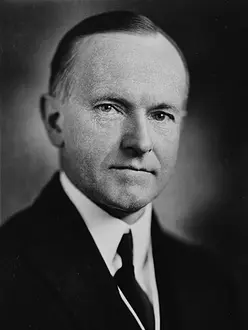
President of the United States (1923–1929)
Coolidge was a Republican small-government conservative who favored low taxes, balanced budgets, a protective tariff, restricted immigration and light business regulation. He defended constitutional limits, representative government and obedience to law, supported women's suffrage and federal action against lynching, and kept the US out of the League of Nations while backing the World Court and the Kellogg-Briand pact.
Closest ideologies
Based on the 58 statements where Calvin Coolidge has a known position.
- Eco-Conservatism (91% match)
- Americanism (88% match)
- New Confucianism (88% match)
- Thatcherism (88% match)
- Ordoliberalism (88% match)
Similar people
- Herbert Hoover (91% alike)
- Warren G. Harding (90% alike)
- Alexis de Tocqueville (89% alike)
- John Adams (89% alike)
- Gerald Ford (89% alike)
Known positions
- Strongly: Prices and competition generally decide better than officials what gets made and who gets it.
- Strongly: Owners' rights to their property should almost never be overridden, even for public goals.
- Strongly: Changes to society should be introduced a little at a time.
- Strongly: Industries such as energy, rail and utilities do not need to be publicly owned.
- Strongly: Tax rates should not rise steeply with income.
- Strongly: Farmers should not be given state protection against swings in the prices they receive.
- Strongly: Taxes on imports should shield domestic producers from foreign competition.
- Strongly: Political power should be split among separate branches and levels that can each limit the others.
- Strongly: Governments should not borrow heavily, spending much more than they collect in taxes, to boost the economy.
- Strongly: Heirs to large fortunes may keep most of what they inherit.
- Strongly: Capitalism built the productive power and wealth that later and better societies rest on.
- Strongly: Democracy is best even when voters make poor choices.
- Strongly: The country should impose strict limits on immigration.
- Strongly: Major laws should not be decided by direct votes of citizens.
- Strongly: Recreational drugs should be illegal for adults.
- Strongly: Free trade does not benefit everyone in the long run.
- Strongly: Employers and workers should treat each other as partners whose cooperation comes before conflict, even where their interests differ.
- Strongly: An electorate should choose the head of state, either directly or through elected representatives.
- Strongly: Profit made from owning businesses does not come from exploiting the workers who produce it.
- Strongly: Historical change does not come mainly from changes in how society produces and exchanges goods.
- Strongly: Public institutions should have the power to constrain a national majority's decisions in a liberal democracy.
- Strongly: No one is better suited by nature to govern than anyone else.
- Strongly: Being the law gives a rule a moral claim to be obeyed.
- Strongly: Equality of outcomes should not be society's goal.
- Strongly: Rulers have a right to rule only because the people they rule have agreed to it.
- Strongly: An economy directed by a central plan is not capable of working better than one directed by market exchange.
- Strongly: The law should treat everyone as an equal, whatever their birth, sex, race or status.
- Strongly: Someone who actually governs a state should not hand that power on to their own child.
- Strongly: Countries may keep controls on who enters and settles, even in the long run.
- Strongly: Keeping a nation's inherited culture alive, including its language, customs and traditions, matters.
- Strongly: Women should be able to vote and stand for office on the same terms as men.
- Strongly: Society needs government of some kind.
- Leans: Temporary rule by a more developed society is justified when it helps the ruled to progress.
- Leans: A free society can coexist with very large concentrations of wealth.
- Leans: Civil servants should be recruited according to their performance in competitive examinations.
- Leans: Rules on how corporations operate may be light.
- Leans: Newcomers should adopt the host nation's culture in place of their original culture.
- Leans: A country should not tie itself to other countries through lasting military alliances.
- Leans: Force is for self-defence alone.
- Leans: Businesses should be legally barred from agreements with competitors to suppress competition, such as fixing prices.
- Leans: Government should be bound by written guarantees of basic rights protected against easy amendment by ordinary majorities.
- Leans: Countries should maintain only the weapons needed for national safety.
- Leans: Religious values and institutions should shape laws, schools and public life.
- Leans: A president should be limited in how many times he or she may stand for re-election.
- Leans: Political decisions should rest with the smallest local community able to handle them, with wider authorities handling matters that need a wider reach.
- Leans: What you owe your community matters more than your personal rights.
- Leans: Society should take active steps to make up for the harm done by past racial injustices.
- Leans: Workers' pay should be settled in collective bargaining between their union and their employer.
- Leans: Collecting taxes does not in itself amount to stealing people's money.
- Leans: Government should have other tasks besides protecting people from physical violence.
- Leans: A country may keep all its decisions in its own hands rather than pooling them with other nations.
- Leans: Nobody should hold a special rank by birth, such as a noble title, a hereditary crown or a caste position, or the special rights attached to one.
- Leans: It is legitimate to take pride in the racial group one belongs to.
- Leans: Private ownership is legitimate only insofar as it benefits society.
- Leans: Member states should keep the final decision on whether to follow UN decisions.
- Leans: Whatever their circumstances, everyone should be able to count on the state for enough to live decently, through benefits, pensions or public services.