Political Ideology Atlas · All people · Take the test
North America · born 1735, historical
John Adams
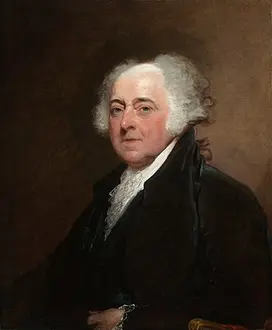
Second president of the United States (1797-1801), Revolutionary leader and author of the Massachusetts Constitution of 1780
John Adams was a Revolutionary leader and Federalist who defended republican government built on a mixed constitution: separated powers, a strong independent executive, a second chamber and independent judges, as checks on any single majority or elite. He held that property must be secure, that suffrage should rest on property, that natural inequalities are unavoidable, and that religion and morals underpin free government. He opposed hereditary monarchy for America, held to neutrality in foreign affairs, abhorred slavery while favoring gradual abolition, and signed and later defended the Alien and Sedition Acts.
Closest ideologies
Based on the 54 statements where John Adams has a known position.
- Ulster loyalism (90% match)
- Eco-Conservatism (90% match)
- Conservatism (89% match)
- Monarchism in Brazil (89% match)
- Americanism (88% match)
Similar people
- William Howard Taft (89% alike)
- Calvin Coolidge (89% alike)
- Warren G. Harding (89% alike)
- Andrew Jackson (88% alike)
- George Washington (88% alike)
Known positions
- Strongly: Only people who own property should have the right to vote.
- Strongly: Women's political rights may differ from men's.
- Strongly: The best government combines a governing role for a few with a governing role for the wider population.
- Strongly: Owners' rights to their property should almost never be overridden, even for public goals.
- Strongly: Besides its directly elected parliament, a legislature should have a second chamber, such as a senate.
- Strongly: Government should be bound by written guarantees of basic rights protected against easy amendment by ordinary majorities.
- Strongly: Property should belong to many people in small holdings.
- Strongly: Political power should be split among separate branches and levels that can each limit the others.
- Strongly: Some institutional ties between government and religion are acceptable.
- Strongly: Large landed estates should not be compulsorily transferred to the people who farm them.
- Strongly: My country should stay neutral and join neither of the opposing great-power alliances.
- Strongly: Major laws should not be decided by direct votes of citizens.
- Strongly: People are entitled to resist a ruler's unconstitutional exercise of power.
- Strongly: An elected legislature must approve the government's budget before the government spends public money.
- Strongly: Rulers must act under lasting, publicly known laws administered by recognised courts.
- Strongly: Public institutions should have the power to constrain a national majority's decisions in a liberal democracy.
- Strongly: Equality of outcomes should not be society's goal.
- Strongly: Rulers have a right to rule only because the people they rule have agreed to it.
- Strongly: Protecting the constitution should be left to civilian institutions, not the armed forces.
- Strongly: Someone who actually governs a state should not hand that power on to their own child.
- Strongly: Religion does not offer illusory comfort for material suffering.
- Strongly: At least some revolutions have been justified.
- Strongly: Society needs government of some kind.
- Strongly: The ruler should be subject to the country's laws.
- Strongly: Government should have other tasks besides protecting people from physical violence.
- Strongly: The holder of the highest state office need not be treated as holy.
- Leans: Private property does not need to serve the common good to be justified.
- Leans: Some people are better suited by nature to govern.
- Leans: Changes to society should be introduced a little at a time.
- Leans: A country should not tie itself to other countries through lasting military alliances.
- Leans: Real authority to command the military should rest with the head of state.
- Leans: Democracy is not the best form of government when voters choose badly.
- Leans: Politics should give compromises among competing groups at least as much weight as a single common good identified by reasoning.
- Leans: Religious values and institutions should shape laws, schools and public life.
- Leans: People should want as few material things as possible.
- Leans: The government should be able to require citizens to serve in the military.
- Leans: Governments should not fix maximum prices for essential foods, even in times of scarcity.
- Leans: Human rights come from the nature that all human beings share.
- Leans: Some things are right or wrong for everyone, in every culture and era.
- Leans: Owning a gun should not face strict legal limits.
- Leans: An electorate should choose the head of state, either directly or through elected representatives.
- Leans: In law, a country's traditional national church should rank no higher than other religious bodies.
- Leans: Nobody should hold a special rank by birth, such as a noble title, a hereditary crown or a caste position, or the special rights attached to one.
- Leans: Constantly seeking additional possessions is harmful overall, despite any benefits it brings.
- Leans: Very large concentrations of wealth threaten a free society.
- Leans: Politics should support people's spiritual well-being.
- Leans: A people with a shared national identity is entitled to its own self-governing state.
- Leans: Political authority does not ultimately come from God.
- Leans: The law should treat everyone as an equal, whatever their birth, sex, race or status.
- Leans: Governments should give no subsidies, licences or protections that favour firms close to them.