Political Ideology Atlas · All people · Take the test
Europe · born 1724, historical
Immanuel Kant
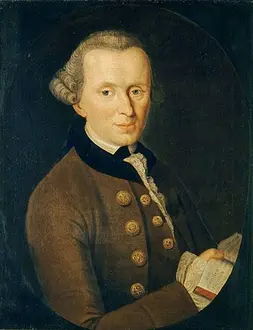
German philosopher (1724-1804)
Kant grounded politics in Right, the coexistence of free persons under law, and argued for a representative republic with separated powers, no hereditary privilege and a federation of free states for perpetual peace. He denied any right of revolution or resistance, defended retributive punishment including the death penalty, and kept women and economically dependent people out of the vote. His views on race and sex conflict with his universal doctrine of human dignity.
Closest ideologies
Based on the 90 statements where Immanuel Kant has a known position.
- Zionism (88% match)
- Asian values (88% match)
- Classical republicanism (87% match)
- New Confucianism (87% match)
- Cultural Nationalism (86% match)
Similar people
- Warren G. Harding (89% alike)
- George Washington (89% alike)
- Santiago Peña Palacios (88% alike)
- William Ewart Gladstone (87% alike)
- Ahmed al-Sharaa (86% alike)
Known positions
- Strongly: Women's political rights may differ from men's.
- Strongly: Same-sex relations between consenting adults should be punishable by law.
- Strongly: Overthrowing a government by revolution is never justified, whatever the cause.
- Strongly: Violence is never an acceptable way to pursue political goals.
- Strongly: Behind their different forms, the great religions point to one shared truth.
- Strongly: A person's sex should affect the public roles legally assigned to them.
- Strongly: Rivalry and conflict between nations or peoples do more than anything else to drive humanity forward.
- Strongly: One spouse may have more authority than the other within a marriage.
- Strongly: A ruler's unconstitutional acts do not give people a right to resist.
- Strongly: Changes to society should be introduced a little at a time.
- Strongly: At least some unjust laws impose a moral duty of obedience.
- Strongly: Prisons should focus at least as much on punishment as on rehabilitation.
- Strongly: Inherited religious teachings should be understood anew in light of present conditions.
- Strongly: Rich people have an obligation to help those worse off than they are.
- Strongly: Political power should be split among separate branches and levels that can each limit the others.
- Strongly: The worst crimes can be punished by death.
- Strongly: A woman who has sex outside marriage is doing something wrong.
- Strongly: Government should serve people's good while respecting each person as more than an instrument of the state or community.
- Strongly: Every treaty and agreement between governments should be made public.
- Strongly: Major laws should not be decided by direct votes of citizens.
- Strongly: Some things are right or wrong for everyone, in every culture and era.
- Strongly: You can't reach a free, fair society by unfree or unfair means.
- Strongly: Direct action does not have to take the place of elections and parliament as the way to achieve political change.
- Strongly: Some cultures are superior to others.
- Strongly: Government should rely at least as much on legal enforcement as on its rulers' moral example.
- Strongly: Racial categories are not merely social constructs without a scientific basis.
- Strongly: The law should not extend marriage to same-sex couples.
- Strongly: Nobody should hold a special rank by birth, such as a noble title, a hereditary crown or a caste position, or the special rights attached to one.
- Strongly: Being the law gives a rule a moral claim to be obeyed.
- Strongly: Rulers have a right to rule only because the people they rule have agreed to it.
- Strongly: The existing governing institutions should be retained, even if their personnel, policies or procedures change.
- Strongly: My country should not send weapons to foreign insurgents, whatever it thinks of the governments they fight.
- Strongly: The holy scripture of one's faith is not God's own error-free word.
- Strongly: Being powerful does not mean a country should bring more land within its borders.
- Strongly: An armed minority's actions are incapable of bringing about the conditions for a broader revolutionary uprising.
- Strongly: Religion does not offer illusory comfort for material suffering.
- Strongly: Looking after your own interests is not a moral good in itself.
- Strongly: News media should decide for themselves what they publish, whoever holds power.
- Strongly: No society has the right to rule another for its supposed improvement, however advanced it is.
- Strongly: The ruler should be subject to the country's laws.
- Strongly: Great powers should have no right to send troops against allied governments' wishes for the purpose of preserving those countries' political systems.
- Strongly: Overseas territories need not be run mainly for the ruling country's economic benefit.
- Strongly: Farmers should have the legal freedom to leave the estates they work.
- Leans: Only people who own property should have the right to vote.
- Leans: Most of the average difference in ability between racial groups comes from genes.
- Leans: Whoever first settles and works unowned land becomes its rightful owner.
- Leans: It is acceptable for a monarch who inherits the throne to be the country's symbolic head while others govern.
- Leans: More democracies means fewer wars, so promoting democracy serves peace.
- Leans: Where they conflict, evidence and reasoning should count for more than faith, God, revelation or scripture.
- Leans: The government should have authority over religious institutions' internal affairs.
- Leans: Defense should rest with armed ordinary citizens, not a standing force.
- Leans: Outside governments have no entitlement to interfere in another country's internal affairs for any purpose.
- Leans: Government should maintain a strict institutional separation from religion.
- Leans: People do not have full ownership of their own bodies.
- Leans: Working together internationally should count at least as much as my country's own priorities.
- Leans: Countries should maintain only the weapons needed for national safety.
- Leans: Allies are bound to defend one another against armed attack.
- Leans: My country may keep a military no stronger than its rivals'.
- Leans: The government should be able to require citizens to serve in the military.
- Leans: The state should treat all streams and interpretations of a religion equally under the law.
- Leans: Indigenous peoples should control their traditional territories.
- Leans: Ideas of what men and women are like do not come mostly from culture.
- Leans: Final authority over a state's laws need not belong to its most senior religious scholars.
- Leans: Human rights come from the nature that all human beings share.
- Leans: Sex work between consenting adults should be illegal.
- Leans: A country can get through deadlock among its institutions without a leader who overrides them.
- Leans: Land that a state declares its own against its people's will is still illegally occupied by that state.
- Leans: A person loses freedom from being at another person's mercy, even if that power is never exercised.
- Leans: An elected legislature must approve the government's budget before the government spends public money.
- Leans: Government should have other tasks besides protecting people from physical violence.
- Leans: Private charity does not help people in poverty better than government programs do.
- Leans: Rulers must act under lasting, publicly known laws administered by recognised courts.
- Leans: Publicly insulting a religion's sacred beliefs should be left outside the criminal law.
- Leans: Countries may keep controls on who enters and settles, even in the long run.
- Leans: Whatever their circumstances, everyone should be able to count on the state for enough to live decently, through benefits, pensions or public services.
- Leans: A people with a shared national identity is entitled to its own self-governing state.
- Leans: The government should let its political opponents organise, speak and compete for power.
- Leans: Laws should not be required to follow religious texts.
- Leans: Political authority does not ultimately come from God.