Political Ideology Atlas · All people · Take the test
Africa · born 1949, historical
Thomas Sankara
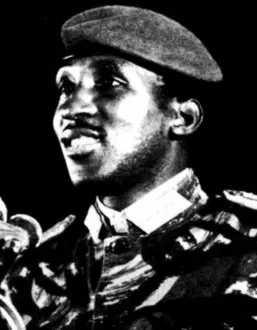
Burkinabe army captain and revolutionary; president of Upper Volta/Burkina Faso (1983-1987)
Marxist-influenced anti-imperialist and pan-Africanist who led a military-backed popular revolution in Burkina Faso. His programme combined self-reliance, rejection of foreign debt and aid, land nationalization, mass health and literacy campaigns, reforestation, women's emancipation and an austere style of rule, enforced through CDRs and revolutionary tribunals that curtailed opposition, unions and chiefs.
Closest ideologies
Based on the 146 statements where Thomas Sankara has a known position.
- Sankarism (95% match)
- Chavismo (89% match)
- Third-worldism (89% match)
- Bolivarian Socialism (89% match)
- Anti-imperialism (87% match)
Similar people
- Che Guevara (88% alike)
- Subhas Chandra Bose (87% alike)
- Josip Broz Tito (87% alike)
- Miguel Díaz-Canel (87% alike)
- Raúl Castro (87% alike)
Known positions
- Strongly: The UN should have authority to compel member states to comply with its decisions.
- Strongly: History is mainly driven by conflict between economic classes.
- Strongly: Political change should replace the existing administrative and coercive institutions with new forms of organization, rather than put new leaders in charge of the old apparatus.
- Strongly: Housework and childcare should be provided as public services in place of being done within families.
- Strongly: Laws, police and government mainly serve the interests of whoever owns the economy and holds power.
- Strongly: Owners' profit is value taken from workers' labor.
- Strongly: The law limits how much landlords can charge where homes are scarce.
- Strongly: Ideas of what men and women are like come mostly from culture, not biology.
- Strongly: Taxes on imports should shield domestic producers from foreign competition.
- Strongly: Women's subordination is tied to how the economy is organised, so reform of laws and attitudes is not enough.
- Strongly: Countries should maintain only the weapons needed for national safety.
- Strongly: Farmers should get price floors, state buying or cheap credit to keep them secure.
- Strongly: Sharing a language is not sufficient for people to constitute one nation.
- Strongly: The global economic system keeps poorer countries poor by directing their wealth toward richer countries.
- Strongly: Communist one-party states should not receive the same condemnation as fascist states.
- Strongly: Laws, institutions and customs still favor men over women.
- Strongly: The goods people consume should mainly come from nearby producers.
- Strongly: Countries that feel dominated by Western powers should band together to resist them.
- Strongly: Defeating communism should not take priority over coexistence with it.
- Strongly: The foreign debts of poor countries should be written off, ending their obligation to repay them.
- Strongly: My country should stay neutral and join neither of the opposing great-power alliances.
- Strongly: Civilization's main goals may lie elsewhere than in spreading into space.
- Strongly: A poor country should develop mainly with its own resources.
- Strongly: A state of their own in the Land of Israel is not something Jews are owed as a people.
- Strongly: Sex work between consenting adults should be illegal.
- Strongly: Society may be changed in large, rapid steps.
- Strongly: Workers' solidarity with workers in other countries should count at least as much as solidarity with their own nation.
- Strongly: Free trade does not benefit everyone in the long run.
- Strongly: Land that a state declares its own against its people's will is still illegally occupied by that state.
- Strongly: How someone turns out is shaped more by upbringing, society and experience than by the traits they are born with.
- Strongly: Each country's communist party should decide its strategy for socialism without taking orders from another country's party.
- Strongly: Owners' rights to their property need not be protected against being overridden for public goals.
- Strongly: Officials decide what gets made and who gets it at least as well as prices and competition do.
- Strongly: Ethnic diversity does not weaken a society's ability to hold together.
- Strongly: Political institutions developed in the West are not a suitable model for every civilization.
- Strongly: A country should reject spending cuts demanded in return for loans and set its own course.
- Strongly: A country may keep a region that wants to leave.
- Strongly: The general public should have at least as much say in policy as experts.
- Strongly: The nation's cause and the cause of its ordinary working people are one and the same.
- Strongly: It is legitimate to take pride in the racial group one belongs to.
- Strongly: A nation does not need one main ethnic group: it can be made up of people of many ancestries.
- Strongly: Meeting poor people's needs should be the first consideration in public policy.
- Strongly: Publicly honouring a national leader as the personification of the nation is not acceptable.
- Strongly: Constantly seeking additional possessions is harmful overall, despite any benefits it brings.
- Strongly: Spouses should make marital decisions as equals.
- Strongly: The state should guarantee health care to everyone, whether it runs the services itself or pays for them.
- Strongly: Restoring a lost social order does not matter more than pursuing progress.
- Strongly: Trade, finance and debt rules should be changed to give poorer countries a fairer share.
- Strongly: Racism is still the main obstacle to the advancement of disadvantaged racial groups.
- Strongly: Most people in political office look after themselves first and the public second.
- Strongly: The law should not assign different roles in public life on the basis of sex.
- Strongly: Foreign armies should not be based on the country's territory.
- Strongly: At most half of workers in wealthy countries benefit from the exploitation of poorer countries.
- Strongly: Political violence is sometimes justified.
- Strongly: A people with a shared national identity is entitled to its own self-governing state.
- Strongly: A national development strategy should not accept some regions growing wealthy ahead of the rest.
- Strongly: The law should treat everyone as an equal, whatever their birth, sex, race or status.
- Strongly: Being the first to use force can be right, depending on what it is meant to achieve.
- Strongly: Most of the average difference in ability between racial groups does not come from genes.
- Strongly: A country may make its laws with no formal advisory role for traditional chiefs.
- Strongly: Looking after your own interests is not a moral good in itself.
- Strongly: At least some revolutions have been justified.
- Strongly: Small, informal, trust-based groups should not take the place of lasting parties, unions and federations in political action.
- Strongly: Population growth does not mainly drive lasting poverty.
- Strongly: No society has the right to rule another for its supposed improvement, however advanced it is.
- Strongly: Each country should hold ultimate authority over its natural resources, without foreign interests controlling them.
- Strongly: Women should be able to vote and stand for office on the same terms as men.
- Strongly: Society needs government of some kind.
- Strongly: Great powers should have no right to send troops against allied governments' wishes for the purpose of preserving those countries' political systems.
- Strongly: Voting should not be limited to members of one ethnic group.
- Strongly: Killing another person can be right in self-defence or in defence of others.
- Strongly: Overseas territories need not be run mainly for the ruling country's economic benefit.
- Strongly: The holder of the highest state office need not be treated as holy.
- Strongly: Taking part in politics is at least as good a way to live as living privately away from public affairs.
- Strongly: A weaker state need not formally treat a stronger power as its superior.
- Strongly: Public spaces such as schools and facilities should not be separated by race under the law.
- Strongly: The Holocaust happened as historians describe it.
- Leans: A workers' state must suppress the old ruling class for a time.
- Leans: Workers require political leadership from a tightly organised revolutionary party.
- Leans: The military should have a political role in protecting the constitution and public order, stepping in when they are threatened.
- Leans: The government should stop its political opponents from organising, speaking or competing for power.
- Leans: An economy whose production is directed by a central plan is capable of working better than an economy directed by market exchange.
- Leans: Religious teaching and institutions are a main reason women have been held down.
- Leans: Countries should hand part of their decision-making power to a union of nations, such as the European Union.
- Leans: A healthy society does not depend on the traditional family, such as a married mother and father raising their children.
- Leans: Races are not natural scientific divisions of humanity but categories created by society.
- Leans: A country should try to sell more abroad than it buys from abroad.
- Leans: Government should depend more on leaders setting a good example than on enforcing laws with penalties.
- Leans: When people's freedom to do something harms the environment, the law should limit that freedom.
- Leans: People should work mainly out of responsibility to society and a shared purpose, with personal material rewards playing a secondary role.
- Leans: Cultures do not rank above one another in overall worth.
- Leans: People seeking political change should act directly—for example, with strikes, boycotts or occupations—instead of pursuing change through elections and parliaments.
- Leans: Defense should rest with armed ordinary citizens, not a standing force.
- Leans: No moral truths hold across all cultures.
- Leans: People with advanced schooling are cut off from how ordinary people live and work.
- Leans: Countries that had colonies should compensate the countries they colonized.
- Leans: A national emergency sometimes justifies temporarily withdrawing normal legal safeguards against people the government regards as internal enemies, such as protections against detention without trial.
- Leans: What gets treated as fact or expert knowledge reflects the interests of whoever has power, not a neutral search for truth.
- Leans: Force is for self-defence alone.
- Leans: The farmers who work large estates should take ownership from the landowners, with the transfer compulsory if owners refuse.
- Leans: Outside governments have no entitlement to interfere in another country's internal affairs for any purpose.
- Leans: Society does not need a third course beyond capitalism and communism.
- Leans: Entertainment produced for mass audiences tends to weaken people's willingness to challenge the established social order.
- Leans: Rich people have an obligation to help those worse off than they are.
- Leans: Trade unions may be subject to state direction of their affairs.
- Leans: The ruling class stays in power mainly through people going along with its ideas.
- Leans: High earners and the very rich should pay tax at a much higher rate than everyone else.
- Leans: People outside state forces should also be allowed to bear arms.
- Leans: The Soviet economy was not capitalism under state ownership with the state in place of private capitalists.
- Leans: Museums, libraries and other inherited culture should not be destroyed, even when they stand in the way of new creation.
- Leans: Political decisions should rest with the smallest local community able to handle them, with wider authorities handling matters that need a wider reach.
- Leans: A government should outlaw political parties that aim to do away with its constitutional order.
- Leans: Whether a policy fits an ideology should count independently of its results.
- Leans: Formal press freedom is hollow when wealth decides who can actually be heard.
- Leans: The government should steer investment into industries it sees as key to the country's future.
- Leans: After members debate and adopt a party decision, every member should have to help implement it, including those who opposed it.
- Leans: Government should impose strict rules on how corporations operate.
- Leans: Public institutions should help minority languages be used in public life, for example through teaching or services in those languages.
- Leans: Schools should cultivate patriotic feeling: loyalty to and pride in the nation, expressed for example through respect for its flag and anthem.
- Leans: Nobody should hold a special rank by birth, such as a noble title, a hereditary crown or a caste position, or the special rights attached to one.
- Leans: Industrial society has done at least as much good as harm to humanity.
- Leans: Even a purely ceremonial head of state should not hold the position by birth.
- Leans: Private ownership is legitimate only insofar as it benefits society.
- Leans: We have a duty to leave the planet in good condition for those who come after us.
- Leans: Income from useful work should be rewarded ahead of income from merely owning property.
- Leans: A government needs more than fair elections to be democratic.
- Leans: School history should mostly tell the story of the student's own nation.
- Leans: Governments should give no subsidies, licences or protections that favour firms close to them.