Political Ideology Atlas · All people · Take the test
Europe · born 1892, historical
Josip Broz Tito
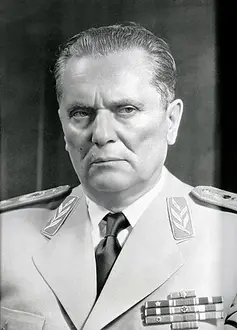
Yugoslav Partisan leader, prime minister (1943-1963) and president of Yugoslavia (1953-1980)
A Marxist-Leninist who led the Partisan uprising and then a one-party socialist federation, nationalised industry and redistributed land, and after the 1948 break with Stalin developed workers' self-management and non-alignment. He backed national equality within Yugoslavia and decentralisation, opposed colonialism and Soviet dominance, and ruled through party control, repressing dissent and nationalist movements.
Closest ideologies
Based on the 148 statements where Josip Broz Tito has a known position.
- Titoism (93% match)
- Kaysone Phomvihane Thought (90% match)
- Marxism–Leninism–Maoism–Prachanda Path (87% match)
- Nkrumaism (87% match)
- Soviet democracy (87% match)
Similar people
- Maxim Gorky (91% alike)
- Raúl Castro (91% alike)
- Mao Zedong (89% alike)
- Miguel Díaz-Canel (89% alike)
- Ho Chi Minh (89% alike)
Known positions
- Strongly: A workers' state must suppress the old ruling class for a time.
- Strongly: A state whose economy is publicly owned and planned should be defended against a return to capitalism even if a bureaucracy rules it.
- Strongly: One ideologically correct party should hold state leadership without competing parties having a right to replace it.
- Strongly: The people in power should decide what the country's news media publish.
- Strongly: Workers require political leadership from a tightly organised revolutionary party.
- Strongly: The government should stop its political opponents from organising, speaking or competing for power.
- Strongly: History is mainly driven by conflict between economic classes.
- Strongly: Political change should replace the existing administrative and coercive institutions with new forms of organization, rather than put new leaders in charge of the old apparatus.
- Strongly: Historical change comes mainly from changes in how society produces and exchanges goods.
- Strongly: It is acceptable to praise a national leader openly as the one who stands for the whole nation.
- Strongly: Laws, police and government mainly serve the interests of whoever owns the economy and holds power.
- Strongly: Owners' profit is value taken from workers' labor.
- Strongly: Cooperation between employers and workers should not come before conflict where their interests differ.
- Strongly: Speech that attacks groups for who they are can be punished by law.
- Strongly: A democratic constitution should rest on rejecting fascism.
- Strongly: Workers should form a party of their own, separate from the parties already in place.
- Strongly: A country should not tie itself to other countries through lasting military alliances.
- Strongly: A country should press its neighbour to give back land taken from it in an old war.
- Strongly: Force is for self-defence alone.
- Strongly: The farmers who work large estates should take ownership from the landowners, with the transfer compulsory if owners refuse.
- Strongly: A president should be free to stand for re-election as many times as they like.
- Strongly: Outside governments have no entitlement to interfere in another country's internal affairs for any purpose.
- Strongly: Only the state's armed forces and police should have permission to carry weapons.
- Strongly: Society does not need a third course beyond capitalism and communism.
- Strongly: Religious values and institutions should not have a major part in shaping laws, schools and public life.
- Strongly: Employees should have voting rights in the management of large companies.
- Strongly: Distance and nationality do not weaken the duty of the rich to help the poor abroad.
- Strongly: Property need not be spread among many small owners.
- Strongly: Countries should maintain only the weapons needed for national safety.
- Strongly: Trade unions may be subject to state direction of their affairs.
- Strongly: Production should be organised to provide what people need, instead of being organised around what yields a profit.
- Strongly: Communist one-party states should not receive the same condemnation as fascist states.
- Strongly: Areas where an ethnic minority makes up most of the population should be able to run many of their own affairs within the state.
- Strongly: Industries such as energy, rail and utilities should be owned by the state or public bodies, not private companies.
- Strongly: Defeating communism should not take priority over coexistence with it.
- Strongly: A government should outlaw political parties that aim to do away with its constitutional order.
- Strongly: My country should stay neutral and join neither of the opposing great-power alliances.
- Strongly: Without workers' own political power, state ownership is not socialism.
- Strongly: A head of state may take a side in party politics.
- Strongly: The government should steer investment into industries it sees as key to the country's future.
- Strongly: After members debate and adopt a party decision, every member should have to help implement it, including those who opposed it.
- Strongly: A region need not keep most of the tax money it raises for itself.
- Strongly: Public institutions should help minority languages be used in public life, for example through teaching or services in those languages.
- Strongly: Each country's communist party should decide its strategy for socialism without taking orders from another country's party.
- Strongly: Owners' rights to their property need not be protected against being overridden for public goals.
- Strongly: Basic local services, such as water, hospitals and local transport, should be publicly owned and run.
- Strongly: Ethnic diversity does not weaken a society's ability to hold together.
- Strongly: People should have a direct role in making decisions where they work, live and study, rather than having those decisions made entirely for them.
- Strongly: In law, a country's traditional national church should rank no higher than other religious bodies.
- Strongly: Being free requires having the practical resources to act on one's choices, such as an adequate livelihood.
- Strongly: Private charity does not help people in poverty better than government programs do.
- Strongly: Political independence means little unless the economic and property system is also transformed.
- Strongly: The nation's cause and the cause of its ordinary working people are one and the same.
- Strongly: A nation does not need one main ethnic group: it can be made up of people of many ancestries.
- Strongly: Lasting socialism in one country does not require socialist revolutions abroad.
- Strongly: Restoring a lost social order does not matter more than pursuing progress.
- Strongly: Other things drive humanity forward at least as much as rivalry and conflict between peoples.
- Strongly: Even a purely ceremonial head of state should not hold the position by birth.
- Strongly: The law should not assign different roles in public life on the basis of sex.
- Strongly: Leading roles in a country's economy should not depend on belonging to the majority national group.
- Strongly: Whatever their circumstances, everyone should be able to count on the state for enough to live decently, through benefits, pensions or public services.
- Strongly: Political violence is sometimes justified.
- Strongly: Income from useful work should be rewarded ahead of income from merely owning property.
- Strongly: A people with a shared national identity is entitled to its own self-governing state.
- Strongly: Being powerful does not mean a country should bring more land within its borders.
- Strongly: A socialist state with hostile neighbours need not build up its state power.
- Strongly: The leader should not bypass political intermediaries in dealing with the people.
- Strongly: A country may leave other nations to choose their own political systems.
- Strongly: A mother country and its colonies may trade with the outside world.
- Strongly: The law should treat everyone as an equal, whatever their birth, sex, race or status.
- Strongly: In an economy with common ownership of productive assets, people should still own their personal belongings.
- Strongly: Poor countries should retain economic ties with rich countries.
- Strongly: A government needs more than fair elections to be democratic.
- Strongly: Being the first to use force can be right, depending on what it is meant to achieve.
- Strongly: Belonging to the nation does not go with sharing its religion.
- Strongly: Looking after your own interests is not a moral good in itself.
- Strongly: Soldiers and conscripts need not refuse to fight when their state goes to war.
- Strongly: Industrial society has done at least as much good as harm to humanity.
- Strongly: Some areas of life should remain outside state direction.
- Strongly: Private owners' choice of whom they deal with should be subject to some restrictions.
- Strongly: No society has the right to rule another for its supposed improvement, however advanced it is.
- Strongly: Each country should hold ultimate authority over its natural resources, without foreign interests controlling them.
- Strongly: Women should be able to vote and stand for office on the same terms as men.
- Strongly: Countries should keep their armed forces.
- Strongly: Government should have other tasks besides protecting people from physical violence.
- Strongly: Great powers should have no right to send troops against allied governments' wishes for the purpose of preserving those countries' political systems.
- Strongly: Voting should not be limited to members of one ethnic group.
- Strongly: Killing another person can be right in self-defence or in defence of others.
- Strongly: Overseas territories need not be run mainly for the ruling country's economic benefit.
- Strongly: A weaker state need not formally treat a stronger power as its superior.
- Strongly: Public spaces such as schools and facilities should not be separated by race under the law.
- Leans: A socialist system led by a communist party is able to include a market economy.
- Leans: A state may force a minority it sees as hostile to leave the country.
- Leans: Religion gives people a false consolation for hardship in their material lives.
- Leans: Conflicts between social classes persist after a society becomes socialist.
- Leans: The presence of people belonging to the same nation gives a state a legitimate territorial claim outside its borders.
- Leans: Housework and childcare should be provided as public services in place of being done within families.
- Leans: A healthy society does not depend on the traditional family, such as a married mother and father raising their children.
- Leans: The state should keep the colonial-era boundaries it inherits at independence.
- Leans: In the society we should aim for, a person's needs should determine their share of goods.
- Leans: The head of state should not have to be chosen by election.
- Leans: Each main community should have a guaranteed place in government, even against a numerical majority.
- Leans: Cultures do not rank above one another in overall worth.
- Leans: Firms should compete in markets, but be owned by the people who work in them.
- Leans: Judge policies by what they achieve, independently of whether they match an ideology.
- Leans: A national minority should run its own schools, language and cultural institutions inside the state it lives in.
- Leans: Countries that feel dominated by Western powers may handle their relations with them separately.
- Leans: Working together internationally should count at least as much as my country's own priorities.
- Leans: Women's subordination is tied to how the economy is organised, so reform of laws and attitudes is not enough.
- Leans: Businesses should belong to the people who work in them, for example as cooperatives.
- Leans: A general collapse of capitalism is unavoidable.
- Leans: The global economic system keeps poorer countries poor by directing their wealth toward richer countries.
- Leans: The Soviet economy was not capitalism under state ownership with the state in place of private capitalists.
- Leans: Political decisions should rest with the smallest local community able to handle them, with wider authorities handling matters that need a wider reach.
- Leans: Within a country, the richer regions grew rich by draining the poorer ones, much as colonial powers drained their colonies.
- Leans: Capitalism built the productive power and wealth that later and better societies rest on.
- Leans: A state of their own in the Land of Israel is not something Jews are owed as a people.
- Leans: Society may be changed in large, rapid steps.
- Leans: A country should not be ready to use military force abroad without UN Security Council authorization.
- Leans: Officials decide what gets made and who gets it at least as well as prices and competition do.
- Leans: Workers are better off for having labor unions.
- Leans: A former empire should claim no special ties, leadership or sphere of influence in its old territories.
- Leans: Political institutions developed in the West are not a suitable model for every civilization.
- Leans: Society needs government of some kind.
- Leans: A country may keep a region that wants to leave.
- Leans: The general public should have at least as much say in policy as experts.
- Leans: Schools should cultivate patriotic feeling: loyalty to and pride in the nation, expressed for example through respect for its flag and anthem.
- Leans: Nobody should hold a special rank by birth, such as a noble title, a hereditary crown or a caste position, or the special rights attached to one.
- Leans: A state should take responsibility for the welfare of its national communities across neighbouring borders.
- Leans: National policy should give priority to preventing outside powers from splitting the country territorially.
- Leans: My country can do without nuclear weapons that it alone controls.
- Leans: Spouses should make marital decisions as equals.
- Leans: The state should guarantee health care to everyone, whether it runs the services itself or pays for them.
- Leans: Trade, finance and debt rules should be changed to give poorer countries a fairer share.
- Leans: Private ownership is legitimate only insofar as it benefits society.
- Leans: Keeping a nation's inherited culture alive, including its language, customs and traditions, matters.
- Leans: Foreign armies should not be based on the country's territory.
- Leans: A national development strategy should not accept some regions growing wealthy ahead of the rest.
- Leans: An armed minority's actions are incapable of bringing about the conditions for a broader revolutionary uprising.
- Leans: Groups have rights of their own.