Political Ideology Atlas · All people · Take the test
Latin America & Caribbean · born 1960
Miguel Díaz-Canel
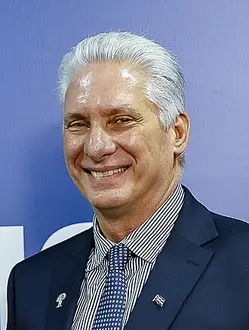
President of Cuba (President of the Council of State 2018-2019, President of the Republic since 2019); First Secretary of the Communist Party of Cuba since 2021
A Communist Party career official who leads Cuba as head of state and party, defending one-party socialism, state enterprise as the economy's pillar and sovereignty against the US embargo. In office he has opened the economy step by step (currency unification, small and medium private enterprises, foreign and private investment, targeted instead of general subsidies) and backed a progressive Family Code, while his government has jailed protesters and opposition figures and controls the media. In foreign policy he calls for a multipolar order, UN reform, debt relief and aid from rich countries and rejects intervention.
Closest ideologies
Based on the 145 statements where Miguel Díaz-Canel has a known position.
- Titoism (90% match)
- Sankarism (88% match)
- Anti-imperialism (85% match)
- Pashtun nationalism (85% match)
- Market Socialism (85% match)
Similar people
- Raúl Castro (91% alike)
- Josip Broz Tito (89% alike)
- Thomas Sankara (87% alike)
- Ho Chi Minh (86% alike)
- Diane Abbott (86% alike)
Known positions
- Strongly: A state whose economy is publicly owned and planned should be defended against a return to capitalism even if a bureaucracy rules it.
- Strongly: One ideologically correct party should hold state leadership without competing parties having a right to replace it.
- Strongly: The people in power should decide what the country's news media publish.
- Strongly: Workers require political leadership from a tightly organised revolutionary party.
- Strongly: The government should stop its political opponents from organising, speaking or competing for power.
- Strongly: People should lose their right to a plot of land when they no longer use it.
- Strongly: Two people of the same sex can legally marry each other.
- Strongly: Countries that had colonies should compensate the countries they colonized.
- Strongly: Universal social programmes should give way to programmes restricted to the poorest people, with eligibility based on financial need.
- Strongly: Force is for self-defence alone.
- Strongly: Outside governments have no entitlement to interfere in another country's internal affairs for any purpose.
- Strongly: Working together internationally should count at least as much as my country's own priorities.
- Strongly: Society does not need a third course beyond capitalism and communism.
- Strongly: A country with nuclear weapons may give them up even while its rivals keep theirs.
- Strongly: Distance and nationality do not weaken the duty of the rich to help the poor abroad.
- Strongly: Countries should maintain only the weapons needed for national safety.
- Strongly: Trade unions may be subject to state direction of their affairs.
- Strongly: The global economic system keeps poorer countries poor by directing their wealth toward richer countries.
- Strongly: The state should limit or screen money that foreign donors give to charities, campaign groups, the press and universities.
- Strongly: Industries such as energy, rail and utilities should be owned by the state or public bodies, not private companies.
- Strongly: Countries that feel dominated by Western powers should band together to resist them.
- Strongly: Defeating communism should not take priority over coexistence with it.
- Strongly: The government should be able to require citizens to serve in the military.
- Strongly: Governments should not fix maximum prices for essential foods, even in times of scarcity.
- Strongly: A head of state may take a side in party politics.
- Strongly: Students should pay no tuition to attend public higher education institutions.
- Strongly: Climate change calls for drastic action by governments.
- Strongly: The government should have the ability to identify the participants in every payment.
- Strongly: No nuclear weapons, ours or an ally's, should be stationed here.
- Strongly: Social duty should not take the place of material rewards as the main reason people work.
- Strongly: A country should not be ready to use military force abroad without UN Security Council authorization.
- Strongly: Ethnic diversity does not weaken a society's ability to hold together.
- Strongly: People should have a direct role in making decisions where they work, live and study, rather than having those decisions made entirely for them.
- Strongly: People who give their lives for the nation deserve to be remembered as martyrs, with reverence beyond ordinary thanks.
- Strongly: Political institutions developed in the West are not a suitable model for every civilization.
- Strongly: The nation's cause and the cause of its ordinary working people are one and the same.
- Strongly: Meeting poor people's needs should be the first consideration in public policy.
- Strongly: Constantly seeking additional possessions is harmful overall, despite any benefits it brings.
- Strongly: My country can do without nuclear weapons that it alone controls.
- Strongly: Spouses should make marital decisions as equals.
- Strongly: The state should guarantee health care to everyone, whether it runs the services itself or pays for them.
- Strongly: Other things drive humanity forward at least as much as rivalry and conflict between peoples.
- Strongly: Trade, finance and debt rules should be changed to give poorer countries a fairer share.
- Strongly: The law should not assign different roles in public life on the basis of sex.
- Strongly: Foreign armies should not be based on the country's territory.
- Strongly: World power should be distributed among several independent major powers, without one dominant power.
- Strongly: A people with a shared national identity is entitled to its own self-governing state.
- Strongly: Being powerful does not mean a country should bring more land within its borders.
- Strongly: Political authority does not ultimately come from God.
- Strongly: The leader should not bypass political intermediaries in dealing with the people.
- Strongly: A country may leave other nations to choose their own political systems.
- Strongly: A mother country and its colonies may trade with the outside world.
- Strongly: Individual farms should not give way to joint cultivation by groups of farmers.
- Strongly: Poor countries should retain economic ties with rich countries.
- Strongly: A government needs more than fair elections to be democratic.
- Strongly: Belonging to the nation does not go with sharing its religion.
- Strongly: Lending money at interest should be legal.
- Strongly: Laws should not be required to follow religious texts.
- Strongly: Looking after your own interests is not a moral good in itself.
- Strongly: At least some revolutions have been justified.
- Strongly: Daughters and widows should inherit and own land on the same terms as sons and husbands.
- Strongly: The law should not punish consenting adults for same-sex relations.
- Strongly: Keeping a nation's inherited culture alive, including its language, customs and traditions, matters.
- Strongly: Religious conversion should be free of legal restriction.
- Strongly: Publicly insulting a religion's sacred beliefs should be left outside the criminal law.
- Strongly: Private owners' choice of whom they deal with should be subject to some restrictions.
- Strongly: No society has the right to rule another for its supposed improvement, however advanced it is.
- Strongly: Each country should hold ultimate authority over its natural resources, without foreign interests controlling them.
- Strongly: Marriage should retain legal recognition.
- Strongly: Women should be able to vote and stand for office on the same terms as men.
- Strongly: Society needs government of some kind.
- Strongly: Countries should keep their armed forces.
- Strongly: The ruler should be subject to the country's laws.
- Strongly: Government should have other tasks besides protecting people from physical violence.
- Strongly: Collecting taxes does not in itself amount to stealing people's money.
- Strongly: Voting should not be limited to members of one ethnic group.
- Strongly: Overseas territories need not be run mainly for the ruling country's economic benefit.
- Strongly: People without property should also have the right to vote.
- Strongly: State schools need not steer pupils away from belief in God.
- Strongly: Public spaces such as schools and facilities should not be separated by race under the law.
- Strongly: People must be free to leave their religion without legal penalty.
- Strongly: Museums, libraries and other inherited culture should not be destroyed, even when they stand in the way of new creation.
- Leans: A socialist system led by a communist party is able to include a market economy.
- Leans: A government should sometimes be entitled to stop internet connectivity across an area for public-order reasons.
- Leans: A socialist state with hostile countries all around it should work to make its state power stronger.
- Leans: The UN should have authority to compel member states to comply with its decisions.
- Leans: A healthy society does not depend on the traditional family, such as a married mother and father raising their children.
- Leans: Wars between great powers are an unavoidable consequence of capitalism.
- Leans: Elected politicians should serve only a small number of terms.
- Leans: Those who elected someone should be able to remove them before their term ends, whenever they choose.
- Leans: The representative legislature should have the final say on legislation.
- Leans: A national emergency sometimes justifies temporarily withdrawing normal legal safeguards against people the government regards as internal enemies, such as protections against detention without trial.
- Leans: Publicly funded services such as hospitals and schools should be run by private companies and charities as well as the state.
- Leans: Changes to society should be introduced a little at a time.
- Leans: A democratic constitution should rest on rejecting fascism.
- Leans: Major laws should be decided by citizens voting on them themselves.
- Leans: Real authority to command the military should rest with the head of state.
- Leans: Democracy is not the best form of government when voters choose badly.
- Leans: Government should maintain a strict institutional separation from religion.
- Leans: State schools should not teach religion.
- Leans: A country should seek closer ties with China than with the United States.
- Leans: Political power may be concentrated in one body.
- Leans: The goods people consume should mainly come from nearby producers.
- Leans: A president should be limited in how many times he or she may stand for re-election.
- Leans: Political decisions should rest with the smallest local community able to handle them, with wider authorities handling matters that need a wider reach.
- Leans: Governments should not borrow heavily, spending much more than they collect in taxes, to boost the economy.
- Leans: A government should outlaw political parties that aim to do away with its constitutional order.
- Leans: The state should treat all streams and interpretations of a religion equally under the law.
- Leans: The foreign debts of poor countries should be written off, ending their obligation to repay them.
- Leans: Citizens should have a legal right to see government information.
- Leans: The government should steer investment into industries it sees as key to the country's future.
- Leans: Society should take active steps to make up for the harm done by past racial injustices.
- Leans: After members debate and adopt a party decision, every member should have to help implement it, including those who opposed it.
- Leans: The state should stop foreign buyers from taking over key national businesses.
- Leans: Free trade does not benefit everyone in the long run.
- Leans: Voters should be able to remove elected officials before their terms end.
- Leans: An elected legislature must approve the government's budget before the government spends public money.
- Leans: Each country's communist party should decide its strategy for socialism without taking orders from another country's party.
- Leans: Owners' rights to their property need not be protected against being overridden for public goals.
- Leans: The head of state should not be elected directly by the voters.
- Leans: An electorate should choose the head of state, either directly or through elected representatives.
- Leans: Officials decide what gets made and who gets it at least as well as prices and competition do.
- Leans: Schools should cultivate patriotic feeling: loyalty to and pride in the nation, expressed for example through respect for its flag and anthem.
- Leans: Private charity does not help people in poverty better than government programs do.
- Leans: Animals can suffer, and that suffering counts in how we treat them.
- Leans: Equality of outcomes should not be society's goal.
- Leans: Private ownership is legitimate only insofar as it benefits society.
- Leans: Very large concentrations of wealth threaten a free society.
- Leans: We have a duty to leave the planet in good condition for those who come after us.
- Leans: Whatever their circumstances, everyone should be able to count on the state for enough to live decently, through benefits, pensions or public services.
- Leans: Political violence is sometimes justified.
- Leans: Income from useful work should be rewarded ahead of income from merely owning property.
- Leans: Someone who actually governs a state should not hand that power on to their own child.