Political Ideology Atlas · All ideologies · Take the test
Third-worldism
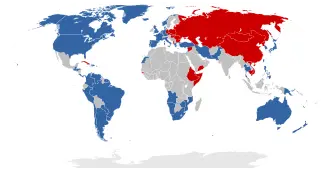
Third-worldism holds that the main political divide is between the rich former colonial powers and the poor formerly colonised countries rather than between the Cold War blocs. It calls for solidarity among Global South states and peoples against imperialism and neocolonialism, national self-determination, and economic independence from the core. Its radical wing, represented by Fanon, Guevara and Amin, adds armed struggle, land reform and a break with the world market.
What it stands for
- Poor countries should stop economic relations with wealthy countries.
- Countries that had colonies should compensate the countries they colonized.
- The farmers who work large estates should take ownership from the landowners, with the transfer compulsory if owners refuse.
- Taxes on imports should shield domestic producers from foreign competition.
- The global economic system keeps poorer countries poor by directing their wealth toward richer countries.
- Industries such as energy, rail and utilities should be owned by the state or public bodies, not private companies.
Key figures
- Frantz Fanon: Theorist of anti-colonial struggle and author of The Wretched of the Earth
- Samir Amin: Economist who developed the theory of delinking from the world system
- Gamal Abdel Nasser: Leader of the Bandung-era non-aligned Third World bloc
Closest ideologies
- Sandinista ideology (93% match)
- Revolutionary nationalism (92% match)
- Chavismo (92% match)
- Sankarism (91% match)
- Bolivarian Socialism (91% match)
People closest to it
- Frantz Fanon (90% alike)
- Subhas Chandra Bose (90% alike)
- Thomas Sankara (89% alike)
- Maximilien Robespierre (88% alike)
- George Orwell (88% alike)
Key positions
- Strongly: Poor countries should stop economic relations with wealthy countries.
- Strongly: Countries that had colonies should compensate the countries they colonized.
- Strongly: The farmers who work large estates should take ownership from the landowners, with the transfer compulsory if owners refuse.
- Strongly: Governments should limit how money and investment can be moved across borders.
- Strongly: Taxes on imports should shield domestic producers from foreign competition.
- Strongly: The global economic system keeps poorer countries poor by directing their wealth toward richer countries.
- Strongly: Industries such as energy, rail and utilities should be owned by the state or public bodies, not private companies.
- Strongly: Countries that feel dominated by Western powers should band together to resist them.
- Strongly: Defeating communism should not take priority over coexistence with it.
- Strongly: My country should stay neutral and join neither of the opposing great-power alliances.
- Strongly: The government should steer investment into industries it sees as key to the country's future.
- Strongly: A state of their own in the Land of Israel is not something Jews are owed as a people.
- Strongly: The state should stop foreign buyers from taking over key national businesses.
- Strongly: Government should impose strict rules on how corporations operate.
- Strongly: Free trade does not benefit everyone in the long run.
- Strongly: Owners' rights to their property need not be protected against being overridden for public goals.
- Strongly: Officials decide what gets made and who gets it at least as well as prices and competition do.
- Strongly: Political independence means little unless the economic and property system is also transformed.
- Strongly: National policy should give priority to preventing outside powers from splitting the country territorially.
- Strongly: Meeting poor people's needs should be the first consideration in public policy.
- Strongly: No one is better suited by nature to govern than anyone else.
- Strongly: Other things drive humanity forward at least as much as rivalry and conflict between peoples.
- Strongly: Trade, finance and debt rules should be changed to give poorer countries a fairer share.
- Strongly: Income-tax percentages may differ between income levels.
- Strongly: Private ownership is legitimate only insofar as it benefits society.
- Strongly: Foreign armies should not be based on the country's territory.
- Strongly: World power should be distributed among several independent major powers, without one dominant power.
- Strongly: Economic growth should not be limited for the sake of the environment.
- Strongly: Whatever their circumstances, everyone should be able to count on the state for enough to live decently, through benefits, pensions or public services.
- Strongly: Political violence is sometimes justified.
- Strongly: A people with a shared national identity is entitled to its own self-governing state.
- Strongly: Being powerful does not mean a country should bring more land within its borders.
- Strongly: A national development strategy should not accept some regions growing wealthy ahead of the rest.
- Strongly: A country may leave other nations to choose their own political systems.
- Strongly: The law should treat everyone as an equal, whatever their birth, sex, race or status.
- Strongly: Being the first to use force can be right, depending on what it is meant to achieve.
- Strongly: Most of the average difference in ability between racial groups does not come from genes.
- Strongly: Minority groups are not, as groups, secretly plotting to harm the nation.
- Strongly: Looking after your own interests is not a moral good in itself.
- Strongly: At least some revolutions have been justified.
- Strongly: Central banks should keep a role in controlling the money supply.
- Strongly: Population growth does not mainly drive lasting poverty.
- Strongly: There is no deliberate plan behind immigration aimed at replacing the native population.
- Strongly: No state may force a minority out of the country, however hostile it judges that minority to be.
- Strongly: No society has the right to rule another for its supposed improvement, however advanced it is.
- Strongly: Each country should hold ultimate authority over its natural resources, without foreign interests controlling them.
- Strongly: The vote keeps a government in check at least as well as being able to leave the country does.
- Strongly: Society needs government of some kind.
- Strongly: The ruler should be subject to the country's laws.
- Strongly: The state should not be managed the way a well-run business is.
- Strongly: Government should have other tasks besides protecting people from physical violence.
- Strongly: Collecting taxes does not in itself amount to stealing people's money.
- Strongly: Public policy should not be used to reduce the passing on of inherited disabilities.
- Strongly: Great powers should have no right to send troops against allied governments' wishes for the purpose of preserving those countries' political systems.
- Strongly: Political authority need not rest on oaths of loyalty sworn to a lord.
- Strongly: Killing another person can be right in self-defence or in defence of others.
- Strongly: Overseas territories need not be run mainly for the ruling country's economic benefit.
- Strongly: The holder of the highest state office need not be treated as holy.
- Strongly: Taking part in politics is at least as good a way to live as living privately away from public affairs.
- Strongly: A weaker state need not formally treat a stronger power as its superior.
- Strongly: Public spaces such as schools and facilities should not be separated by race under the law.
- Strongly: Courts need not be handed over to private businesses.
- Strongly: Museums, libraries and other inherited culture should not be destroyed, even when they stand in the way of new creation.
- Strongly: Humanity would gain nothing by going back to living off hunting and gathering.
- Strongly: Farmers should have the legal freedom to leave the estates they work.
- Leans: An armed minority's actions are capable of bringing about conditions that enable a broader revolutionary uprising.
- Leans: An economy whose production is directed by a central plan is capable of working better than an economy directed by market exchange.
- Leans: My country should give weapons to foreign insurgents fighting governments it regards as enemies.
- Leans: History is mainly driven by conflict between economic classes.
- Leans: Society should aim for people to end up with broadly equal material conditions.
- Leans: Historical change comes mainly from changes in how society produces and exchanges goods.
- Leans: Laws, police and government mainly serve the interests of whoever owns the economy and holds power.
- Leans: Owners' profit is value taken from workers' labor.
- Leans: In the society we should aim for, a person's needs should determine their share of goods.
- Leans: Cooperation between employers and workers should not come before conflict where their interests differ.
- Leans: Cultures do not rank above one another in overall worth.
- Leans: People seeking political change should act directly—for example, with strikes, boycotts or occupations—instead of pursuing change through elections and parliaments.
- Leans: Defense should rest with armed ordinary citizens, not a standing force.
- Leans: People with advanced schooling are cut off from how ordinary people live and work.
- Leans: Workers' solidarity with their own nation should take priority over solidarity with workers across borders.
- Leans: Countries within one civilization should unite politically.
- Leans: A country should not tie itself to other countries through lasting military alliances.
- Leans: Capitalism did not build the productive power and wealth that a better society can rest on.
- Leans: Outside governments have no entitlement to interfere in another country's internal affairs for any purpose.
- Leans: Working together internationally should count at least as much as my country's own priorities.
- Leans: New oil and gas wells and coal mines should be permitted.
- Leans: Settlers from abroad who displace a land's people and found a state there are carrying out colonialism.
- Leans: Employees should have voting rights in the management of large companies.
- Leans: Distance and nationality do not weaken the duty of the rich to help the poor abroad.
- Leans: Those who hold public office should be paid no more than an average worker.
- Leans: Allied countries are free to decide for themselves whether to help one that is attacked.
- Leans: Countries should maintain only the weapons needed for national safety.
- Leans: A general collapse of capitalism is unavoidable.
- Leans: Some race-based affirmative action should continue.
- Leans: Society should follow a third course beyond capitalism and communism.
- Leans: High earners and the very rich should pay tax at a much higher rate than everyone else.
- Leans: Production should be organised to provide what people need, instead of being organised around what yields a profit.
- Leans: The nation has decayed and must be reborn.
- Leans: Full-time work at the legal wage floor should pay enough to meet basic living costs.
- Leans: The goods people consume should mainly come from nearby producers.
- Leans: My country may keep a military no stronger than its rivals'.
- Leans: Indigenous peoples should control their traditional territories.
- Leans: Whether a policy fits an ideology should count independently of its results.
- Leans: Trade deals may leave out legally binding requirements protecting workers.
- Leans: The economy should not combine mainly private markets with government support for people who cannot meet their basic needs.
- Leans: People must be free to leave their religion without legal penalty.
- Leans: Society should take active steps to make up for the harm done by past racial injustices.
- Leans: A national language that people no longer use every day should be brought back as the state's official language.
- Leans: Final authority over a state's laws need not belong to its most senior religious scholars.
- Leans: A poor country should develop mainly with its own resources.
- Leans: Women may go out in public without any legal duty to cover fully.
- Leans: Society may be changed in large, rapid steps.
- Leans: A country's constitution should prevail when it conflicts with international legal obligations.
- Leans: A nation need not wait for a cultural revival before building its state.
- Leans: People who became refugees during a conflict should be permitted to return to the homes they themselves left.
- Leans: A country can get through deadlock among its institutions without a leader who overrides them.
- Leans: A person loses freedom from being at another person's mercy, even if that power is never exercised.
- Leans: How someone turns out is shaped more by upbringing, society and experience than by the traits they are born with.
- Leans: Voting should not be limited to members of one ethnic group.
- Leans: No nuclear weapons, ours or an ally's, should be stationed here.
- Leans: Owning a gun should not face strict legal limits.
- Leans: Today, nobody is bound by a colonial-era treaty that divided a people without asking them.
- Leans: Workers are better off for having labor unions.
- Leans: Ethnic diversity does not weaken a society's ability to hold together.
- Leans: People should have a direct role in making decisions where they work, live and study, rather than having those decisions made entirely for them.
- Leans: A former empire should claim no special ties, leadership or sphere of influence in its old territories.
- Leans: Political institutions developed in the West are not a suitable model for every civilization.
- Leans: A country may keep a region that wants to leave.
- Leans: Being free requires having the practical resources to act on one's choices, such as an adequate livelihood.
- Leans: A country may keep all its decisions in its own hands rather than pooling them with other nations.
- Leans: Political representation should not come through social bodies such as families, local communities and occupational associations instead of political parties.
- Leans: The general public should have at least as much say in policy as experts.
- Leans: Schools should cultivate patriotic feeling: loyalty to and pride in the nation, expressed for example through respect for its flag and anthem.
- Leans: Nobody should hold a special rank by birth, such as a noble title, a hereditary crown or a caste position, or the special rights attached to one.
- Leans: A people split by an imposed border should be brought together in a single state.
- Leans: Spreading democracy does not bring peace.
- Leans: A nation does not need one main ethnic group: it can be made up of people of many ancestries.
- Leans: Publicly honouring a national leader as the personification of the nation is not acceptable.
- Leans: Some areas of life should remain outside state direction.
- Leans: Work may stay divided into separate specialized jobs held by different people.
- Leans: Lasting socialism in one country does not require socialist revolutions abroad.
- Leans: The presence of people of its nationality does not give a state a rightful claim to land beyond its borders.
- Leans: Restoring a lost social order does not matter more than pursuing progress.
- Leans: Industrial society has done at least as much good as harm to humanity.
- Leans: Public school science classes may teach evolution on its own.
- Leans: Rulers have a right to rule only because the people they rule have agreed to it.
- Leans: Even a purely ceremonial head of state should not hold the position by birth.
- Leans: The law should not assign different roles in public life on the basis of sex.
- Leans: In a war between great powers, workers need not seek their own government's defeat.
- Leans: Keeping a nation's inherited culture alive, including its language, customs and traditions, matters.
- Leans: Leading roles in a country's economy should not depend on belonging to the majority national group.
- Leans: Political power may rest on something other than workplace-elected councils.
- Leans: A country may make its laws with no formal advisory role for traditional chiefs.
- Leans: Laws should not be required to follow religious texts.
- Leans: Religion does not offer illusory comfort for material suffering.
- Leans: Groups have rights of their own.