Political Ideology Atlas · All people · Take the test
Latin America & Caribbean · born 1928, historical
Che Guevara
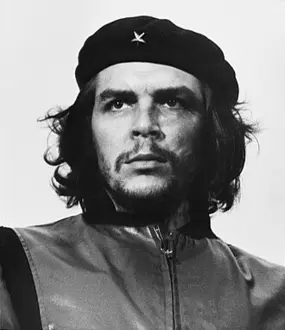
Argentine-Cuban revolutionary and Cuban minister of industries (1961–1965)
Guevara advocated socialist revolution, public ownership and central planning, combined with moral incentives and the formation of a new socialist consciousness. He supported guerrilla struggle, anti-colonial liberation and international economic arrangements favouring dependent countries.
Closest ideologies
Based on the 61 statements where Che Guevara has a known position.
- Guevarism (89% match)
- Fidelismo (87% match)
- Nkrumaism (87% match)
- Maoism (86% match)
- Sankarism (86% match)
Similar people
- Mao Zedong (88% alike)
- Thomas Sankara (88% alike)
- Subhas Chandra Bose (88% alike)
- Maxim Gorky (88% alike)
- Kwame Nkrumah (87% alike)
Known positions
- Strongly: A workers' state must suppress the old ruling class for a time.
- Strongly: Eventually people should produce and share without money.
- Strongly: One ideologically correct party should hold state leadership without competing parties having a right to replace it.
- Strongly: Workers require political leadership from a tightly organised revolutionary party.
- Strongly: An armed minority's actions are capable of bringing about conditions that enable a broader revolutionary uprising.
- Strongly: An economy whose production is directed by a central plan is capable of working better than an economy directed by market exchange.
- Strongly: My country should give weapons to foreign insurgents fighting governments it regards as enemies.
- Strongly: Laws, police and government mainly serve the interests of whoever owns the economy and holds power.
- Strongly: Wars between great powers are an unavoidable consequence of capitalism.
- Strongly: People should work mainly out of responsibility to society and a shared purpose, with personal material rewards playing a secondary role.
- Strongly: Cooperation between employers and workers should not come before conflict where their interests differ.
- Strongly: People seeking political change should act directly—for example, with strikes, boycotts or occupations—instead of pursuing change through elections and parliaments.
- Strongly: The system in which people work for wages for an employer should be ended.
- Strongly: Society should push new technology forward faster, even where it overturns established institutions.
- Strongly: Governments should set legal price ceilings on essential foods when supplies are scarce.
- Strongly: The farmers who work large estates should take ownership from the landowners, with the transfer compulsory if owners refuse.
- Strongly: Working together internationally should count at least as much as my country's own priorities.
- Strongly: Wage work cuts people off from the meaning and creativity of what they make.
- Strongly: Distance and nationality do not weaken the duty of the rich to help the poor abroad.
- Strongly: Countries should maintain only the weapons needed for national safety.
- Strongly: What things are worth comes from the work put into them.
- Strongly: Production should be organised to provide what people need, instead of being organised around what yields a profit.
- Strongly: The worst crimes can be punished by death.
- Strongly: The global economic system keeps poorer countries poor by directing their wealth toward richer countries.
- Strongly: Industries such as energy, rail and utilities should be owned by the state or public bodies, not private companies.
- Strongly: Countries that feel dominated by Western powers should band together to resist them.
- Strongly: Armed forces may sometimes be used for purposes beyond defending the country against attack.
- Strongly: Society should take active steps to make up for the harm done by past racial injustices.
- Strongly: After members debate and adopt a party decision, every member should have to help implement it, including those who opposed it.
- Strongly: Workers' solidarity with workers in other countries should count at least as much as solidarity with their own nation.
- Strongly: The state should stop foreign buyers from taking over key national businesses.
- Strongly: Free trade does not benefit everyone in the long run.
- Strongly: Owners' rights to their property need not be protected against being overridden for public goals.
- Strongly: Officials decide what gets made and who gets it at least as well as prices and competition do.
- Strongly: Being free requires having the practical resources to act on one's choices, such as an adequate livelihood.
- Strongly: Private charity does not help people in poverty better than government programs do.
- Strongly: Political independence means little unless the economic and property system is also transformed.
- Strongly: Meeting poor people's needs should be the first consideration in public policy.
- Strongly: Constantly seeking additional possessions is harmful overall, despite any benefits it brings.
- Strongly: The state should guarantee health care to everyone, whether it runs the services itself or pays for them.
- Strongly: Trade, finance and debt rules should be changed to give poorer countries a fairer share.
- Strongly: Foreign armies should not be based on the country's territory.
- Strongly: Political violence is sometimes justified.
- Strongly: A people with a shared national identity is entitled to its own self-governing state.
- Strongly: Being powerful does not mean a country should bring more land within its borders.
- Strongly: A government needs more than fair elections to be democratic.
- Strongly: Local community ownership of the means of production should not replace private or state ownership.
- Strongly: Looking after your own interests is not a moral good in itself.
- Strongly: At least some revolutions have been justified.
- Strongly: Each country should hold ultimate authority over its natural resources, without foreign interests controlling them.
- Strongly: A market economy is incompatible with socialism under communist-party leadership.
- Strongly: Public spaces such as schools and facilities should not be separated by race under the law.
- Leans: Every part of life should be subject to state direction.
- Leans: Government should depend more on leaders setting a good example than on enforcing laws with penalties.
- Leans: Having a human nature in common is not what gives people their rights.
- Leans: Taxes on imports should shield domestic producers from foreign competition.
- Leans: Trade unions should control their own affairs without state direction.
- Leans: Technology will not solve most of humanity's problems.
- Leans: What you owe your community matters more than your personal rights.
- Leans: Socialism cannot be reached just by winning elections and governing through parliament.
- Leans: People should have a direct role in making decisions where they work, live and study, rather than having those decisions made entirely for them.