Political Ideology Atlas · All people · Take the test
North America · born 1743, historical
Thomas Jefferson
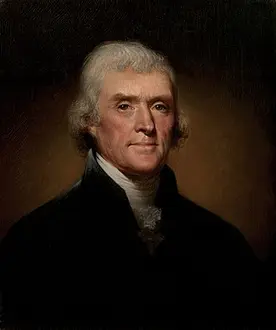
Principal author of the Declaration of Independence; third President of the United States (1801-1809)
A Virginia planter and republican theorist who argued that government rests on the consent of the governed, should be limited, divided among separate branches and kept close to the people through states and local wards. He championed religious freedom and a wall between church and state, preferred an agrarian society of small landholders to banks and manufactures, and doubted that one generation may bind another. He enslaved people throughout his life, called slavery a moral evil, and wrote that Black people were probably inferior and should be freed and colonized elsewhere.
Closest ideologies
Based on the 70 statements where Thomas Jefferson has a known position.
- Jeffersonian democracy (92% match)
- Anti-Federalists (86% match)
- Zionism (85% match)
- Localism in Hong Kong (85% match)
- Greater Albania (84% match)
Similar people
- Benjamin Franklin (88% alike)
- Elon Musk (86% alike)
- Ulrich Siegmund (85% alike)
- Immanuel Kant (84% alike)
- Tulsi Gabbard (84% alike)
Known positions
- Strongly: Some people are better suited by nature to govern.
- Strongly: An assembly elected by the people for that purpose should draft the constitution.
- Strongly: Parties that seek to abolish a country's constitutional order should be free to organize.
- Strongly: Government should maintain a strict institutional separation from religion.
- Strongly: State schools should not teach religion.
- Strongly: Government borrowing should be subject to binding legal limits.
- Strongly: Property should belong to many people in small holdings.
- Strongly: Political power should be split among separate branches and levels that can each limit the others.
- Strongly: Living in the countryside does more for a person's moral wellbeing than living in a city.
- Strongly: Political decisions should rest with the smallest local community able to handle them, with wider authorities handling matters that need a wider reach.
- Strongly: The state should treat all streams and interpretations of a religion equally under the law.
- Strongly: People are entitled to resist a ruler's unconstitutional exercise of power.
- Strongly: An electorate should choose the head of state, either directly or through elected representatives.
- Strongly: Racial categories are not merely social constructs without a scientific basis.
- Strongly: In law, a country's traditional national church should rank no higher than other religious bodies.
- Strongly: Nobody should hold a special rank by birth, such as a noble title, a hereditary crown or a caste position, or the special rights attached to one.
- Strongly: Rulers have a right to rule only because the people they rule have agreed to it.
- Strongly: Even a purely ceremonial head of state should not hold the position by birth.
- Strongly: Political violence is sometimes justified.
- Strongly: A people with a shared national identity is entitled to its own self-governing state.
- Strongly: The government should let its political opponents organise, speak and compete for power.
- Strongly: Protecting the constitution should be left to civilian institutions, not the armed forces.
- Strongly: Political authority does not ultimately come from God.
- Strongly: Someone who actually governs a state should not hand that power on to their own child.
- Strongly: Laws should not be required to follow religious texts.
- Strongly: At least some revolutions have been justified.
- Strongly: News media should decide for themselves what they publish, whoever holds power.
- Strongly: Religious conversion should be free of legal restriction.
- Strongly: Publicly insulting a religion's sacred beliefs should be left outside the criminal law.
- Strongly: Society needs government of some kind.
- Strongly: The ruler should be subject to the country's laws.
- Strongly: Overseas territories need not be run mainly for the ruling country's economic benefit.
- Strongly: The holder of the highest state office need not be treated as holy.
- Strongly: People must be free to leave their religion without legal penalty.
- Leans: A government should exist, with protection against physical violence as its only task.
- Leans: A state may force a minority it sees as hostile to leave the country.
- Leans: People of different races should be discouraged from forming a family together, whether through marriage or having children.
- Leans: Central banks should give way to a market in which people choose the money they use without a central bank controlling its supply.
- Leans: Same-sex relations between consenting adults should be punishable by law.
- Leans: Most of the average difference in ability between racial groups comes from genes.
- Leans: A powerful country should bring more land within its borders.
- Leans: Where they conflict, evidence and reasoning should count for more than faith, God, revelation or scripture.
- Leans: A country should not tie itself to other countries through lasting military alliances.
- Leans: Decisions about indigenous peoples' traditional lands may rest with the wider state, not with those peoples.
- Leans: Religious values and institutions should not have a major part in shaping laws, schools and public life.
- Leans: Besides its directly elected parliament, a legislature should have a second chamber, such as a senate.
- Leans: Taxes on imports should shield domestic producers from foreign competition.
- Leans: Government should be bound by written guarantees of basic rights protected against easy amendment by ordinary majorities.
- Leans: Countries should maintain only the weapons needed for national safety.
- Leans: The worst crimes can be punished by death.
- Leans: My country may keep a military no stronger than its rivals'.
- Leans: My country should stay neutral and join neither of the opposing great-power alliances.
- Leans: Democracy is best even when voters make poor choices.
- Leans: Society may be changed in large, rapid steps.
- Leans: People without property should also have the right to vote.
- Leans: A country can get through deadlock among its institutions without a leader who overrides them.
- Leans: Some things are right or wrong for everyone, in every culture and era.
- Leans: An elected legislature must approve the government's budget before the government spends public money.
- Leans: Defense should not rest with armed ordinary citizens in place of a standing force.
- Leans: People should have a direct role in making decisions where they work, live and study, rather than having those decisions made entirely for them.
- Leans: The general public should have at least as much say in policy as experts.
- Leans: Most people in political office look after themselves first and the public second.
- Leans: Very large concentrations of wealth threaten a free society.
- Leans: Daughters and widows should inherit and own land on the same terms as sons and husbands.
- Leans: War does not strengthen a nation's character.
- Leans: Governments should give no subsidies, licences or protections that favour firms close to them.