Political Ideology Atlas · All ideologies · Take the test
Anti-Federalists
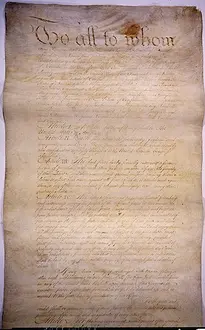
The Anti-Federalists opposed ratifying the 1787 US Constitution as drafted, fearing it would consolidate the states into one distant national government. They held that free republics must be small, that representatives should be numerous, close to and dependent on ordinary citizens, and that rulers, standing armies and federal taxing power threaten liberty unless limited by explicit rights. Their pressure helped produce the Bill of Rights.
What it stands for
- Elected politicians should serve only a small number of terms.
- Government should be bound by written guarantees of basic rights protected against easy amendment by ordinary majorities.
- My country may keep a military no stronger than its rivals'.
- Political decisions should rest with the smallest local community able to handle them, with wider authorities handling matters that need a wider reach.
- The national legislature should not be able to take back powers given to regions on its own.
- Ordinary legal protections, such as the right not to be held without trial, should stay in force even in a national emergency.
Key figures
- Patrick Henry: Leader of the Anti-Federalist opposition in Virginia
- George Mason: Delegate who refused to sign the Constitution and demanded a bill of rights
- Richard Henry Lee: Virginia Anti-Federalist, often named as a candidate author of the Federal Farmer letters
Closest ideologies
- Localism in Hong Kong (91% match)
- Jeffersonian democracy (88% match)
- Rugged individualism (88% match)
- Social credit (88% match)
- Procedural democracy (87% match)
People closest to it
- Alexis de Tocqueville (88% alike)
- Hannah Arendt (87% alike)
- Elon Musk (87% alike)
- Thomas Jefferson (86% alike)
- Alexei Navalny (86% alike)
Key positions
- Strongly: Elected politicians should serve only a small number of terms.
- Strongly: Government should be bound by written guarantees of basic rights protected against easy amendment by ordinary majorities.
- Strongly: People outside state forces should also be allowed to bear arms.
- Strongly: My country may keep a military no stronger than its rivals'.
- Strongly: Political decisions should rest with the smallest local community able to handle them, with wider authorities handling matters that need a wider reach.
- Strongly: The national legislature should not be able to take back powers given to regions on its own.
- Strongly: Ordinary legal protections, such as the right not to be held without trial, should stay in force even in a national emergency.
- Strongly: Voters should be able to remove elected officials before their terms end.
- Strongly: A country can get through deadlock among its institutions without a leader who overrides them.
- Strongly: An elected legislature must approve the government's budget before the government spends public money.
- Strongly: An electorate should choose the head of state, either directly or through elected representatives.
- Strongly: The general public should have at least as much say in policy as experts.
- Strongly: Rulers must act under lasting, publicly known laws administered by recognised courts.
- Strongly: No one is better suited by nature to govern than anyone else.
- Strongly: Rulers have a right to rule only because the people they rule have agreed to it.
- Strongly: Even a purely ceremonial head of state should not hold the position by birth.
- Strongly: Most people in political office look after themselves first and the public second.
- Strongly: An economy directed by a central plan is not capable of working better than one directed by market exchange.
- Strongly: The government should let its political opponents organise, speak and compete for power.
- Strongly: Rapid economic development does not justify temporary restrictions on political freedom.
- Strongly: Protecting the constitution should be left to civilian institutions, not the armed forces.
- Strongly: Individual farms should not give way to joint cultivation by groups of farmers.
- Strongly: Someone who actually governs a state should not hand that power on to their own child.
- Strongly: News media should decide for themselves what they publish, whoever holds power.
- Strongly: No party's ideology should give it an exclusive right to lead the state.
- Strongly: The armed forces may be controlled by someone other than the governing party's leadership.
- Strongly: No state may force a minority out of the country, however hostile it judges that minority to be.
- Strongly: A workers' state does not need to suppress the old ruling class, even for a time.
- Strongly: Society needs government of some kind.
- Strongly: The ruler should be subject to the country's laws.
- Strongly: Political authority need not rest on oaths of loyalty sworn to a lord.
- Strongly: Taking part in politics is at least as good a way to live as living privately away from public affairs.
- Strongly: Courts need not be handed over to private businesses.
- Strongly: Final authority over a state's laws need not belong to its most senior religious scholars.
- Strongly: Suspected drug dealers should never be put to death without a trial.
- Strongly: Humanity would gain nothing by going back to living off hunting and gathering.
- Leans: Women's political rights may differ from men's.
- Leans: Towns and cities should link through councils whose delegates coordinate and administer what local assemblies decide, without making policy themselves.
- Leans: The state should not guarantee health care to everyone.
- Leans: Groups of citizens chosen at random should meet to consider major public issues, with their conclusions contributing to policy decisions.
- Leans: A society holds together less well when its members belong to different ethnic groups.
- Leans: Defense should rest with armed ordinary citizens, not a standing force.
- Leans: People with advanced schooling are cut off from how ordinary people live and work.
- Leans: A people's historical tie to a land does not give it a stronger claim than other peoples living there now.
- Leans: An assembly elected by the people for that purpose should draft the constitution.
- Leans: Society may deal with racial discrimination as it arises today without programs aimed at past wrongs.
- Leans: Individual rights matter at least as much as what citizens owe their community.
- Leans: Military service should always be voluntary.
- Leans: The nation does not need a radical rebirth to overcome decadence.
- Leans: Property should belong to many people in small holdings.
- Leans: Work under capitalism does not alienate people from their own creative activity.
- Leans: Living in the countryside does more for a person's moral wellbeing than living in a city.
- Leans: A country does not have the right to stop a region becoming independent by using its military.
- Leans: Large landed estates should not be compulsorily transferred to the people who farm them.
- Leans: Government should serve people's good while respecting each person as more than an instrument of the state or community.
- Leans: Whether a policy fits an ideology should count independently of its results.
- Leans: Democracy is best even when voters make poor choices.
- Leans: Citizens should have a legal right to see government information.
- Leans: Real command of the military may rest with someone other than the head of state.
- Leans: Human rights come from the nature that all human beings share.
- Leans: Countries within one civilization may remain politically separate.
- Leans: A person loses freedom from being at another person's mercy, even if that power is never exercised.
- Leans: Direct action does not have to take the place of elections and parliament as the way to achieve political change.
- Leans: Recruitment to the civil service should not depend on competitive examinations.
- Leans: Collecting taxes does not in itself amount to stealing people's money.
- Leans: People should have a direct role in making decisions where they work, live and study, rather than having those decisions made entirely for them.
- Leans: Political institutions developed in the West are not a suitable model for every civilization.
- Leans: Countries should keep their armed forces.
- Leans: Peoples who share an ethnic heritage, such as the Slavic peoples, should not come together in one state.
- Leans: Public offices may be filled by methods other than drawing lots.
- Leans: A healthy society depends on the traditional family, such as a married mother and father raising their children.
- Leans: Political representation should not come through social bodies such as families, local communities and occupational associations instead of political parties.
- Leans: Nobody should hold a special rank by birth, such as a noble title, a hereditary crown or a caste position, or the special rights attached to one.
- Leans: Young people should not be organised into uniformed, drilled groups that prepare them to serve the nation.
- Leans: The vote keeps a government in check at least as well as being able to leave the country does.
- Leans: Wages need not be set through negotiating bodies that the state officially recognizes.
- Leans: Other forces move history at least as much as conflict between classes does.
- Leans: At least some revolutions have been justified.
- Leans: Political violence is sometimes justified.
- Leans: Being powerful does not mean a country should bring more land within its borders.
- Leans: Political authority does not ultimately come from God.