Political Ideology Atlas · All ideologies · Take the test
Greater Albania
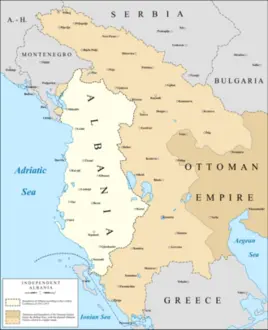
Greater Albania (also called Ethnic Albania or Natural Albania) is a nationalist and irredentist idea that Albanians divided by the borders of 1913 should live in one state, taking in Kosovo and parts of North Macedonia, Montenegro, southern Serbia and Greek Chameria. Its carriers have ranged from the League of Prizren and wartime nationalists to the KLA and small groups such as the ANA. Today it is mostly held as a cultural and political aspiration of unification by consent, often alongside EU and NATO aims, and the idea itself carries no social or economic programme.
What it stands for
- The presence of people belonging to the same nation gives a state a legitimate territorial claim outside its borders.
- A nation should be mainly one ethnic people.
- Speaking a common language is sufficient for people to constitute one nation.
- A people should have one region of its own rather than being split across several.
- People who became refugees during a conflict should be permitted to return to the homes they themselves left.
- An ancestral bond to a land gives a people a claim that outweighs the claims of other peoples who now live there.
Key figures
- Abdyl Frashëri: Leading figure of the League of Prizren, who pushed it toward Albanian autonomy and unification of the four vilayets
- Ismail Qemali: Led the 1912 declaration of Albanian independence at Vlorë
Closest ideologies
- Cultural Nationalism (88% match)
- Poporanism (88% match)
- Pan-nationalism (87% match)
- Zionism (87% match)
- Sahrawi nationalism (86% match)
People closest to it
- Benjamin Franklin (91% alike)
- Marcus Garvey (90% alike)
- Shinzō Abe (89% alike)
- Ulysses S. Grant (87% alike)
- Péter Magyar (87% alike)
Key positions
- Strongly: The presence of people belonging to the same nation gives a state a legitimate territorial claim outside its borders.
- Strongly: A nation should be mainly one ethnic people.
- Strongly: Speaking a common language is sufficient for people to constitute one nation.
- Strongly: A people should have one region of its own rather than being split across several.
- Strongly: People who became refugees during a conflict should be permitted to return to the homes they themselves left.
- Strongly: An ancestral bond to a land gives a people a claim that outweighs the claims of other peoples who now live there.
- Strongly: The people living in a disputed territory should choose by voting which country it joins.
- Strongly: Today's nation is the same people as its ancient and medieval forebears.
- Strongly: Gathering all the people in the homeland should have at least as much priority as supporting diaspora culture.
- Strongly: Today, nobody is bound by a colonial-era treaty that divided a people without asking them.
- Strongly: A people split by an imposed border should be brought together in a single state.
- Strongly: A state should take responsibility for the welfare of its national communities across neighbouring borders.
- Strongly: A people with a shared national identity is entitled to its own self-governing state.
- Strongly: Political authority does not ultimately come from God.
- Strongly: Belonging to the nation does not go with sharing its religion.
- Strongly: Workers do not need a disciplined revolutionary party to lead them.
- Strongly: Laws should not be required to follow religious texts.
- Strongly: Islam is compatible with Western values.
- Strongly: News media should decide for themselves what they publish, whoever holds power.
- Strongly: No party's ideology should give it an exclusive right to lead the state.
- Strongly: Keeping a nation's inherited culture alive, including its language, customs and traditions, matters.
- Strongly: In a war between great powers, workers need not seek their own government's defeat.
- Strongly: The armed forces may be controlled by someone other than the governing party's leadership.
- Strongly: In the long run people should still produce and share using money.
- Strongly: People of different races should not be discouraged from forming a family together, including through marriage and children.
- Strongly: Some areas of life should remain outside state direction.
- Strongly: A workers' state does not need to suppress the old ruling class, even for a time.
- Strongly: Society needs government of some kind.
- Strongly: Countries should keep their armed forces.
- Strongly: The ruler should be subject to the country's laws.
- Strongly: The holder of the highest state office need not be treated as holy.
- Strongly: Public spaces such as schools and facilities should not be separated by race under the law.
- Strongly: Women may go out in public without any legal duty to cover fully.
- Strongly: Final authority over a state's laws need not belong to its most senior religious scholars.
- Strongly: People must be free to leave their religion without legal penalty.
- Strongly: Museums, libraries and other inherited culture should not be destroyed, even when they stand in the way of new creation.
- Leans: In the long run people should be free to live and work in any country.
- Leans: An armed minority's actions are capable of bringing about conditions that enable a broader revolutionary uprising.
- Leans: A powerful country should bring more land within its borders.
- Leans: My country should give weapons to foreign insurgents fighting governments it regards as enemies.
- Leans: Members of every racial group should organise politically around interests specific to their group.
- Leans: Countries should hand part of their decision-making power to a union of nations, such as the European Union.
- Leans: A region should be entitled to leave its current country.
- Leans: Major laws should be decided by citizens voting on them themselves.
- Leans: A country should press its neighbour to give back land taken from it in an old war.
- Leans: Only the state's armed forces and police should have permission to carry weapons.
- Leans: Only children of citizens should be citizens at birth: being born in the country should not be enough.
- Leans: Government should maintain a strict institutional separation from religion.
- Leans: Religious values and institutions should not have a major part in shaping laws, schools and public life.
- Leans: Businesses need not belong to the people who work in them.
- Leans: A country does not have the right to stop a region becoming independent by using its military.
- Leans: Areas where an ethnic minority makes up most of the population should be able to run many of their own affairs within the state.
- Leans: Military intervention abroad is sometimes necessary to protect human rights.
- Leans: Belonging to the nation ties a person's life to a sacred community that goes on after their death.
- Leans: Cultural life inside a state should not be placed under the control of each national minority.
- Leans: Democracy is best even when voters make poor choices.
- Leans: Society may be changed in large, rapid steps.
- Leans: Countries within one civilization may remain politically separate.
- Leans: Public institutions should help minority languages be used in public life, for example through teaching or services in those languages.
- Leans: Land that a state declares its own against its people's will is still illegally occupied by that state.
- Leans: Killing another person can be right in self-defence or in defence of others.
- Leans: Belonging to a religious minority is no ground for shoppers to stay away from a shop.
- Leans: Renting out housing should be permitted in at least some circumstances.
- Leans: Government should rely at least as much on legal enforcement as on its rulers' moral example.
- Leans: Collecting taxes does not in itself amount to stealing people's money.
- Leans: Adults may marry across religions without legal restriction.
- Leans: Public offices may be filled by methods other than drawing lots.
- Leans: The people who own the economy and hold power are not the ones the state mainly serves.
- Leans: It is legitimate to take pride in the racial group one belongs to.
- Leans: National policy should give priority to preventing outside powers from splitting the country territorially.
- Leans: Publicly honouring a national leader as the personification of the nation is not acceptable.
- Leans: No state may force a minority out of the country, however hostile it judges that minority to be.
- Leans: There is no deliberate plan behind immigration aimed at replacing the native population.
- Leans: Population growth does not mainly drive lasting poverty.
- Leans: No one is better suited by nature to govern than anyone else.
- Leans: Lasting socialism in one country does not require socialist revolutions abroad.
- Leans: Rulers have a right to rule only because the people they rule have agreed to it.
- Leans: Art should not be censored for its effect on people's moral character.
- Leans: Other forces move history at least as much as conflict between classes does.
- Leans: Small, informal, trust-based groups should not take the place of lasting parties, unions and federations in political action.
- Leans: Class struggle does not continue under socialism.
- Leans: At least some revolutions have been justified.
- Leans: Rapid economic development does not justify temporary restrictions on political freedom.
- Leans: Minority groups are not, as groups, secretly plotting to harm the nation.
- Leans: A socialist state with hostile neighbours need not build up its state power.
- Leans: Someone who actually governs a state should not hand that power on to their own child.
- Leans: A country may leave other nations to choose their own political systems.
- Leans: Being the first to use force can be right, depending on what it is meant to achieve.
- Leans: Groups have rights of their own.