Political Ideology Atlas · All people · Take the test
North America · born 1858, historical
Theodore Roosevelt
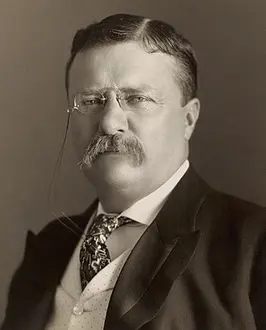
26th president of the United States (1901-1909); Progressive (Bull Moose) Party candidate (1912)
A Republican-turned-Progressive who as president (1901-1909) and in his 1910-1912 New Nationalism backed strong federal regulation of corporations, labor protections, graduated income and inheritance taxes, conservation and direct democracy, including primaries, recall and a popular vote on some state court rulings. He was a firm advocate of naval and military strength, universal military service, American expansion and tutelage over peoples he judged less advanced, strict separation of church and state, and the full Americanization of immigrants in one language and one allegiance, and he held hierarchical views of race alongside a stated rule of judging each man on his merits.
Closest ideologies
Based on the 130 statements where Theodore Roosevelt has a known position.
- Right-Wing Populism (89% match)
- Turanism (88% match)
- German nationalism (87% match)
- Pan-Iranism (87% match)
- American nationalism (86% match)
Similar people
- William McKinley (88% alike)
- Wang Jingwei (87% alike)
- Napoleon III (86% alike)
- Niccolò Machiavelli (86% alike)
- Asmongold (86% alike)
Known positions
- Strongly: Public policy, such as sterilization or incentives, should reduce the passing on of inherited disabilities.
- Strongly: Temporary rule by a more developed society is justified when it helps the ruled to progress.
- Strongly: A powerful country should bring more land within its borders.
- Strongly: War develops virtues in a nation, such as courage and discipline.
- Strongly: Rivalry and conflict between nations or peoples do more than anything else to drive humanity forward.
- Strongly: Civil servants should be recruited according to their performance in competitive examinations.
- Strongly: The state should make one language the only common language of government, schooling and public life, limiting the use of others.
- Strongly: Public institutions do not need to help minority languages be used in public life.
- Strongly: Newcomers should adopt the host nation's culture in place of their original culture.
- Strongly: Decisions about indigenous peoples' traditional lands may rest with the wider state, not with those peoples.
- Strongly: Some of the foreign debts of poor countries should still be repaid.
- Strongly: Those who inherit a large fortune should hand over a big share of it in tax.
- Strongly: Many political decisions should rest with national or wider authorities, even where a smaller community could handle them.
- Strongly: Government should maintain a strict institutional separation from religion.
- Strongly: Taxes on imports should shield domestic producers from foreign competition.
- Strongly: Rich people have an obligation to help those worse off than they are.
- Strongly: The worst crimes can be punished by death.
- Strongly: Ending a marriage should not be possible without proving fault.
- Strongly: Foreign powers sometimes have a right to intervene in a country's internal affairs.
- Strongly: Military intervention abroad is sometimes necessary to protect human rights.
- Strongly: The government should be able to require citizens to serve in the military.
- Strongly: Cultural life inside a state should not be placed under the control of each national minority.
- Strongly: Armed forces may sometimes be used for purposes beyond defending the country against attack.
- Strongly: What you owe your community matters more than your personal rights.
- Strongly: Sex work between consenting adults should be illegal.
- Strongly: Government should impose strict rules on how corporations operate.
- Strongly: Free trade does not benefit everyone in the long run.
- Strongly: Voters should be able to remove elected officials before their terms end.
- Strongly: Direct action does not have to take the place of elections and parliament as the way to achieve political change.
- Strongly: Some cultures are superior to others.
- Strongly: Employers and workers should treat each other as partners whose cooperation comes before conflict, even where their interests differ.
- Strongly: Profit made from owning businesses does not come from exploiting the workers who produce it.
- Strongly: In law, a country's traditional national church should rank no higher than other religious bodies.
- Strongly: The state should make immigrants learn the language of the country they settle in.
- Strongly: A healthy society depends on the traditional family, such as a married mother and father raising their children.
- Strongly: Population growth may be left to run its course.
- Strongly: Other forces move history at least as much as conflict between classes does.
- Strongly: Income-tax percentages may differ between income levels.
- Strongly: Private ownership is legitimate only insofar as it benefits society.
- Strongly: Very large concentrations of wealth threaten a free society.
- Strongly: Businesses gain too much influence over government policy from their lobbying.
- Strongly: Being the first to use force can be right, depending on what it is meant to achieve.
- Strongly: Belonging to the nation does not go with sharing its religion.
- Strongly: Countries may keep controls on who enters and settles, even in the long run.
- Strongly: We have a duty to leave the planet in good condition for those who come after us.
- Strongly: Keeping a nation's inherited culture alive, including its language, customs and traditions, matters.
- Strongly: In a war between great powers, workers need not seek their own government's defeat.
- Strongly: Women should be able to vote and stand for office on the same terms as men.
- Strongly: Society needs government of some kind.
- Strongly: Countries should keep their armed forces.
- Strongly: Government should have other tasks besides protecting people from physical violence.
- Strongly: Collecting taxes does not in itself amount to stealing people's money.
- Strongly: Voting should not be limited to members of one ethnic group.
- Strongly: Humanity would gain nothing by going back to living off hunting and gathering.
- Leans: Spreading our political system abroad should be a special calling of our nation.
- Leans: The leader should bypass parties and organised interest groups in dealing with the people.
- Leans: Having a shared national identity does not by itself entitle a people to its own self-governing state.
- Leans: My country should give weapons to foreign insurgents fighting governments it regards as enemies.
- Leans: The UN should have authority to compel member states to comply with its decisions.
- Leans: Choices that harm no one else should never be crimes.
- Leans: Once the national majority has decided, public institutions, including courts and independent bodies, should not limit its decision.
- Leans: A country should limit who may immigrate according to their race.
- Leans: The country would benefit from a strong leader with the power to act despite deadlock among its political institutions.
- Leans: Major laws should be decided by citizens voting on them themselves.
- Leans: Judge policies by what they achieve, independently of whether they match an ideology.
- Leans: My country's military strength should exceed that of its rivals.
- Leans: Industries such as energy, rail and utilities do not need to be publicly owned.
- Leans: Businesses should be legally barred from agreements with competitors to suppress competition, such as fixing prices.
- Leans: A country has the right to stop a region becoming independent by using its military.
- Leans: New oil and gas wells and coal mines should be permitted.
- Leans: State schools should not teach religion.
- Leans: Capitalism is not bound to suffer a general collapse.
- Leans: Political power may be concentrated in one body.
- Leans: Allies are bound to defend one another against armed attack.
- Leans: Creating new money should be reserved to public institutions, excluding private banks' creation of money through lending.
- Leans: The public should receive official records showing how government decisions were reached.
- Leans: Farmers should get price floors, state buying or cheap credit to keep them secure.
- Leans: Living in the countryside does more for a person's moral wellbeing than living in a city.
- Leans: Workers should be entitled to take or keep a job without being required to pay a union, including representation fees charged to nonmembers.
- Leans: Being a foreigner should not by itself bar someone from owning land in the country.
- Leans: High earners and the very rich should pay tax at a much higher rate than everyone else.
- Leans: Full-time work at the legal wage floor should pay enough to meet basic living costs.
- Leans: Abortion should be illegal in most cases.
- Leans: A woman who has sex outside marriage is doing something wrong.
- Leans: People able to work should get welfare benefits only in return for some work, such as a job or a work scheme.
- Leans: A president should be limited in how many times he or she may stand for re-election.
- Leans: It is morally acceptable to kill animals for food while minimising their suffering.
- Leans: The law should limit the making or sale of pornography.
- Leans: Whoever uses land or resources owes the rest of society a share of their value.
- Leans: Democracy is best even when voters make poor choices.
- Leans: One worker's pay should cover the living needs of that worker's family, including the worker.
- Leans: Workers' pay should be settled in collective bargaining between their union and their employer.
- Leans: Overseas territories need not be run mainly for the ruling country's economic benefit.
- Leans: Defense should not rest with armed ordinary citizens in place of a standing force.
- Leans: Owners' rights to their property need not be protected against being overridden for public goals.
- Leans: The law should impose no restrictions on strikes.
- Leans: Officials decide what gets made and who gets it at least as well as prices and competition do.
- Leans: Workers are better off for having labor unions.
- Leans: There should be no regular state payment that every adult gets whether or not they work.
- Leans: A country may keep a region that wants to leave.
- Leans: Being free requires having the practical resources to act on one's choices, such as an adequate livelihood.
- Leans: A nation does not need one main ethnic group: it can be made up of people of many ancestries.
- Leans: Animals can suffer, and that suffering counts in how we treat them.
- Leans: Constantly seeking additional possessions is harmful overall, despite any benefits it brings.
- Leans: Historical change does not come mainly from changes in how society produces and exchanges goods.
- Leans: Public schooling money may go straight to schools instead of to parents as vouchers.
- Leans: Spouses should make marital decisions as equals.
- Leans: The state should guarantee health care to everyone, whether it runs the services itself or pays for them.
- Leans: Being the law gives a rule a moral claim to be obeyed.
- Leans: Equality of outcomes should not be society's goal.
- Leans: Central banks should keep a role in controlling the money supply.
- Leans: Most people in political office look after themselves first and the public second.
- Leans: Economic growth should not be limited for the sake of the environment.
- Leans: Whatever their circumstances, everyone should be able to count on the state for enough to live decently, through benefits, pensions or public services.
- Leans: At least some revolutions have been justified.
- Leans: Political violence is sometimes justified.
- Leans: Looking after your own interests is not a moral good in itself.
- Leans: Income from useful work should be rewarded ahead of income from merely owning property.
- Leans: Elected governments need not leave monetary policy to central banks acting on their own.
- Leans: People should be free to own land privately.