Political Ideology Atlas · All people · Take the test
East Asia · born 1866, historical
Sun Yat-sen
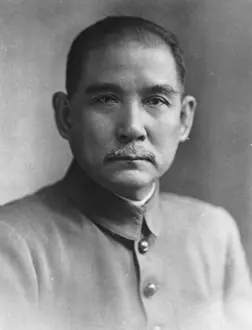
Chinese revolutionary; first provisional president of the Republic of China (1912); founder of the Kuomintang
Sun Yat-sen led the revolution that ended the Qing monarchy and built his politics on the Three Principles of nationalism, popular sovereignty and the people's livelihood. He proposed a republic reached through military rule and party tutelage, with a five-Yuan government, examinations and local self-government, and state-led industrial development financed by foreign capital. He rejected Marxian class struggle while cooperating with Soviet Russia.
Closest ideologies
Based on the 48 statements where Sun Yat-sen has a known position.
- Pan-Arabism (91% match)
- Islamic Socialism (89% match)
- Arab nationalism (89% match)
- Sahrawi nationalism (89% match)
- Pan-Africanism (89% match)
Similar people
- Abraham Lincoln (91% alike)
- Harry S. Truman (89% alike)
- Bassirou Diomaye Faye (89% alike)
- Hassan Sheikh Mohamud (89% alike)
- Mahathir Mohamad (89% alike)
Known positions
- Strongly: Civil servants should be recruited according to their performance in competitive examinations.
- Strongly: A poor country should rely on foreign money at least as much as on its own resources.
- Strongly: Industries such as energy, rail and utilities should be owned by the state or public bodies, not private companies.
- Strongly: Countries that feel dominated by Western powers should band together to resist them.
- Strongly: Defeating communism should not take priority over coexistence with it.
- Strongly: What you owe your community matters more than your personal rights.
- Strongly: The government should steer investment into industries it sees as key to the country's future.
- Strongly: Government should impose strict rules on how corporations operate.
- Strongly: Voters should be able to remove elected officials before their terms end.
- Strongly: Employers and workers should treat each other as partners whose cooperation comes before conflict, even where their interests differ.
- Strongly: An electorate should choose the head of state, either directly or through elected representatives.
- Strongly: Historical change does not come mainly from changes in how society produces and exchanges goods.
- Strongly: Even a purely ceremonial head of state should not hold the position by birth.
- Strongly: Other forces move history at least as much as conflict between classes does.
- Strongly: Political violence is sometimes justified.
- Strongly: Being powerful does not mean a country should bring more land within its borders.
- Strongly: A mother country and its colonies may trade with the outside world.
- Strongly: Poor countries should retain economic ties with rich countries.
- Strongly: At least some revolutions have been justified.
- Strongly: Keeping a nation's inherited culture alive, including its language, customs and traditions, matters.
- Strongly: No society has the right to rule another for its supposed improvement, however advanced it is.
- Strongly: Overseas territories need not be run mainly for the ruling country's economic benefit.
- Strongly: The holder of the highest state office need not be treated as holy.
- Leans: One ideologically correct party should hold state leadership without competing parties having a right to replace it.
- Leans: An armed minority's actions are capable of bringing about conditions that enable a broader revolutionary uprising.
- Leans: Some people are better suited by nature to govern.
- Leans: Countries within one civilization should unite politically.
- Leans: An assembly elected by the people for that purpose should draft the constitution.
- Leans: Major laws should be decided by citizens voting on them themselves.
- Leans: Political power should be split among separate branches and levels that can each limit the others.
- Leans: Society should follow a third course beyond capitalism and communism.
- Leans: The global economic system keeps poorer countries poor by directing their wealth toward richer countries.
- Leans: Capitalism built the productive power and wealth that later and better societies rest on.
- Leans: After members debate and adopt a party decision, every member should have to help implement it, including those who opposed it.
- Leans: Owners' rights to their property need not be protected against being overridden for public goals.
- Leans: A healthy society depends on the traditional family, such as a married mother and father raising their children.
- Leans: A workers' state does not need to suppress the old ruling class, even for a time.
- Leans: Schools should cultivate patriotic feeling: loyalty to and pride in the nation, expressed for example through respect for its flag and anthem.
- Leans: Nobody should hold a special rank by birth, such as a noble title, a hereditary crown or a caste position, or the special rights attached to one.
- Leans: Each country should hold ultimate authority over its natural resources, without foreign interests controlling them.
- Leans: Rulers have a right to rule only because the people they rule have agreed to it.
- Leans: Private ownership is legitimate only insofar as it benefits society.
- Leans: Political power may rest on something other than workplace-elected councils.
- Leans: A people with a shared national identity is entitled to its own self-governing state.