Political Ideology Atlas · All people · Take the test
North America · born 1809, historical
Abraham Lincoln
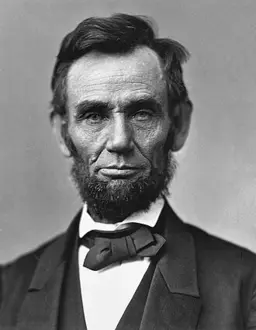
16th President of the United States (1861-1865)
A self-taught Illinois lawyer and Whig turned Republican who held that the Union is perpetual and that no state may lawfully secede, and led the Union through the Civil War. He called slavery morally wrong but at first aimed only to stop its spread, later issued the Emancipation Proclamation and pressed for the Thirteenth Amendment. He backed protective tariffs, federal support for railroads, land grants and a homestead law, and held that labor ranks above capital while capital has rights. In 1858 he rejected social and political equality of the races, and by April 1865 he favored suffrage for some Black men.
Closest ideologies
Based on the 71 statements where Abraham Lincoln has a known position.
- Tridemism (90% match)
- Person Dignity Theory (89% match)
- Pan-nationalism (89% match)
- Integral humanism (89% match)
- Sahrawi nationalism (89% match)
Similar people
- William McKinley (92% alike)
- Ulysses S. Grant (92% alike)
- Sun Yat-sen (91% alike)
- Mahathir Mohamad (91% alike)
- Charles de Gaulle (91% alike)
Known positions
- Strongly: A national emergency sometimes justifies temporarily withdrawing normal legal safeguards against people the government regards as internal enemies, such as protections against detention without trial.
- Strongly: Real authority to command the military should rest with the head of state.
- Strongly: The country may allow more immigration than strict limits would permit.
- Strongly: At least some unjust laws impose a moral duty of obedience.
- Strongly: A country has the right to stop a region becoming independent by using its military.
- Strongly: Taxes on imports should shield domestic producers from foreign competition.
- Strongly: Property should belong to many people in small holdings.
- Strongly: Democracy is best even when voters make poor choices.
- Strongly: Free trade does not benefit everyone in the long run.
- Strongly: An electorate should choose the head of state, either directly or through elected representatives.
- Strongly: A country may keep a region that wants to leave.
- Strongly: Inventions and creative works should remain legally ownable, as under patents and copyrights.
- Strongly: Public institutions should have the power to constrain a national majority's decisions in a liberal democracy.
- Strongly: The American Civil War arose mainly from slavery.
- Strongly: Being the law gives a rule a moral claim to be obeyed.
- Strongly: Rulers have a right to rule only because the people they rule have agreed to it.
- Strongly: Some decisions should bind people who have not consented to them.
- Strongly: Society needs government of some kind.
- Strongly: The ruler should be subject to the country's laws.
- Strongly: Collecting taxes does not in itself amount to stealing people's money.
- Leans: People of different races should be discouraged from forming a family together, whether through marriage or having children.
- Leans: The people in power should decide what the country's news media publish.
- Leans: Most of the average difference in ability between racial groups comes from genes.
- Leans: The government should stop its political opponents from organising, speaking or competing for power.
- Leans: Believers can be excused from rules, such as dress or work-day rules, that conflict with their faith.
- Leans: Changes to society should be introduced a little at a time.
- Leans: Judge policies by what they achieve, independently of whether they match an ideology.
- Leans: Decisions about indigenous peoples' traditional lands may rest with the wider state, not with those peoples.
- Leans: Government should maintain a strict institutional separation from religion.
- Leans: Living in a city does at least as much for a person's moral wellbeing as living in the countryside.
- Leans: Creating new money should be reserved to public institutions, excluding private banks' creation of money through lending.
- Leans: Political power should be split among separate branches and levels that can each limit the others.
- Leans: Religious values and institutions should shape laws, schools and public life.
- Leans: High earners and the very rich should pay tax at a much higher rate than everyone else.
- Leans: The worst crimes can be punished by death.
- Leans: A person's body belongs entirely to that person.
- Leans: The government should be able to require citizens to serve in the military.
- Leans: Political decisions should rest with the smallest local community able to handle them, with wider authorities handling matters that need a wider reach.
- Leans: Belonging to the nation ties a person's life to a sacred community that goes on after their death.
- Leans: Capitalism built the productive power and wealth that later and better societies rest on.
- Leans: The government should steer investment into industries it sees as key to the country's future.
- Leans: Society should take active steps to make up for the harm done by past racial injustices.
- Leans: Public spaces such as schools and facilities should not be separated by race under the law.
- Leans: Some things are right or wrong for everyone, in every culture and era.
- Leans: Voting should not be limited to members of one ethnic group.
- Leans: Direct action does not have to take the place of elections and parliament as the way to achieve political change.
- Leans: Some cultures are superior to others.
- Leans: Owners' rights to their property need not be protected against being overridden for public goals.
- Leans: In the society we should aim for, a person's share of goods may depend on things besides their needs.
- Leans: Government should have other tasks besides protecting people from physical violence.
- Leans: Religious institutions should be independent of government direction in their internal affairs.
- Leans: Profit made from owning businesses does not come from exploiting the workers who produce it.
- Leans: People who give their lives for the nation deserve to be remembered as martyrs, with reverence beyond ordinary thanks.
- Leans: Schools should cultivate patriotic feeling: loyalty to and pride in the nation, expressed for example through respect for its flag and anthem.
- Leans: The nation's cause and the cause of its ordinary working people are one and the same.
- Leans: Women should be able to vote and stand for office on the same terms as men.
- Leans: No state may force a minority out of the country, however hostile it judges that minority to be.
- Leans: Equality of outcomes should not be society's goal.
- Leans: Industrial society has done at least as much good as harm to humanity.
- Leans: Central banks should keep a role in controlling the money supply.
- Leans: Even a purely ceremonial head of state should not hold the position by birth.
- Leans: Very large concentrations of wealth threaten a free society.
- Leans: Keeping a nation's inherited culture alive, including its language, customs and traditions, matters.
- Leans: No party's ideology should give it an exclusive right to lead the state.
- Leans: At least some revolutions have been justified.
- Leans: Political violence is sometimes justified.
- Leans: A people with a shared national identity is entitled to its own self-governing state.
- Leans: Being powerful does not mean a country should bring more land within its borders.
- Leans: Political authority does not ultimately come from God.
- Leans: Belonging to the nation does not go with sharing its religion.
- Leans: The law should treat everyone as an equal, whatever their birth, sex, race or status.