Political Ideology Atlas · All people · Take the test
Middle East & North Africa · born 1937, historical
Saddam Hussein
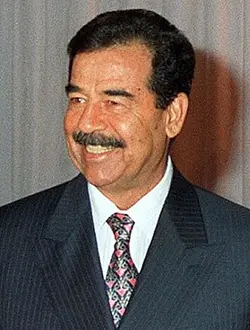
President of Iraq (1979-2003) and leader of the Ba'ath Party
Saddam Hussein ruled Iraq as a single-party Ba'athist state combining Arab nationalism, state-planned socialism with a limited private sector, and personal authoritarian rule. He nationalised oil, promoted women's education and work, fought wars with Iran and Kuwait, and suppressed Kurdish, Shia and party opponents; from 1991-93 his regime moved from secular Ba'athism to a state religious campaign.
Closest ideologies
Based on the 110 statements where Saddam Hussein has a known position.
- Saddamism (90% match)
- Ethnocacerism (84% match)
- Eurasianism (84% match)
- Pahlavism (84% match)
- German nationalism (83% match)
Similar people
- Chiang Kai-shek (86% alike)
- Bashar al-Assad (86% alike)
- Vladislav Surkov (84% alike)
- Alexander I of Yugoslavia (83% alike)
- Oliver Cromwell (83% alike)
Known positions
- Strongly: A state may force a minority it sees as hostile to leave the country.
- Strongly: People of other ethnic groups should be made to leave the country.
- Strongly: The governing party's own leadership should control the armed forces.
- Strongly: One ideologically correct party should hold state leadership without competing parties having a right to replace it.
- Strongly: The state should encourage people of the majority group to move into areas where minority groups are in the majority.
- Strongly: The government should stop its political opponents from organising, speaking or competing for power.
- Strongly: A powerful country should bring more land within its borders.
- Strongly: It is acceptable to praise a national leader openly as the one who stands for the whole nation.
- Strongly: Young people should belong to uniformed, drilled organisations that prepare them to serve the nation.
- Strongly: Peoples who share an ethnic heritage, such as the Slavic, Arab or Turkic peoples, should come together in one state, even across present borders.
- Strongly: A country should be ready to use military force abroad on its own judgment, even if the UN Security Council has not authorized it.
- Strongly: The country would benefit from a strong leader with the power to act despite deadlock among its political institutions.
- Strongly: A national emergency sometimes justifies temporarily withdrawing normal legal safeguards against people the government regards as internal enemies, such as protections against detention without trial.
- Strongly: Countries within one civilization should unite politically.
- Strongly: Real authority to command the military should rest with the head of state.
- Strongly: A country should press its neighbour to give back land taken from it in an old war.
- Strongly: The farmers who work large estates should take ownership from the landowners, with the transfer compulsory if owners refuse.
- Strongly: A president should be free to stand for re-election as many times as they like.
- Strongly: My country's military strength should exceed that of its rivals.
- Strongly: Only the state's armed forces and police should have permission to carry weapons.
- Strongly: A country has the right to stop a region becoming independent by using its military.
- Strongly: Speaking a common language is sufficient for people to constitute one nation.
- Strongly: The state should offer public work to anyone who wants a job and cannot find one.
- Strongly: Land stays in the hands of citizens; foreigners may not buy it.
- Strongly: Political power may be concentrated in one body.
- Strongly: Women's subordination is tied to how the economy is organised, so reform of laws and attitudes is not enough.
- Strongly: Allies are bound to defend one another against armed attack.
- Strongly: State schools may teach pupils a religious faith, for example through lessons in its beliefs and practice.
- Strongly: Society should follow a third course beyond capitalism and communism.
- Strongly: The worst crimes can be punished by death.
- Strongly: Ending a marriage should not be possible without proving fault.
- Strongly: The global economic system keeps poorer countries poor by directing their wealth toward richer countries.
- Strongly: Industries such as energy, rail and utilities should be owned by the state or public bodies, not private companies.
- Strongly: The government should be able to require citizens to serve in the military.
- Strongly: Armed forces may sometimes be used for purposes beyond defending the country against attack.
- Strongly: My country should stay neutral and join neither of the opposing great-power alliances.
- Strongly: The government should steer investment into industries it sees as key to the country's future.
- Strongly: Students should pay no tuition to attend public higher education institutions.
- Strongly: A state of their own in the Land of Israel is not something Jews are owed as a people.
- Strongly: Working for wages should remain a normal way for people to earn a living.
- Strongly: Elected politicians should be able to serve any number of terms in any office.
- Strongly: Employers and workers should treat each other as partners whose cooperation comes before conflict, even where their interests differ.
- Strongly: Today's nation is the same people as its ancient and medieval forebears.
- Strongly: Profit made from owning businesses does not come from exploiting the workers who produce it.
- Strongly: People who give their lives for the nation deserve to be remembered as martyrs, with reverence beyond ordinary thanks.
- Strongly: A country may keep a region that wants to leave.
- Strongly: Schools should cultivate patriotic feeling: loyalty to and pride in the nation, expressed for example through respect for its flag and anthem.
- Strongly: A people split by an imposed border should be brought together in a single state.
- Strongly: The state should guarantee health care to everyone, whether it runs the services itself or pays for them.
- Strongly: Trade, finance and debt rules should be changed to give poorer countries a fairer share.
- Strongly: Other forces move history at least as much as conflict between classes does.
- Strongly: Private ownership is legitimate only insofar as it benefits society.
- Strongly: Foreign armies should not be based on the country's territory.
- Strongly: Whatever their circumstances, everyone should be able to count on the state for enough to live decently, through benefits, pensions or public services.
- Strongly: Political violence is sometimes justified.
- Strongly: Religion does not offer illusory comfort for material suffering.
- Strongly: At least some revolutions have been justified.
- Strongly: Keeping a nation's inherited culture alive, including its language, customs and traditions, matters.
- Strongly: Each country should hold ultimate authority over its natural resources, without foreign interests controlling them.
- Strongly: Women should be able to vote and stand for office on the same terms as men.
- Strongly: State schools need not steer pupils away from belief in God.
- Strongly: Final authority over a state's laws need not belong to its most senior religious scholars.
- Leans: The people in power should decide what the country's news media publish.
- Leans: Laws should follow religious texts.
- Leans: An armed minority's actions are capable of bringing about conditions that enable a broader revolutionary uprising.
- Leans: Having a shared national identity does not by itself entitle a people to its own self-governing state.
- Leans: An economy whose production is directed by a central plan is capable of working better than an economy directed by market exchange.
- Leans: My country should give weapons to foreign insurgents fighting governments it regards as enemies.
- Leans: In war, the enemy's civilians are legitimate targets.
- Leans: Consent of the governed is not the only basis of legitimate political authority.
- Leans: The government should have authority over religious institutions' internal affairs.
- Leans: Voters themselves should elect the head of state, without an intermediary body selecting the officeholder.
- Leans: Women should have different military draft obligations from men.
- Leans: A national minority should run its own schools, language and cultural institutions inside the state it lives in.
- Leans: Collective goals can justify treating a person merely as a tool.
- Leans: Settlers from abroad who displace a land's people and found a state there are carrying out colonialism.
- Leans: Government should support building nuclear power plants.
- Leans: Property should belong to many people in small holdings.
- Leans: Trade unions may be subject to state direction of their affairs.
- Leans: Religious values and institutions should shape laws, schools and public life.
- Leans: When national priorities conflict with working together internationally, my country should choose its own priorities.
- Leans: The nation has decayed and must be reborn.
- Leans: Laws, institutions and customs still favor men over women.
- Leans: Areas where an ethnic minority makes up most of the population should be able to run many of their own affairs within the state.
- Leans: Foreign powers sometimes have a right to intervene in a country's internal affairs.
- Leans: Countries that feel dominated by Western powers should band together to resist them.
- Leans: A government should outlaw political parties that aim to do away with its constitutional order.
- Leans: What you owe your community matters more than your personal rights.
- Leans: Public institutions should help minority languages be used in public life, for example through teaching or services in those languages.
- Leans: Defense should not rest with armed ordinary citizens in place of a standing force.
- Leans: Owners' rights to their property need not be protected against being overridden for public goals.
- Leans: Social duty should not take the place of material rewards as the main reason people work.
- Leans: An electorate should choose the head of state, either directly or through elected representatives.
- Leans: Officials decide what gets made and who gets it at least as well as prices and competition do.
- Leans: Workers are better off for having labor unions.
- Leans: Where they conflict, religious faith should count for at least as much as evidence and reasoning.
- Leans: Political institutions developed in the West are not a suitable model for every civilization.
- Leans: A healthy society depends on the traditional family, such as a married mother and father raising their children.
- Leans: National policy should give priority to preventing outside powers from splitting the country territorially.
- Leans: Equality of outcomes should not be society's goal.
- Leans: Member states should keep the final decision on whether to follow UN decisions.
- Leans: World power should be distributed among several independent major powers, without one dominant power.
- Leans: Daughters and widows should inherit and own land on the same terms as sons and husbands.
- Leans: A government needs more than fair elections to be democratic.
- Leans: Individual farms should not give way to joint cultivation by groups of farmers.