Political Ideology Atlas · All people · Take the test
East Asia · born 1887, historical
Chiang Kai-shek
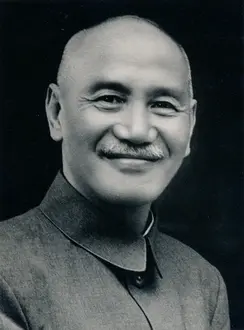
Leader of the Republic of China (1928-1975); Kuomintang leader; president on Taiwan
An authoritarian nationalist and anti-Communist who led the Kuomintang party-state on the mainland and then on Taiwan. He drew on Sun Yat-sen's Three Principles of the People, Confucian virtues and a state-guided planned economy, rejecting both laissez-faire liberalism and Marxist class struggle. He ruled under political tutelage, martial law and emergency provisions while promising eventual constitutional democracy.
Closest ideologies
Based on the 75 statements where Chiang Kai-shek has a known position.
- Person Dignity Theory (88% match)
- German nationalism (88% match)
- Brazilian Integralism (87% match)
- Ilminism (86% match)
- Totalitarian democracy (86% match)
Similar people
- Martin Luther (89% alike)
- Vladimir Putin (89% alike)
- Bashar al-Assad (89% alike)
- Wang Jingwei (87% alike)
- Recep Tayyip Erdoğan (87% alike)
Known positions
- Strongly: One ideologically correct party should hold state leadership without competing parties having a right to replace it.
- Strongly: The government should stop its political opponents from organising, speaking or competing for power.
- Strongly: The country would benefit from a strong leader with the power to act despite deadlock among its political institutions.
- Strongly: A national emergency sometimes justifies temporarily withdrawing normal legal safeguards against people the government regards as internal enemies, such as protections against detention without trial.
- Strongly: A country should press its neighbour to give back land taken from it in an old war.
- Strongly: My country may join a military alliance led by one of the great powers.
- Strongly: Collective goals can justify treating a person merely as a tool.
- Strongly: A president should be free to stand for re-election as many times as they like.
- Strongly: The political goal should be victory over communism ahead of accommodation with it.
- Strongly: A country has the right to stop a region becoming independent by using its military.
- Strongly: Society should follow a third course beyond capitalism and communism.
- Strongly: The worst crimes can be punished by death.
- Strongly: The nation has decayed and must be reborn.
- Strongly: The government should be able to require citizens to serve in the military.
- Strongly: A government should outlaw political parties that aim to do away with its constitutional order.
- Strongly: What you owe your community matters more than your personal rights.
- Strongly: The government should steer investment into industries it sees as key to the country's future.
- Strongly: Employers and workers should treat each other as partners whose cooperation comes before conflict, even where their interests differ.
- Strongly: Society should use modern technology together with revived values inherited from its ancestors.
- Strongly: Today's nation is the same people as its ancient and medieval forebears.
- Strongly: Political institutions developed in the West are not a suitable model for every civilization.
- Strongly: A country may keep a region that wants to leave.
- Strongly: Schools should cultivate patriotic feeling: loyalty to and pride in the nation, expressed for example through respect for its flag and anthem.
- Strongly: National policy should give priority to preventing outside powers from splitting the country territorially.
- Strongly: Society need not promote ways of living that differ from custom.
- Strongly: Constantly seeking additional possessions is harmful overall, despite any benefits it brings.
- Strongly: Being the law gives a rule a moral claim to be obeyed.
- Strongly: Other forces move history at least as much as conflict between classes does.
- Strongly: Grown children owe care to parents who need it.
- Strongly: Economic growth should not be limited for the sake of the environment.
- Strongly: Political violence is sometimes justified.
- Strongly: A people with a shared national identity is entitled to its own self-governing state.
- Strongly: Being powerful does not mean a country should bring more land within its borders.
- Strongly: Looking after your own interests is not a moral good in itself.
- Strongly: At least some revolutions have been justified.
- Strongly: Keeping a nation's inherited culture alive, including its language, customs and traditions, matters.
- Strongly: Industrial society has done at least as much good as harm to humanity.
- Strongly: No society has the right to rule another for its supposed improvement, however advanced it is.
- Strongly: Society needs government of some kind.
- Strongly: Countries should keep their armed forces.
- Strongly: Government should have other tasks besides protecting people from physical violence.
- Strongly: Overseas territories need not be run mainly for the ruling country's economic benefit.
- Leans: Every part of life should be subject to state direction.
- Leans: An economy whose production is directed by a central plan is capable of working better than an economy directed by market exchange.
- Leans: A nation should be mainly one ethnic people.
- Leans: Specialists should have more weight in decisions than public opinion.
- Leans: Government should depend more on leaders setting a good example than on enforcing laws with penalties.
- Leans: Civil servants should be recruited according to their performance in competitive examinations.
- Leans: Cultures do not rank above one another in overall worth.
- Leans: The state should make one language the only common language of government, schooling and public life, limiting the use of others.
- Leans: Public institutions do not need to help minority languages be used in public life.
- Leans: Fewer tariffs and trade barriers make all countries better off over time.
- Leans: Workers' solidarity with their own nation should take priority over solidarity with workers across borders.
- Leans: An assembly elected by the people for that purpose should draft the constitution.
- Leans: Real authority to command the military should rest with the head of state.
- Leans: Democracy is not the best form of government when voters choose badly.
- Leans: Governments should set legal price ceilings on essential foods when supplies are scarce.
- Leans: The farmers who work large estates should take ownership from the landowners, with the transfer compulsory if owners refuse.
- Leans: Property should belong to many people in small holdings.
- Leans: Political power should be split among separate branches and levels that can each limit the others.
- Leans: Production should be organised to provide what people need, instead of being organised around what yields a profit.
- Leans: Industries such as energy, rail and utilities should be owned by the state or public bodies, not private companies.
- Leans: People should want as few material things as possible.
- Leans: After members debate and adopt a party decision, every member should have to help implement it, including those who opposed it.
- Leans: Government should impose strict rules on how corporations operate.
- Leans: An ancestral bond to a land gives a people a claim that outweighs the claims of other peoples who now live there.
- Leans: Elected politicians should be able to serve any number of terms in any office.
- Leans: Owners' rights to their property need not be protected against being overridden for public goals.
- Leans: Officials decide what gets made and who gets it at least as well as prices and competition do.
- Leans: The state may restrict what adults do for reasons other than preventing harm to others.
- Leans: Most people in political office look after themselves first and the public second.
- Leans: A mother country and its colonies may trade with the outside world.