Political Ideology Atlas · All people · Take the test
Europe · born 1871, historical
Rosa Luxemburg
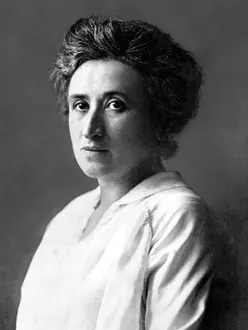
Polish-German Marxist theorist and revolutionary (1871–1919), co-founder of the Spartacus League and German Communist Party
Luxemburg was a revolutionary Marxist who argued that socialism must be won by the working masses' own action through mass strikes and councils, not by gradual reform or by a minority acting for them. She opposed war, militarism and colonialism as products of capitalism, rejected national self-determination as a socialist slogan, and criticised the Bolsheviks' suppression of civil liberties, insisting that freedom is always for the one who thinks differently.
Closest ideologies
Based on the 98 statements where Rosa Luxemburg has a known position.
- Archeio-Marxism (94% match)
- Classical Marxism (93% match)
- Revolutionary socialism (93% match)
- Scientific socialism (92% match)
- Third camp (92% match)
Similar people
- Eugene V. Debs (90% alike)
- Karl Marx (88% alike)
- Hasan Piker (86% alike)
- William Morris (86% alike)
- Antonio Gramsci (85% alike)
Known positions
- Strongly: A workers' state must suppress the old ruling class for a time.
- Strongly: Political power should rest on councils elected in workplaces in place of parliaments.
- Strongly: Having a shared national identity does not by itself entitle a people to its own self-governing state.
- Strongly: An economy whose production is directed by a central plan is capable of working better than an economy directed by market exchange.
- Strongly: History is mainly driven by conflict between economic classes.
- Strongly: Political change should replace the existing administrative and coercive institutions with new forms of organization, rather than put new leaders in charge of the old apparatus.
- Strongly: Socialism in a single country will not endure without successful socialist revolutions in other countries.
- Strongly: Historical change comes mainly from changes in how society produces and exchanges goods.
- Strongly: Laws, police and government mainly serve the interests of whoever owns the economy and holds power.
- Strongly: Wars between great powers are an unavoidable consequence of capitalism.
- Strongly: Owners' profit is value taken from workers' labor.
- Strongly: Cooperation between employers and workers should not come before conflict where their interests differ.
- Strongly: Defense should rest with armed ordinary citizens, not a standing force.
- Strongly: Those who elected someone should be able to remove them before their term ends, whenever they choose.
- Strongly: Workers should form a party of their own, separate from the parties already in place.
- Strongly: Government should maintain a strict institutional separation from religion.
- Strongly: Working together internationally should count at least as much as my country's own priorities.
- Strongly: Society does not need a third course beyond capitalism and communism.
- Strongly: Religious values and institutions should not have a major part in shaping laws, schools and public life.
- Strongly: Employees should have voting rights in the management of large companies.
- Strongly: Political power may be concentrated in one body.
- Strongly: Property need not be spread among many small owners.
- Strongly: Businesses should belong to the people who work in them, for example as cooperatives.
- Strongly: A general collapse of capitalism is unavoidable.
- Strongly: What things are worth comes from the work put into them.
- Strongly: High earners and the very rich should pay tax at a much higher rate than everyone else.
- Strongly: Production should be organised to provide what people need, instead of being organised around what yields a profit.
- Strongly: People outside state forces should also be allowed to bear arms.
- Strongly: Industries such as energy, rail and utilities should be owned by the state or public bodies, not private companies.
- Strongly: My country may keep a military no stronger than its rivals'.
- Strongly: Cultural life inside a state should not be placed under the control of each national minority.
- Strongly: Without workers' own political power, state ownership is not socialism.
- Strongly: Society may be changed in large, rapid steps.
- Strongly: Workers' solidarity with workers in other countries should count at least as much as solidarity with their own nation.
- Strongly: Public institutions should help minority languages be used in public life, for example through teaching or services in those languages.
- Strongly: Ordinary legal protections, such as the right not to be held without trial, should stay in force even in a national emergency.
- Strongly: Voters should be able to remove elected officials before their terms end.
- Strongly: A country can get through deadlock among its institutions without a leader who overrides them.
- Strongly: The state should not make one language the only common language of government, schooling and public life at the cost of limiting others.
- Strongly: Firms in a market economy need not be owned by the people who work in them.
- Strongly: Owners' rights to their property need not be protected against being overridden for public goals.
- Strongly: An electorate should choose the head of state, either directly or through elected representatives.
- Strongly: Officials decide what gets made and who gets it at least as well as prices and competition do.
- Strongly: People should have a direct role in making decisions where they work, live and study, rather than having those decisions made entirely for them.
- Strongly: In law, a country's traditional national church should rank no higher than other religious bodies.
- Strongly: A country may keep a region that wants to leave.
- Strongly: A country may keep all its decisions in its own hands rather than pooling them with other nations.
- Strongly: Nobody should hold a special rank by birth, such as a noble title, a hereditary crown or a caste position, or the special rights attached to one.
- Strongly: People may live and work outside communities that own their property together.
- Strongly: Even a purely ceremonial head of state should not hold the position by birth.
- Strongly: The law should not assign different roles in public life on the basis of sex.
- Strongly: War does not strengthen a nation's character.
- Strongly: Political violence is sometimes justified.
- Strongly: Income from useful work should be rewarded ahead of income from merely owning property.
- Strongly: Being powerful does not mean a country should bring more land within its borders.
- Strongly: The government should let its political opponents organise, speak and compete for power.
- Strongly: Protecting the constitution should be left to civilian institutions, not the armed forces.
- Strongly: The law should treat everyone as an equal, whatever their birth, sex, race or status.
- Strongly: Being the first to use force can be right, depending on what it is meant to achieve.
- Strongly: Someone who actually governs a state should not hand that power on to their own child.
- Strongly: An armed minority's actions are incapable of bringing about the conditions for a broader revolutionary uprising.
- Strongly: Looking after your own interests is not a moral good in itself.
- Strongly: At least some revolutions have been justified.
- Strongly: News media should decide for themselves what they publish, whoever holds power.
- Strongly: No party's ideology should give it an exclusive right to lead the state.
- Strongly: Small, informal, trust-based groups should not take the place of lasting parties, unions and federations in political action.
- Strongly: Publicly insulting a religion's sacred beliefs should be left outside the criminal law.
- Strongly: Some areas of life should remain outside state direction.
- Strongly: No society has the right to rule another for its supposed improvement, however advanced it is.
- Strongly: Women should be able to vote and stand for office on the same terms as men.
- Strongly: Government should have other tasks besides protecting people from physical violence.
- Strongly: Killing another person can be right in self-defence or in defence of others.
- Strongly: Overseas territories need not be run mainly for the ruling country's economic benefit.
- Strongly: People without property should also have the right to vote.
- Strongly: State schools need not steer pupils away from belief in God.
- Leans: A state whose economy is publicly owned and planned should be defended against a return to capitalism even if a bureaucracy rules it.
- Leans: Religion gives people a false consolation for hardship in their material lives.
- Leans: Farming should be organized as joint cultivation by groups of farmers instead of separate individual farm operations.
- Leans: People should work mainly out of responsibility to society and a shared purpose, with personal material rewards playing a secondary role.
- Leans: Delegates selected by councils at one level should select officeholders at higher levels.
- Leans: Women's subordination is tied to how the economy is organised, so reform of laws and attitudes is not enough.
- Leans: The global economic system keeps poorer countries poor by directing their wealth toward richer countries.
- Leans: Areas where an ethnic minority makes up most of the population should be able to run many of their own affairs within the state.
- Leans: Democracy is best even when voters make poor choices.
- Leans: The economy should not combine mainly private markets with government support for people who cannot meet their basic needs.
- Leans: You can't reach a free, fair society by unfree or unfair means.
- Leans: Workers are better off for having labor unions.
- Leans: Countries should keep their armed forces.
- Leans: Political independence means little unless the economic and property system is also transformed.
- Leans: Rulers have a right to rule only because the people they rule have agreed to it.
- Leans: Workers do not need a disciplined revolutionary party to lead them.