Political Ideology Atlas · All people · Take the test
Europe · born 1818, historical
Karl Marx
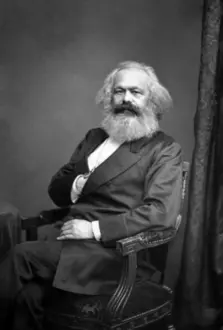
German philosopher, economist and revolutionary socialist (1818-1883)
A German philosopher, economist and journalist who held that history is driven by class struggle rooted in how society produces goods, and that capitalism rests on the exploitation of wage labour. He argued for the revolutionary overthrow of bourgeois rule, a transitional dictatorship of the proletariat, and common ownership of the means of production, leading eventually to a classless society, and he thought peaceful routes were possible in a few countries such as Britain and the United States.
Closest ideologies
Based on the 150 statements where Karl Marx has a known position.
- Marxism (95% match)
- Scientific socialism (93% match)
- Structural Marxism (92% match)
- Dictatorship of the proletariat (92% match)
- Classical Marxism (89% match)
Similar people
- Friedrich Engels (92% alike)
- Rosa Luxemburg (88% alike)
- Antonio Gramsci (88% alike)
- Leon Trotsky (87% alike)
- Nikolai Bukharin (87% alike)
Known positions
- Strongly: A workers' state must suppress the old ruling class for a time.
- Strongly: Eventually people should produce and share without money.
- Strongly: Work should no longer be divided into separate specialized jobs held by different people.
- Strongly: Religion gives people a false consolation for hardship in their material lives.
- Strongly: Farming should be organized as joint cultivation by groups of farmers instead of separate individual farm operations.
- Strongly: All land should be owned by the state.
- Strongly: An economy whose production is directed by a central plan is capable of working better than an economy directed by market exchange.
- Strongly: History is mainly driven by conflict between economic classes.
- Strongly: Political change should replace the existing administrative and coercive institutions with new forms of organization, rather than put new leaders in charge of the old apparatus.
- Strongly: Socialism in a single country will not endure without successful socialist revolutions in other countries.
- Strongly: Historical change comes mainly from changes in how society produces and exchanges goods.
- Strongly: A healthy society does not depend on the traditional family, such as a married mother and father raising their children.
- Strongly: Laws, police and government mainly serve the interests of whoever owns the economy and holds power.
- Strongly: Owners' profit is value taken from workers' labor.
- Strongly: In the society we should aim for, a person's needs should determine their share of goods.
- Strongly: Cooperation between employers and workers should not come before conflict where their interests differ.
- Strongly: Defense should rest with armed ordinary citizens, not a standing force.
- Strongly: Those who elected someone should be able to remove them before their term ends, whenever they choose.
- Strongly: The system in which people work for wages for an employer should be ended.
- Strongly: No moral truths hold across all cultures.
- Strongly: Capitalist exchange makes people's economic relationships look like relationships among the goods they trade.
- Strongly: Workers should form a party of their own, separate from the parties already in place.
- Strongly: Those who inherit a large fortune should hand over a big share of it in tax.
- Strongly: Delegates selected by councils at one level should select officeholders at higher levels.
- Strongly: Government should maintain a strict institutional separation from religion.
- Strongly: The state should be barred from executing people convicted of the gravest crimes, such as terrorism.
- Strongly: Working together internationally should count at least as much as my country's own priorities.
- Strongly: Society does not need a third course beyond capitalism and communism.
- Strongly: Politics should give compromises among competing groups at least as much weight as a single common good identified by reasoning.
- Strongly: Religious values and institutions should not have a major part in shaping laws, schools and public life.
- Strongly: State schools should not teach religion.
- Strongly: Living in a city does at least as much for a person's moral wellbeing as living in the countryside.
- Strongly: Wage work cuts people off from the meaning and creativity of what they make.
- Strongly: Those who hold public office should be paid no more than an average worker.
- Strongly: Property need not be spread among many small owners.
- Strongly: Businesses should belong to the people who work in them, for example as cooperatives.
- Strongly: Having wealth does not by itself create a duty to help those who are worse off.
- Strongly: A general collapse of capitalism is unavoidable.
- Strongly: What things are worth comes from the work put into them.
- Strongly: High earners and the very rich should pay tax at a much higher rate than everyone else.
- Strongly: Agreements between competing firms, price-fixing included, need not be outlawed.
- Strongly: Production should be organised to provide what people need, instead of being organised around what yields a profit.
- Strongly: Industries such as energy, rail and utilities should be owned by the state or public bodies, not private companies.
- Strongly: Defeating communism should not take priority over coexistence with it.
- Strongly: Capitalism built the productive power and wealth that later and better societies rest on.
- Strongly: The economy should not combine mainly private markets with government support for people who cannot meet their basic needs.
- Strongly: Without workers' own political power, state ownership is not socialism.
- Strongly: The government should steer investment into industries it sees as key to the country's future.
- Strongly: Workers' solidarity with workers in other countries should count at least as much as solidarity with their own nation.
- Strongly: Free trade does not benefit everyone in the long run.
- Strongly: Voters should be able to remove elected officials before their terms end.
- Strongly: Purchases of basic necessities should carry no consumption tax.
- Strongly: Firms in a market economy need not be owned by the people who work in them.
- Strongly: How someone turns out is shaped more by upbringing, society and experience than by the traits they are born with.
- Strongly: Owners' rights to their property need not be protected against being overridden for public goals.
- Strongly: Officials decide what gets made and who gets it at least as well as prices and competition do.
- Strongly: In law, a country's traditional national church should rank no higher than other religious bodies.
- Strongly: Politics is not best understood as a contest between spiritual good and evil.
- Strongly: People may live and work outside communities that own their property together.
- Strongly: No one is better suited by nature to govern than anyone else.
- Strongly: The American Civil War arose mainly from slavery.
- Strongly: Restoring a lost social order does not matter more than pursuing progress.
- Strongly: Even a purely ceremonial head of state should not hold the position by birth.
- Strongly: Income-tax percentages may differ between income levels.
- Strongly: At most half of workers in wealthy countries benefit from the exploitation of poorer countries.
- Strongly: Political violence is sometimes justified.
- Strongly: Income from useful work should be rewarded ahead of income from merely owning property.
- Strongly: Naturalized citizens may hold public office as well as people born in the country.
- Strongly: A mother country and its colonies may trade with the outside world.
- Strongly: In an economy with common ownership of productive assets, people should still own their personal belongings.
- Strongly: An armed minority's actions are incapable of bringing about the conditions for a broader revolutionary uprising.
- Strongly: Laws should not be required to follow religious texts.
- Strongly: Local community ownership of the means of production should not replace private or state ownership.
- Strongly: At least some revolutions have been justified.
- Strongly: News media should decide for themselves what they publish, whoever holds power.
- Strongly: Small, informal, trust-based groups should not take the place of lasting parties, unions and federations in political action.
- Strongly: Central banks should keep a role in controlling the money supply.
- Strongly: Population growth does not mainly drive lasting poverty.
- Strongly: Some areas of life should remain outside state direction.
- Strongly: Government should have other tasks besides protecting people from physical violence.
- Strongly: Collecting taxes does not in itself amount to stealing people's money.
- Strongly: Overseas territories need not be run mainly for the ruling country's economic benefit.
- Strongly: Taking part in politics is at least as good a way to live as living privately away from public affairs.
- Strongly: People without property should also have the right to vote.
- Strongly: State schools need not steer pupils away from belief in God.
- Strongly: Farmers should have the legal freedom to leave the estates they work.
- Leans: People should lose their right to a plot of land when they no longer use it.
- Leans: Serving the nation does not mean serving its working people.
- Leans: A region should be entitled to leave its current country.
- Leans: Where they conflict, evidence and reasoning should count for more than faith, God, revelation or scripture.
- Leans: Wars between great powers are an unavoidable consequence of capitalism.
- Leans: At least some public monuments to widely condemned historical figures should be removed from public display.
- Leans: Having a human nature in common is not what gives people their rights.
- Leans: Public higher education should not be universally tuition-free.
- Leans: A country has the right to stop a region becoming independent by using its military.
- Leans: The state should offer public work to anyone who wants a job and cannot find one.
- Leans: Employees should have voting rights in the management of large companies.
- Leans: Political power may be concentrated in one body.
- Leans: Women's subordination is tied to how the economy is organised, so reform of laws and attitudes is not enough.
- Leans: Creating new money should be reserved to public institutions, excluding private banks' creation of money through lending.
- Leans: The ruling class stays in power mainly through people going along with its ideas.
- Leans: Tariffs should not be used to protect domestic industry from foreign competition.
- Leans: Full-time work at the legal wage floor should pay enough to meet basic living costs.
- Leans: The global economic system keeps poorer countries poor by directing their wealth toward richer countries.
- Leans: Laws, institutions and customs still favor men over women.
- Leans: People outside state forces should also be allowed to bear arms.
- Leans: The government should be able to require citizens to serve in the military.
- Leans: Large landed estates should not be compulsorily transferred to the people who farm them.
- Leans: Democracy is best even when voters make poor choices.
- Leans: Automation should be directed towards making the time people need to spend working as short as feasible.
- Leans: Workers' pay should be settled in collective bargaining between their union and their employer.
- Leans: Government should impose strict rules on how corporations operate.
- Leans: Most of government should be funded by taxes other than a tax on the value of land.
- Leans: Direct action does not have to take the place of elections and parliament as the way to achieve political change.
- Leans: Some cultures are superior to others.
- Leans: Owning a gun should not face strict legal limits.
- Leans: An electorate should choose the head of state, either directly or through elected representatives.
- Leans: Workers are better off for having labor unions.
- Leans: People should have a direct role in making decisions where they work, live and study, rather than having those decisions made entirely for them.
- Leans: Being free requires having the practical resources to act on one's choices, such as an adequate livelihood.
- Leans: Private charity does not help people in poverty better than government programs do.
- Leans: Political independence means little unless the economic and property system is also transformed.
- Leans: Nobody should hold a special rank by birth, such as a noble title, a hereditary crown or a caste position, or the special rights attached to one.
- Leans: A people split by an imposed border should be brought together in a single state.
- Leans: Profit-making banks should not be replaced by user-owned banks charging only the costs of running the service.
- Leans: Spouses should make marital decisions as equals.
- Leans: The state should guarantee health care to everyone, whether it runs the services itself or pays for them.
- Leans: Industrial society has done at least as much good as harm to humanity.
- Leans: Other things drive humanity forward at least as much as rivalry and conflict between peoples.
- Leans: Local communities should not tie their joint councils to merely carrying out what local assemblies decide.
- Leans: Art should not be censored for its effect on people's moral character.
- Leans: Most people in political office look after themselves first and the public second.
- Leans: Very large concentrations of wealth threaten a free society.
- Leans: Economic growth should not be limited for the sake of the environment.
- Leans: Whatever their circumstances, everyone should be able to count on the state for enough to live decently, through benefits, pensions or public services.
- Leans: Looking after your own interests is not a moral good in itself.
- Leans: A people with a shared national identity is entitled to its own self-governing state.
- Leans: Being powerful does not mean a country should bring more land within its borders.
- Leans: Businesses gain too much influence over government policy from their lobbying.
- Leans: The law should treat everyone as an equal, whatever their birth, sex, race or status.