Political Ideology Atlas · All people · Take the test
Europe · born 1937, historical
Harald V of Norway
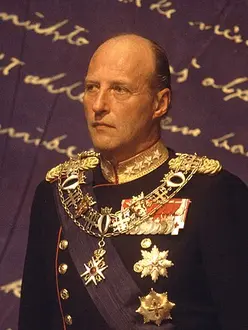
King of Norway (1991–2026)
Harald V reigned as a constitutional monarch and kept to the convention that he does not take party positions; his own speeches stress trust, community, democracy and the equal worth of all people. In his New Year's addresses and in his 2016 garden-party speech he welcomed diversity of origin, religion and sexual orientation, urged action on climate and the environment, and backed international cooperation and fairer sharing of goods. In 1997 he apologised on behalf of the state for the Norwegianisation of the Sami, and he spoke of reconciliation and Sami language rights later in his reign. Laws, throne speeches and other formal acts made on the government's advice are not counted as his positions.
Closest ideologies
Based on the 46 statements where Harald V of Norway has a known position.
- Social Liberalism (91% match)
- Christian humanism (91% match)
- Popolarismo (90% match)
- Nordic Social Democracy (90% match)
- Cultural Zionism (90% match)
Similar people
- Juan Carlos I of Spain (93% alike)
- Robert F. Kennedy (91% alike)
- Angela Merkel (91% alike)
- Václav Havel (90% alike)
- Michael Bloomberg (90% alike)
Known positions
- Strongly: It is acceptable for a monarch who inherits the throne to be the country's symbolic head while others govern.
- Strongly: The head of state should not have to be chosen by election.
- Strongly: The nation's figurehead should be non-partisan and belong to everyone.
- Strongly: Distance and nationality do not weaken the duty of the rich to help the poor abroad.
- Strongly: Democracy is best even when voters make poor choices.
- Strongly: Public institutions should help minority languages be used in public life, for example through teaching or services in those languages.
- Strongly: Nature matters for its own sake, not only because it is useful to people.
- Strongly: The state should not make one language the only common language of government, schooling and public life at the cost of limiting others.
- Strongly: A nation does not need one main ethnic group: it can be made up of people of many ancestries.
- Strongly: Rulers have a right to rule only because the people they rule have agreed to it.
- Strongly: The government should let its political opponents organise, speak and compete for power.
- Strongly: The law should treat everyone as an equal, whatever their birth, sex, race or status.
- Strongly: Belonging to the nation does not go with sharing its religion.
- Strongly: News media should decide for themselves what they publish, whoever holds power.
- Strongly: We have a duty to leave the planet in good condition for those who come after us.
- Strongly: People of different races should not be discouraged from forming a family together, including through marriage and children.
- Strongly: Women should be able to vote and stand for office on the same terms as men.
- Strongly: Adults may marry across religions without legal restriction.
- Strongly: The ruler should be subject to the country's laws.
- Strongly: Public spaces such as schools and facilities should not be separated by race under the law.
- Strongly: The Holocaust happened as historians describe it.
- Leans: People should be encouraged to live in ways that differ from social custom.
- Leans: International criminal courts should try political leaders responsible for atrocities such as genocide, crimes against humanity and war crimes.
- Leans: The representative legislature should have the final say on legislation.
- Leans: Changes to society should be introduced a little at a time.
- Leans: A national minority should run its own schools, language and cultural institutions inside the state it lives in.
- Leans: Working together internationally should count at least as much as my country's own priorities.
- Leans: Lack of full certainty is no reason to delay protective action.
- Leans: Government should be bound by written guarantees of basic rights protected against easy amendment by ordinary majorities.
- Leans: Religious values and institutions should shape laws, schools and public life.
- Leans: Some institutional ties between government and religion are acceptable.
- Leans: People able to work should get welfare benefits only in return for some work, such as a job or a work scheme.
- Leans: People should want as few material things as possible.
- Leans: Society should take active steps to make up for the harm done by past racial injustices.
- Leans: Immigrants should not be expected to replace their original culture with the national culture.
- Leans: Ordinary legal protections, such as the right not to be held without trial, should stay in force even in a national emergency.
- Leans: Some things are right or wrong for everyone, in every culture and era.
- Leans: Hate speech should be legal.
- Leans: Ethnic diversity does not weaken a society's ability to hold together.
- Leans: People should have a direct role in making decisions where they work, live and study, rather than having those decisions made entirely for them.
- Leans: Meeting poor people's needs should be the first consideration in public policy.
- Leans: Constantly seeking additional possessions is harmful overall, despite any benefits it brings.
- Leans: Public institutions should have the power to constrain a national majority's decisions in a liberal democracy.
- Leans: Restoring a lost social order does not matter more than pursuing progress.
- Leans: Keeping a nation's inherited culture alive, including its language, customs and traditions, matters.
- Leans: Islam is compatible with Western values.