Political Ideology Atlas · All people · Take the test
East Asia · born 1941, historical
Kim Jong-il
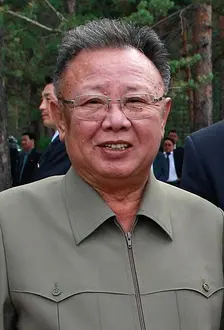
Supreme Leader of North Korea (1994–2011); General Secretary of the Workers' Party of Korea (1997–2011); chairman of the National Defence Commission (1993–2011)
Kim Jong-il led North Korea's one-party state in the name of the Juche idea, a socialism centred on a supreme leader, the party and national self-reliance. He defended state ownership, central planning and party control of ideology and media, rejected market economy and multi-party democracy, and made the military the centre of state policy (Songun). He pursued independent reunification of Korea, opposed foreign troops and 'globalization', and built a nuclear deterrent.
Closest ideologies
Based on the 75 statements where Kim Jong-il has a known position.
- Songun (89% match)
- Neo-Ba'athism (89% match)
- Juche (88% match)
- Guided democracy (86% match)
- National Bolshevism (NazBol) (86% match)
Similar people
- Ibrahim Traoré (87% alike)
- Kim Jong-un (85% alike)
- Pol Pot (83% alike)
- Chiang Kai-shek (83% alike)
- Reza Shah (83% alike)
Known positions
- Strongly: A workers' state must suppress the old ruling class for a time.
- Strongly: Every part of life should be subject to state direction.
- Strongly: The governing party's own leadership should control the armed forces.
- Strongly: A state whose economy is publicly owned and planned should be defended against a return to capitalism even if a bureaucracy rules it.
- Strongly: One ideologically correct party should hold state leadership without competing parties having a right to replace it.
- Strongly: The people in power should decide what the country's news media publish.
- Strongly: Workers require political leadership from a tightly organised revolutionary party.
- Strongly: Someone who actually governs a state may hand that power on to their own child, whether as a king or as a republic's leader.
- Strongly: Farming should be organized as joint cultivation by groups of farmers instead of separate individual farm operations.
- Strongly: A socialist state with hostile countries all around it should work to make its state power stronger.
- Strongly: The government should stop its political opponents from organising, speaking or competing for power.
- Strongly: An economy whose production is directed by a central plan is capable of working better than an economy directed by market exchange.
- Strongly: My country should possess its own nuclear arsenal with independent authority over its use.
- Strongly: It is acceptable to praise a national leader openly as the one who stands for the whole nation.
- Strongly: A nation should be mainly one ethnic people.
- Strongly: Laws, police and government mainly serve the interests of whoever owns the economy and holds power.
- Strongly: Owners' profit is value taken from workers' labor.
- Strongly: The country would benefit from a strong leader with the power to act despite deadlock among its political institutions.
- Strongly: Countries that had colonies should compensate the countries they colonized.
- Strongly: Workers' solidarity with their own nation should take priority over solidarity with workers across borders.
- Strongly: Society does not need a third course beyond capitalism and communism.
- Strongly: Property need not be spread among many small owners.
- Strongly: Trade unions may be subject to state direction of their affairs.
- Strongly: A general collapse of capitalism is unavoidable.
- Strongly: A country with nuclear weapons should keep them for as long as its rivals retain theirs.
- Strongly: Communist one-party states should not receive the same condemnation as fascist states.
- Strongly: Industries such as energy, rail and utilities should be owned by the state or public bodies, not private companies.
- Strongly: Countries that feel dominated by Western powers should band together to resist them.
- Strongly: Defeating communism should not take priority over coexistence with it.
- Strongly: Whether a policy fits an ideology should count independently of its results.
- Strongly: Without workers' own political power, state ownership is not socialism.
- Strongly: Joining a larger state should leave a region free to keep its existing economic arrangements.
- Strongly: Formal press freedom is hollow when wealth decides who can actually be heard.
- Strongly: What you owe your community matters more than your personal rights.
- Strongly: The government should steer investment into industries it sees as key to the country's future.
- Strongly: After members debate and adopt a party decision, every member should have to help implement it, including those who opposed it.
- Strongly: A poor country should develop mainly with its own resources.
- Strongly: Students should pay no tuition to attend public higher education institutions.
- Strongly: Each country's communist party should decide its strategy for socialism without taking orders from another country's party.
- Strongly: Owners' rights to their property need not be protected against being overridden for public goals.
- Strongly: Today's nation is the same people as its ancient and medieval forebears.
- Strongly: Officials decide what gets made and who gets it at least as well as prices and competition do.
- Strongly: Schools should cultivate patriotic feeling: loyalty to and pride in the nation, expressed for example through respect for its flag and anthem.
- Strongly: The nation's cause and the cause of its ordinary working people are one and the same.
- Strongly: A people split by an imposed border should be brought together in a single state.
- Strongly: Historical change does not come mainly from changes in how society produces and exchanges goods.
- Strongly: Governments are under no obligation to fund media that decide their own editorial content.
- Strongly: The state should guarantee health care to everyone, whether it runs the services itself or pays for them.
- Strongly: Equality of outcomes should not be society's goal.
- Strongly: Foreign armies should not be based on the country's territory.
- Strongly: Whatever their circumstances, everyone should be able to count on the state for enough to live decently, through benefits, pensions or public services.
- Strongly: Political violence is sometimes justified.
- Strongly: Income from useful work should be rewarded ahead of income from merely owning property.
- Strongly: A people with a shared national identity is entitled to its own self-governing state.
- Strongly: Businesses gain too much influence over government policy from their lobbying.
- Strongly: A government needs more than fair elections to be democratic.
- Strongly: Looking after your own interests is not a moral good in itself.
- Strongly: At least some revolutions have been justified.
- Strongly: Keeping a nation's inherited culture alive, including its language, customs and traditions, matters.
- Strongly: No society has the right to rule another for its supposed improvement, however advanced it is.
- Strongly: A market economy is incompatible with socialism under communist-party leadership.
- Strongly: Police forces should continue to exist.
- Strongly: Society needs government of some kind.
- Strongly: Countries should keep their armed forces.
- Strongly: Overseas territories need not be run mainly for the ruling country's economic benefit.
- Strongly: A weaker state need not formally treat a stronger power as its superior.
- Strongly: Museums, libraries and other inherited culture should not be destroyed, even when they stand in the way of new creation.
- Leans: The military should have a political role in protecting the constitution and public order, stepping in when they are threatened.
- Leans: People should work mainly out of responsibility to society and a shared purpose, with personal material rewards playing a secondary role.
- Leans: Democracy is not the best form of government when voters choose badly.
- Leans: Outside governments have no entitlement to interfere in another country's internal affairs for any purpose.
- Leans: When national priorities conflict with working together internationally, my country should choose its own priorities.
- Leans: Free trade does not benefit everyone in the long run.
- Leans: Lasting socialism in one country does not require socialist revolutions abroad.
- Leans: Other forces move history at least as much as conflict between classes does.