Political Ideology Atlas · All people · Take the test
Middle East & North Africa · born 1878, historical
Reza Shah
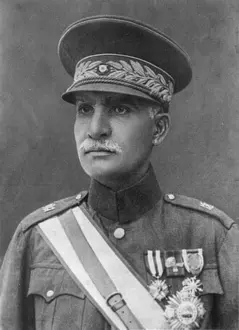
Shah of Iran (1925–1941); earlier army commander and prime minister
Reza Shah pursued centralized royal authority, military consolidation and state-led modernization. He promoted Persian national culture and curtailed clerical authority, while suppressing political opposition and imposing social reforms through coercion.
Closest ideologies
Based on the 41 statements where Reza Shah has a known position.
- Technocracy movement (92% match)
- Pahlavism (89% match)
- Assadism (89% match)
- Guided democracy (88% match)
- Mobutism (88% match)
Similar people
- Jean-Jacques Dessalines (88% alike)
- Ibrahim Traoré (86% alike)
- Vladislav Surkov (83% alike)
- Kim Jong-il (83% alike)
- Mustafa Kemal Atatürk (82% alike)
Known positions
- Strongly: The people in power should decide what the country's news media publish.
- Strongly: Someone who actually governs a state may hand that power on to their own child, whether as a king or as a republic's leader.
- Strongly: The government should stop its political opponents from organising, speaking or competing for power.
- Strongly: Rulers are not bound to act only under lasting, publicly known laws administered by recognised courts.
- Strongly: The government should have authority over religious institutions' internal affairs.
- Strongly: The head of state should not have to be chosen by election.
- Strongly: State institutions should not let staff and pupils wear visible religious dress.
- Strongly: The state should make one language the only common language of government, schooling and public life, limiting the use of others.
- Strongly: The country would benefit from a strong leader with the power to act despite deadlock among its political institutions.
- Strongly: Public institutions do not need to help minority languages be used in public life.
- Strongly: Real authority to command the military should rest with the head of state.
- Strongly: Democracy is not the best form of government when voters choose badly.
- Strongly: Many political decisions should rest with national or wider authorities, even where a smaller community could handle them.
- Strongly: Areas where an ethnic minority is the majority may be governed in the same way as the rest of the state.
- Strongly: Only the state's armed forces and police should have permission to carry weapons.
- Strongly: Government should maintain a strict institutional separation from religion.
- Strongly: A country has the right to stop a region becoming independent by using its military.
- Strongly: Governments should limit how money and investment can be moved across borders.
- Strongly: Political power may be concentrated in one body.
- Strongly: Industries such as energy, rail and utilities should be owned by the state or public bodies, not private companies.
- Strongly: The government should be able to require citizens to serve in the military.
- Strongly: My country should stay neutral and join neither of the opposing great-power alliances.
- Strongly: The government should steer investment into industries it sees as key to the country's future.
- Strongly: Religious minorities should not be exempt from general laws that burden their practice.
- Strongly: Another body may have the final say over what the legislature passes.
- Strongly: Owners' rights to their property need not be protected against being overridden for public goals.
- Strongly: Each country should hold ultimate authority over its natural resources, without foreign interests controlling them.
- Strongly: Killing another person can be right in self-defence or in defence of others.
- Strongly: Women may go out in public without any legal duty to cover fully.
- Strongly: Final authority over a state's laws need not belong to its most senior religious scholars.
- Leans: Foreign loanwords should be removed from the national language and replaced with native words.
- Leans: A national emergency sometimes justifies temporarily withdrawing normal legal safeguards against people the government regards as internal enemies, such as protections against detention without trial.
- Leans: Religious values and institutions should not have a major part in shaping laws, schools and public life.
- Leans: Creating new money should be reserved to public institutions, excluding private banks' creation of money through lending.
- Leans: A poor country should develop mainly with its own resources.
- Leans: Society should use modern technology together with revived values inherited from its ancestors.
- Leans: Officials decide what gets made and who gets it at least as well as prices and competition do.
- Leans: Keeping a nation's inherited culture alive, including its language, customs and traditions, matters.
- Leans: A people's connection to its ancestral land is spiritual, beyond practical interests or ordinary affection.