Political Ideology Atlas · All people · Take the test
East Asia · born 1984
Kim Jong-un
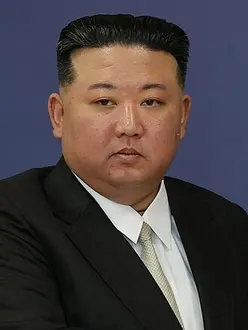
Supreme leader of North Korea (2011–present); General Secretary of the Workers' Party of Korea and President of State Affairs
Kim Jong-un leads a one-party state that he describes as 'own-style socialism' built on self-reliance, state-planned economic management and a monolithic Party leadership. He has made nuclear weapons permanent policy, aligned with Russia and China, and in 2024 abandoned reunification, naming South Korea the principal enemy.
Closest ideologies
Based on the 67 statements where Kim Jong-un has a known position.
- National Communism (89% match)
- National communism in Romania (88% match)
- Neo-Ba'athism (87% match)
- Songun (87% match)
- Syrian nationalism (87% match)
Similar people
- Nicolae Ceaușescu (88% alike)
- Kim Jong-il (85% alike)
- Ibrahim Traoré (84% alike)
- Kim Il-sung (83% alike)
- Joseph Stalin (83% alike)
Known positions
- Strongly: Every part of life should be subject to state direction.
- Strongly: The governing party's own leadership should control the armed forces.
- Strongly: A state whose economy is publicly owned and planned should be defended against a return to capitalism even if a bureaucracy rules it.
- Strongly: One ideologically correct party should hold state leadership without competing parties having a right to replace it.
- Strongly: The people in power should decide what the country's news media publish.
- Strongly: Workers require political leadership from a tightly organised revolutionary party.
- Strongly: Someone who actually governs a state may hand that power on to their own child, whether as a king or as a republic's leader.
- Strongly: A socialist state with hostile countries all around it should work to make its state power stronger.
- Strongly: The government should stop its political opponents from organising, speaking or competing for power.
- Strongly: An economy whose production is directed by a central plan is capable of working better than an economy directed by market exchange.
- Strongly: My country should possess its own nuclear arsenal with independent authority over its use.
- Strongly: It is acceptable to praise a national leader openly as the one who stands for the whole nation.
- Strongly: Young people should belong to uniformed, drilled organisations that prepare them to serve the nation.
- Strongly: A people divided by an imposed border may remain in separate states.
- Strongly: The country would benefit from a strong leader with the power to act despite deadlock among its political institutions.
- Strongly: Real authority to command the military should rest with the head of state.
- Strongly: My country may join a military alliance led by one of the great powers.
- Strongly: My country's military strength should exceed that of its rivals.
- Strongly: Society does not need a third course beyond capitalism and communism.
- Strongly: A country should seek closer ties with China than with the United States.
- Strongly: Political power may be concentrated in one body.
- Strongly: Armaments need not be limited to the minimum needed for national safety.
- Strongly: Allies are bound to defend one another against armed attack.
- Strongly: Trade unions may be subject to state direction of their affairs.
- Strongly: A country with nuclear weapons should keep them for as long as its rivals retain theirs.
- Strongly: When national priorities conflict with working together internationally, my country should choose its own priorities.
- Strongly: Industries such as energy, rail and utilities should be owned by the state or public bodies, not private companies.
- Strongly: Countries that feel dominated by Western powers should band together to resist them.
- Strongly: Defeating communism should not take priority over coexistence with it.
- Strongly: What you owe your community matters more than your personal rights.
- Strongly: The government should steer investment into industries it sees as key to the country's future.
- Strongly: A country may join permanent military alliances.
- Strongly: After members debate and adopt a party decision, every member should have to help implement it, including those who opposed it.
- Strongly: A poor country should develop mainly with its own resources.
- Strongly: Publicly funded services such as hospitals and schools should not be run by private companies and charities.
- Strongly: Each country's communist party should decide its strategy for socialism without taking orders from another country's party.
- Strongly: Basic local services, such as water, hospitals and local transport, should be publicly owned and run.
- Strongly: Officials decide what gets made and who gets it at least as well as prices and competition do.
- Strongly: People who give their lives for the nation deserve to be remembered as martyrs, with reverence beyond ordinary thanks.
- Strongly: Schools should cultivate patriotic feeling: loyalty to and pride in the nation, expressed for example through respect for its flag and anthem.
- Strongly: The nation's cause and the cause of its ordinary working people are one and the same.
- Strongly: Governments are under no obligation to fund media that decide their own editorial content.
- Strongly: The state should guarantee health care to everyone, whether it runs the services itself or pays for them.
- Strongly: Lasting socialism in one country does not require socialist revolutions abroad.
- Strongly: A people with a shared national identity is entitled to its own self-governing state.
- Strongly: A national development strategy should not accept some regions growing wealthy ahead of the rest.
- Strongly: The leader should not bypass political intermediaries in dealing with the people.
- Strongly: Looking after your own interests is not a moral good in itself.
- Strongly: At least some revolutions have been justified.
- Strongly: Keeping a nation's inherited culture alive, including its language, customs and traditions, matters.
- Strongly: Society needs government of some kind.
- Strongly: Countries should keep their armed forces.
- Leans: Farming should be organized as joint cultivation by groups of farmers instead of separate individual farm operations.
- Leans: Art, poetry and stories that harm people's moral character should be censored.
- Leans: Many political decisions should rest with national or wider authorities, even where a smaller community could handle them.
- Leans: Outside governments have no entitlement to interfere in another country's internal affairs for any purpose.
- Leans: New oil and gas wells and coal mines should be permitted.
- Leans: Government should support building nuclear power plants.
- Leans: The goods people consume should mainly come from nearby producers.
- Leans: Government should serve people's good while respecting each person as more than an instrument of the state or community.
- Leans: Armed forces may sometimes be used for purposes beyond defending the country against attack.
- Leans: A market economy is incompatible with socialism under communist-party leadership.
- Leans: Most people in political office look after themselves first and the public second.
- Leans: Economic growth should not be limited for the sake of the environment.