Political Ideology Atlas · All people · Take the test
South & Southeast Asia · born 1925, historical
Pol Pot
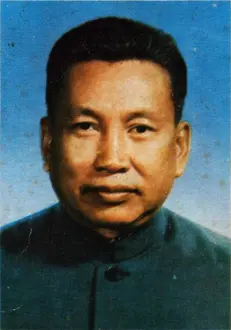
Leader of the Khmer Rouge and de facto ruler of Democratic Kampuchea (1975-1979)
Pol Pot led the Communist Party of Kampuchea and ran Democratic Kampuchea, a one-party state that emptied the cities, abolished money, markets and religion, and collectivised agriculture under the Four-Year Plan. His own speeches stress independence and self-reliance, class struggle, and armed revolution; he saw Vietnam as the chief threat and purged party members as agents. Estimates of deaths under his rule run to 1.5-2 million.
Closest ideologies
Based on the 180 statements where Pol Pot has a known position.
- National Bolshevism (NazBol) (85% match)
- National Communism (85% match)
- Burmese Way to Socialism (84% match)
- National communism in Romania (83% match)
- Stalinism (82% match)
Similar people
- Nicolae Ceaușescu (83% alike)
- Mustafa Kemal Atatürk (83% alike)
- Kim Jong-il (83% alike)
- Kim Jong-un (82% alike)
- Ibrahim Traoré (80% alike)
Known positions
- Strongly: A workers' state must suppress the old ruling class for a time.
- Strongly: Every part of life should be subject to state direction.
- Strongly: A state may force a minority it sees as hostile to leave the country.
- Strongly: Eventually people should produce and share without money.
- Strongly: The governing party's own leadership should control the armed forces.
- Strongly: A state whose economy is publicly owned and planned should be defended against a return to capitalism even if a bureaucracy rules it.
- Strongly: One ideologically correct party should hold state leadership without competing parties having a right to replace it.
- Strongly: The people in power should decide what the country's news media publish.
- Strongly: Workers require political leadership from a tightly organised revolutionary party.
- Strongly: An armed minority's actions are capable of bringing about conditions that enable a broader revolutionary uprising.
- Strongly: Common ownership of production need not leave personal belongings private.
- Strongly: The law may treat people differently according to such things as birth, sex, race and status.
- Strongly: Farming should be organized as joint cultivation by groups of farmers instead of separate individual farm operations.
- Strongly: A socialist state with hostile countries all around it should work to make its state power stronger.
- Strongly: The government should stop its political opponents from organising, speaking or competing for power.
- Strongly: An economy whose production is directed by a central plan is capable of working better than an economy directed by market exchange.
- Strongly: Political change should replace the existing administrative and coercive institutions with new forms of organization, rather than put new leaders in charge of the old apparatus.
- Strongly: Society should aim for people to end up with broadly equal material conditions.
- Strongly: A nation should be mainly one ethnic people.
- Strongly: People should live and work in communities that own land and goods together and govern themselves.
- Strongly: A healthy society does not depend on the traditional family, such as a married mother and father raising their children.
- Strongly: Laws, police and government mainly serve the interests of whoever owns the economy and holds power.
- Strongly: Wars between great powers are an unavoidable consequence of capitalism.
- Strongly: Owners' profit is value taken from workers' labor.
- Strongly: The government should have authority over religious institutions' internal affairs.
- Strongly: People should work mainly out of responsibility to society and a shared purpose, with personal material rewards playing a secondary role.
- Strongly: State institutions should not let staff and pupils wear visible religious dress.
- Strongly: Cooperation between employers and workers should not come before conflict where their interests differ.
- Strongly: People with advanced schooling are cut off from how ordinary people live and work.
- Strongly: A national emergency sometimes justifies temporarily withdrawing normal legal safeguards against people the government regards as internal enemies, such as protections against detention without trial.
- Strongly: Public institutions do not need to help minority languages be used in public life.
- Strongly: Newcomers should adopt the host nation's culture in place of their original culture.
- Strongly: Society should push new technology forward faster, even where it overturns established institutions.
- Strongly: Workers should form a party of their own, separate from the parties already in place.
- Strongly: Democracy is not the best form of government when voters choose badly.
- Strongly: Collective goals can justify treating a person merely as a tool.
- Strongly: Outside governments have no entitlement to interfere in another country's internal affairs for any purpose.
- Strongly: Areas where an ethnic minority is the majority may be governed in the same way as the rest of the state.
- Strongly: People do not have full ownership of their own bodies.
- Strongly: Society does not need a third course beyond capitalism and communism.
- Strongly: Religious values and institutions should not have a major part in shaping laws, schools and public life.
- Strongly: Governments should limit how money and investment can be moved across borders.
- Strongly: A country should seek closer ties with China than with the United States.
- Strongly: Those who hold public office should be paid no more than an average worker.
- Strongly: Political power may be concentrated in one body.
- Strongly: Property need not be spread among many small owners.
- Strongly: Living in the countryside does more for a person's moral wellbeing than living in a city.
- Strongly: When national priorities conflict with working together internationally, my country should choose its own priorities.
- Strongly: The worst crimes can be punished by death.
- Strongly: The nation has decayed and must be reborn.
- Strongly: The global economic system keeps poorer countries poor by directing their wealth toward richer countries.
- Strongly: The state should limit or screen money that foreign donors give to charities, campaign groups, the press and universities.
- Strongly: The goods people consume should mainly come from nearby producers.
- Strongly: Industries such as energy, rail and utilities should be owned by the state or public bodies, not private companies.
- Strongly: People able to work should get welfare benefits only in return for some work, such as a job or a work scheme.
- Strongly: Defeating communism should not take priority over coexistence with it.
- Strongly: The government should be able to require citizens to serve in the military.
- Strongly: Cultural life inside a state should not be placed under the control of each national minority.
- Strongly: A government should outlaw political parties that aim to do away with its constitutional order.
- Strongly: My country should stay neutral and join neither of the opposing great-power alliances.
- Strongly: Whoever uses land or resources owes the rest of society a share of their value.
- Strongly: The country should impose strict limits on immigration.
- Strongly: What you owe your community matters more than your personal rights.
- Strongly: The government should steer investment into industries it sees as key to the country's future.
- Strongly: After members debate and adopt a party decision, every member should have to help implement it, including those who opposed it.
- Strongly: A poor country should develop mainly with its own resources.
- Strongly: Sex work between consenting adults should be illegal.
- Strongly: Society may be changed in large, rapid steps.
- Strongly: A country's constitution should prevail when it conflicts with international legal obligations.
- Strongly: The state should stop foreign buyers from taking over key national businesses.
- Strongly: Free trade does not benefit everyone in the long run.
- Strongly: Religious minorities should not be exempt from general laws that burden their practice.
- Strongly: Land that a state declares its own against its people's will is still illegally occupied by that state.
- Strongly: How someone turns out is shaped more by upbringing, society and experience than by the traits they are born with.
- Strongly: Each country's communist party should decide its strategy for socialism without taking orders from another country's party.
- Strongly: Owners' rights to their property need not be protected against being overridden for public goals.
- Strongly: Basic local services, such as water, hospitals and local transport, should be publicly owned and run.
- Strongly: Officials decide what gets made and who gets it at least as well as prices and competition do.
- Strongly: People should have a direct role in making decisions where they work, live and study, rather than having those decisions made entirely for them.
- Strongly: In law, a country's traditional national church should rank no higher than other religious bodies.
- Strongly: The state should make immigrants learn the language of the country they settle in.
- Strongly: A country may keep all its decisions in its own hands rather than pooling them with other nations.
- Strongly: Schools should cultivate patriotic feeling: loyalty to and pride in the nation, expressed for example through respect for its flag and anthem.
- Strongly: Political independence means little unless the economic and property system is also transformed.
- Strongly: The nation's cause and the cause of its ordinary working people are one and the same.
- Strongly: Nobody should hold a special rank by birth, such as a noble title, a hereditary crown or a caste position, or the special rights attached to one.
- Strongly: National policy should give priority to preventing outside powers from splitting the country territorially.
- Strongly: Meeting poor people's needs should be the first consideration in public policy.
- Strongly: Society need not promote ways of living that differ from custom.
- Strongly: Constantly seeking additional possessions is harmful overall, despite any benefits it brings.
- Strongly: Public schooling money may go straight to schools instead of to parents as vouchers.
- Strongly: Population growth may be left to run its course.
- Strongly: Even a purely ceremonial head of state should not hold the position by birth.
- Strongly: Land does not belong to whoever first puts it to use.
- Strongly: Member states should keep the final decision on whether to follow UN decisions.
- Strongly: Economic growth should not be limited for the sake of the environment.
- Strongly: Political violence is sometimes justified.
- Strongly: A people with a shared national identity is entitled to its own self-governing state.
- Strongly: Being powerful does not mean a country should bring more land within its borders.
- Strongly: A national development strategy should not accept some regions growing wealthy ahead of the rest.
- Strongly: Being the first to use force can be right, depending on what it is meant to achieve.
- Strongly: Laws should not be required to follow religious texts.
- Strongly: Looking after your own interests is not a moral good in itself.
- Strongly: At least some revolutions have been justified.
- Strongly: Small, informal, trust-based groups should not take the place of lasting parties, unions and federations in political action.
- Strongly: Industrial society has done at least as much good as harm to humanity.
- Strongly: Population growth does not mainly drive lasting poverty.
- Strongly: No society has the right to rule another for its supposed improvement, however advanced it is.
- Strongly: Each country should hold ultimate authority over its natural resources, without foreign interests controlling them.
- Strongly: A market economy is incompatible with socialism under communist-party leadership.
- Strongly: Society needs government of some kind.
- Strongly: Countries should keep their armed forces.
- Strongly: Government should have other tasks besides protecting people from physical violence.
- Strongly: Killing another person can be right in self-defence or in defence of others.
- Strongly: Overseas territories need not be run mainly for the ruling country's economic benefit.
- Strongly: The holder of the highest state office need not be treated as holy.
- Strongly: Taking part in politics is at least as good a way to live as living privately away from public affairs.
- Strongly: A weaker state need not formally treat a stronger power as its superior.
- Strongly: Courts need not be handed over to private businesses.
- Strongly: Humanity would gain nothing by going back to living off hunting and gathering.
- Leans: Museums, libraries and other inherited culture that stand in the way of new creation should be destroyed.
- Leans: Education provided by the state should encourage people to reject belief in God.
- Leans: The ruler should not be bound by the country's laws, including those made by that ruler and by earlier ones.
- Leans: Work should no longer be divided into separate specialized jobs held by different people.
- Leans: Religion gives people a false consolation for hardship in their material lives.
- Leans: A minority group is working in secret to harm the nation.
- Leans: Poor countries should stop economic relations with wealthy countries.
- Leans: The mother country and its colonies should meet their economic needs within their own bloc instead of trading with the outside world.
- Leans: Temporary limits on political freedom are justified to achieve rapid economic development.
- Leans: War develops virtues in a nation, such as courage and discipline.
- Leans: Conflicts between social classes persist after a society becomes socialist.
- Leans: History is mainly driven by conflict between economic classes.
- Leans: Art, poetry and stories that harm people's moral character should be censored.
- Leans: Consent of the governed is not the only basis of legitimate political authority.
- Leans: Housework and childcare should be provided as public services in place of being done within families.
- Leans: Historical change comes mainly from changes in how society produces and exchanges goods.
- Leans: Where they conflict, evidence and reasoning should count for more than faith, God, revelation or scripture.
- Leans: The state should keep the colonial-era boundaries it inherits at independence.
- Leans: A country should try to sell more abroad than it buys from abroad.
- Leans: In the society we should aim for, a person's needs should determine their share of goods.
- Leans: People seeking political change should act directly—for example, with strikes, boycotts or occupations—instead of pursuing change through elections and parliaments.
- Leans: Defense should rest with armed ordinary citizens, not a standing force.
- Leans: The state should make one language the only common language of government, schooling and public life, limiting the use of others.
- Leans: Workers' solidarity with their own nation should take priority over solidarity with workers across borders.
- Leans: Force is for self-defence alone.
- Leans: Many political decisions should rest with national or wider authorities, even where a smaller community could handle them.
- Leans: The farmers who work large estates should take ownership from the landowners, with the transfer compulsory if owners refuse.
- Leans: My country's military strength should exceed that of its rivals.
- Leans: The state should offer public work to anyone who wants a job and cannot find one.
- Leans: State schools should not teach religion.
- Leans: Prisons should focus at least as much on punishment as on rehabilitation.
- Leans: Businesses should belong to the people who work in them, for example as cooperatives.
- Leans: Production should be organised to provide what people need, instead of being organised around what yields a profit.
- Leans: People should want as few material things as possible.
- Leans: Countries that feel dominated by Western powers should band together to resist them.
- Leans: Belonging to the nation ties a person's life to a sacred community that goes on after their death.
- Leans: Without workers' own political power, state ownership is not socialism.
- Leans: A country may accept its present border with a neighbour even if it lost land in an old war.
- Leans: Recreational drugs should be illegal for adults.
- Leans: Another body may have the final say over what the legislature passes.
- Leans: Firms in a market economy need not be owned by the people who work in them.
- Leans: Today's nation is the same people as its ancient and medieval forebears.
- Leans: People who give their lives for the nation deserve to be remembered as martyrs, with reverence beyond ordinary thanks.
- Leans: Political institutions developed in the West are not a suitable model for every civilization.
- Leans: The general public should have at least as much say in policy as experts.
- Leans: Women should be able to vote and stand for office on the same terms as men.
- Leans: Publicly honouring a national leader as the personification of the nation is not acceptable.
- Leans: The state should guarantee health care to everyone, whether it runs the services itself or pays for them.
- Leans: Lasting socialism in one country does not require socialist revolutions abroad.
- Leans: Restoring a lost social order does not matter more than pursuing progress.
- Leans: Private ownership is legitimate only insofar as it benefits society.
- Leans: Income from useful work should be rewarded ahead of income from merely owning property.
- Leans: A government needs more than fair elections to be democratic.