Political Ideology Atlas · All people · Take the test
Europe · born 1820, historical
Friedrich Engels
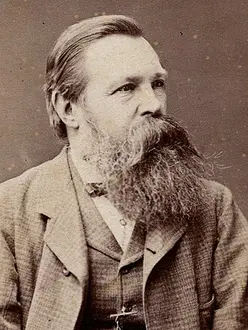
German philosopher, revolutionary socialist and co-founder of Marxism (1820-1895)
Engels co-wrote the Communist Manifesto with Marx and, in works such as Anti-Dühring, Socialism: Utopian and Scientific and The Origin of the Family, set out a materialist account of history, class struggle, the state as a class instrument and a planned classless society that would abolish private property, money and religion's social basis. He favoured a democratic republic, universal suffrage and an independent workers' party, while holding revolution justified and defending the Paris Commune as the dictatorship of the proletariat; late in life he stressed mass electoral organisation over minority uprisings.
Closest ideologies
Based on the 97 statements where Friedrich Engels has a known position.
- Marxism (91% match)
- Dictatorship of the proletariat (90% match)
- Scientific socialism (89% match)
- Structural Marxism (88% match)
- Communism (88% match)
Similar people
- Karl Marx (92% alike)
- Leon Trotsky (90% alike)
- Nikolai Bukharin (88% alike)
- Eugene V. Debs (85% alike)
- Rosa Luxemburg (85% alike)
Known positions
- Strongly: A workers' state must suppress the old ruling class for a time.
- Strongly: Eventually people should produce and share without money.
- Strongly: Work should no longer be divided into separate specialized jobs held by different people.
- Strongly: Religion gives people a false consolation for hardship in their material lives.
- Strongly: An economy whose production is directed by a central plan is capable of working better than an economy directed by market exchange.
- Strongly: History is mainly driven by conflict between economic classes.
- Strongly: Housework and childcare should be provided as public services in place of being done within families.
- Strongly: Historical change comes mainly from changes in how society produces and exchanges goods.
- Strongly: A healthy society does not depend on the traditional family, such as a married mother and father raising their children.
- Strongly: Laws, police and government mainly serve the interests of whoever owns the economy and holds power.
- Strongly: Owners' profit is value taken from workers' labor.
- Strongly: In the society we should aim for, a person's needs should determine their share of goods.
- Strongly: Cooperation between employers and workers should not come before conflict where their interests differ.
- Strongly: Defense should rest with armed ordinary citizens, not a standing force.
- Strongly: Those who elected someone should be able to remove them before their term ends, whenever they choose.
- Strongly: No moral truths hold across all cultures.
- Strongly: The representative legislature should have the final say on legislation.
- Strongly: Workers should form a party of their own, separate from the parties already in place.
- Strongly: Those who inherit a large fortune should hand over a big share of it in tax.
- Strongly: Government should maintain a strict institutional separation from religion.
- Strongly: Working together internationally should count at least as much as my country's own priorities.
- Strongly: The state should offer public work to anyone who wants a job and cannot find one.
- Strongly: Religious values and institutions should not have a major part in shaping laws, schools and public life.
- Strongly: State schools should not teach religion.
- Strongly: Living in a city does at least as much for a person's moral wellbeing as living in the countryside.
- Strongly: Those who hold public office should be paid no more than an average worker.
- Strongly: Women's subordination is tied to how the economy is organised, so reform of laws and attitudes is not enough.
- Strongly: Property need not be spread among many small owners.
- Strongly: Creating new money should be reserved to public institutions, excluding private banks' creation of money through lending.
- Strongly: What things are worth comes from the work put into them.
- Strongly: High earners and the very rich should pay tax at a much higher rate than everyone else.
- Strongly: Agreements between competing firms, price-fixing included, need not be outlawed.
- Strongly: Production should be organised to provide what people need, instead of being organised around what yields a profit.
- Strongly: Laws, institutions and customs still favor men over women.
- Strongly: Industries such as energy, rail and utilities should be owned by the state or public bodies, not private companies.
- Strongly: Capitalism built the productive power and wealth that later and better societies rest on.
- Strongly: Real command of the military may rest with someone other than the head of state.
- Strongly: Workers' solidarity with workers in other countries should count at least as much as solidarity with their own nation.
- Strongly: Voters should be able to remove elected officials before their terms end.
- Strongly: Purchases of basic necessities should carry no consumption tax.
- Strongly: Firms in a market economy need not be owned by the people who work in them.
- Strongly: Direct action does not have to take the place of elections and parliament as the way to achieve political change.
- Strongly: Owners' rights to their property need not be protected against being overridden for public goals.
- Strongly: The people living in a disputed territory should choose by voting which country it joins.
- Strongly: An electorate should choose the head of state, either directly or through elected representatives.
- Strongly: Officials decide what gets made and who gets it at least as well as prices and competition do.
- Strongly: Workers are better off for having labor unions.
- Strongly: Nobody should hold a special rank by birth, such as a noble title, a hereditary crown or a caste position, or the special rights attached to one.
- Strongly: Spouses should make marital decisions as equals.
- Strongly: Restoring a lost social order does not matter more than pursuing progress.
- Strongly: Even a purely ceremonial head of state should not hold the position by birth.
- Strongly: Income-tax percentages may differ between income levels.
- Strongly: Whatever their circumstances, everyone should be able to count on the state for enough to live decently, through benefits, pensions or public services.
- Strongly: Political violence is sometimes justified.
- Strongly: Income from useful work should be rewarded ahead of income from merely owning property.
- Strongly: Elected governments need not leave monetary policy to central banks acting on their own.
- Strongly: In an economy with common ownership of productive assets, people should still own their personal belongings.
- Strongly: Laws should not be required to follow religious texts.
- Strongly: At least some revolutions have been justified.
- Strongly: Central banks should keep a role in controlling the money supply.
- Strongly: Industrial society has done at least as much good as harm to humanity.
- Strongly: Collecting taxes does not in itself amount to stealing people's money.
- Strongly: Renting out housing should be permitted in at least some circumstances.
- Strongly: Overseas territories need not be run mainly for the ruling country's economic benefit.
- Strongly: People without property should also have the right to vote.
- Strongly: State schools need not steer pupils away from belief in God.
- Strongly: Humanity would gain nothing by going back to living off hunting and gathering.
- Strongly: Farmers should have the legal freedom to leave the estates they work.
- Leans: Marriage should cease to be a legally recognised status.
- Leans: Temporary rule by a more developed society is justified when it helps the ruled to progress.
- Leans: Keeping a nation's inherited culture alive, including its language, customs and traditions, is not important.
- Leans: Farming should be organized as joint cultivation by groups of farmers instead of separate individual farm operations.
- Leans: A majority of workers in rich countries gain material benefits from exploitation of poorer countries.
- Leans: Political change should replace the existing administrative and coercive institutions with new forms of organization, rather than put new leaders in charge of the old apparatus.
- Leans: Socialism in a single country will not endure without successful socialist revolutions in other countries.
- Leans: Wars between great powers are an unavoidable consequence of capitalism.
- Leans: Major laws should be decided by citizens voting on them themselves.
- Leans: The farmers who work large estates should take ownership from the landowners, with the transfer compulsory if owners refuse.
- Leans: A woman who has sex outside marriage is not doing anything wrong.
- Leans: Employees should have voting rights in the management of large companies.
- Leans: Wage work cuts people off from the meaning and creativity of what they make.
- Leans: Political power may be concentrated in one body.
- Leans: Businesses should belong to the people who work in them, for example as cooperatives.
- Leans: The directly elected parliament should be a legislature's only chamber.
- Leans: The government should be able to require citizens to serve in the military.
- Leans: The government should steer investment into industries it sees as key to the country's future.
- Leans: An elected legislature must approve the government's budget before the government spends public money.
- Leans: Being free requires having the practical resources to act on one's choices, such as an adequate livelihood.
- Leans: Other things drive humanity forward at least as much as rivalry and conflict between peoples.
- Leans: In a war between great powers, workers need not seek their own government's defeat.
- Leans: A people with a shared national identity is entitled to its own self-governing state.
- Leans: Being powerful does not mean a country should bring more land within its borders.
- Leans: Workers do not need a disciplined revolutionary party to lead them.
- Leans: The law should treat everyone as an equal, whatever their birth, sex, race or status.