Political Ideology Atlas · All people · Take the test
Europe · born 1748, historical
Jeremy Bentham
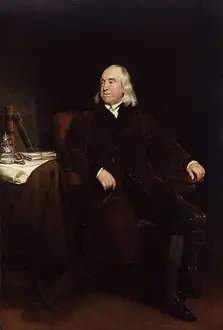
English philosopher, jurist and reformer (1748–1832)
Founder of classical utilitarianism, Bentham judged laws and institutions by their effect on happiness. He opposed natural rights, the Anglican establishment, colonies and hereditary privilege, and argued for near-universal suffrage, secret ballot, publicity and free markets.
Closest ideologies
Based on the 43 statements where Jeremy Bentham has a known position.
- Levellers (93% match)
- Georgism (91% match)
- Manchester Liberalism (90% match)
- Procedural democracy (89% match)
- Liberal democracy (89% match)
Similar people
- Alexei Navalny (89% alike)
- Arnold Schwarzenegger (89% alike)
- Voltaire (88% alike)
- Nandan Nilekani (88% alike)
- Hannah Arendt (87% alike)
Known positions
- Strongly: One spouse may have more authority than the other within a marriage.
- Strongly: Opening markets across borders leaves every trading country better off over time.
- Strongly: Government should maintain a strict institutional separation from religion.
- Strongly: A country should not tie itself to other countries through lasting military alliances.
- Strongly: The state should be barred from executing people convicted of the gravest crimes, such as terrorism.
- Strongly: The directly elected parliament should be a legislature's only chamber.
- Strongly: Allied countries are free to decide for themselves whether to help one that is attacked.
- Strongly: The public should receive official records showing how government decisions were reached.
- Strongly: Those who elected someone should be able to remove them before their term ends, whenever they choose.
- Strongly: Countries should maintain only the weapons needed for national safety.
- Strongly: Tariffs should not be used to protect domestic industry from foreign competition.
- Strongly: In law, a country's traditional national church should rank no higher than other religious bodies.
- Strongly: Citizens should have a legal right to see government information.
- Strongly: Being powerful does not mean a country should bring more land within its borders.
- Strongly: Rulers must act under lasting, publicly known laws administered by recognised courts.
- Strongly: Lending money at interest should be legal.
- Strongly: People should have a way to vote an officeholder out between regular elections.
- Strongly: News media should decide for themselves what they publish, whoever holds power.
- Strongly: Animals can suffer, and that suffering counts in how we treat them.
- Strongly: The law should not punish consenting adults for same-sex relations.
- Strongly: Overseas territories need not be run mainly for the ruling country's economic benefit.
- Strongly: People without property should also have the right to vote.
- Leans: A person's sex should affect the public roles legally assigned to them.
- Leans: Choices that harm no one else should never be crimes.
- Leans: At least some unjust laws impose a moral duty of obedience.
- Leans: The representative legislature should have the final say on legislation.
- Leans: Civil servants should be recruited according to their performance in competitive examinations.
- Leans: Using a country's armed forces for wider policy goals is a misuse of military power.
- Leans: The national parliament stays the final authority and can take powers back from the regions.
- Leans: Prices and competition generally decide better than officials what gets made and who gets it.
- Leans: Democracy is best even when voters make poor choices.
- Leans: Prisons should mainly help offenders rejoin society.
- Leans: Either spouse can leave a marriage without showing wrongdoing by the other.
- Leans: My country may keep a military no stronger than its rivals'.
- Leans: It is morally acceptable to kill animals for food while minimising their suffering.
- Leans: Public spaces such as schools and facilities should not be separated by race under the law.
- Leans: Being the law gives a rule a moral claim to be obeyed.
- Leans: Countries should start from a policy of staying out of other countries' internal affairs.
- Leans: Rules need not set equal numbers of women and men on public bodies.
- Leans: Nobody should hold a special rank by birth, such as a noble title, a hereditary crown or a caste position, or the special rights attached to one.