Political Ideology Atlas · All ideologies · Take the test
Liberal democracy
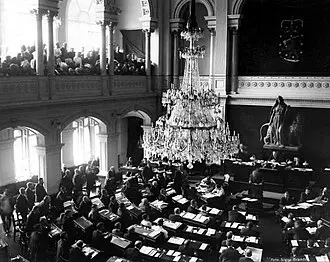
Liberal democracy is a form of government that joins popular rule through free, competitive elections with liberal constitutionalism: rulers hold power by the consent of the governed but are constitutionally bound to respect individual and minority rights. Its defining accounts name universal suffrage, secret ballots and freedom to form parties; guarantees of speech, press, conscience, religion, assembly and property; equality before the law; and separated powers, an independent judiciary and the rule of law that limit what majorities and executives may do. It rests on claims of human equality and universal natural rights going back to Locke, and its adherents divide, as liberal right and liberal left, over how far the state should act in the economy.
What it stands for
- Political power should be split among separate branches and levels that can each limit the others.
- Government should serve people's good while respecting each person as more than an instrument of the state or community.
- A country can get through deadlock among its institutions without a leader who overrides them.
- Rulers must act under lasting, publicly known laws administered by recognised courts.
- Public institutions should have the power to constrain a national majority's decisions in a liberal democracy.
- No one is better suited by nature to govern than anyone else.
Key figures
- John Locke: Philosopher whose doctrine of human equality, consent and natural rights the Gale entry names as the origin of liberal democracy.
- James Madison: Author of Federalist No. 10, whose vision of checked majorities Plattner calls the vision of liberal democracy.
- Francis Fukuyama: Political scientist who argued that liberal democracy is the end point of mankind's ideological evolution.
Closest ideologies
- Pluralist democracy (93% match)
- Liberal internationalism (93% match)
- Rugged individualism (92% match)
- Liberalism (92% match)
- Political moderate (91% match)
People closest to it
- Nandan Nilekani (93% alike)
- Arnold Schwarzenegger (91% alike)
- Don Bacon (90% alike)
- Alexei Navalny (90% alike)
- Hannah Arendt (90% alike)
Key positions
- Strongly: Political power should be split among separate branches and levels that can each limit the others.
- Strongly: Government should serve people's good while respecting each person as more than an instrument of the state or community.
- Strongly: A country can get through deadlock among its institutions without a leader who overrides them.
- Strongly: Rulers must act under lasting, publicly known laws administered by recognised courts.
- Strongly: Public institutions should have the power to constrain a national majority's decisions in a liberal democracy.
- Strongly: No one is better suited by nature to govern than anyone else.
- Strongly: Rulers have a right to rule only because the people they rule have agreed to it.
- Strongly: The government should let its political opponents organise, speak and compete for power.
- Strongly: Political authority does not ultimately come from God.
- Strongly: The leader should not bypass political intermediaries in dealing with the people.
- Strongly: The law should treat everyone as an equal, whatever their birth, sex, race or status.
- Strongly: A government needs more than fair elections to be democratic.
- Strongly: Workers do not need a disciplined revolutionary party to lead them.
- Strongly: News media should decide for themselves what they publish, whoever holds power.
- Strongly: Daughters and widows should inherit and own land on the same terms as sons and husbands.
- Strongly: No party's ideology should give it an exclusive right to lead the state.
- Strongly: Religious conversion should be free of legal restriction.
- Strongly: Members of other ethnic groups should be free to stay in the country.
- Strongly: Publicly insulting a religion's sacred beliefs should be left outside the criminal law.
- Strongly: No state may force a minority out of the country, however hostile it judges that minority to be.
- Strongly: Some areas of life should remain outside state direction.
- Strongly: Women should be able to vote and stand for office on the same terms as men.
- Strongly: A market economy is incompatible with socialism under communist-party leadership.
- Strongly: A workers' state does not need to suppress the old ruling class, even for a time.
- Strongly: Society needs government of some kind.
- Strongly: The ruler should be subject to the country's laws.
- Strongly: Voting should not be limited to members of one ethnic group.
- Strongly: People without property should also have the right to vote.
- Strongly: Public spaces such as schools and facilities should not be separated by race under the law.
- Strongly: Final authority over a state's laws need not belong to its most senior religious scholars.
- Strongly: People must be free to leave their religion without legal penalty.
- Strongly: Suspected drug dealers should never be put to death without a trial.
- Strongly: Farmers should have the legal freedom to leave the estates they work.
- Leans: It is acceptable for a monarch who inherits the throne to be the country's symbolic head while others govern.
- Leans: More democracies means fewer wars, so promoting democracy serves peace.
- Leans: Western political institutions are suitable for every civilization.
- Leans: Prices and competition generally decide better than officials what gets made and who gets it.
- Leans: Owners' rights to their property should almost never be overridden, even for public goals.
- Leans: The representative legislature should have the final say on legislation.
- Leans: Free citizens need the freedom to own property, trade and choose work, or political freedom cannot last.
- Leans: Individual rights matter at least as much as what citizens owe their community.
- Leans: Communist one-party regimes should be condemned as severely as fascist regimes.
- Leans: Government should maintain a strict institutional separation from religion.
- Leans: Politics should give compromises among competing groups at least as much weight as a single common good identified by reasoning.
- Leans: Government should be bound by written guarantees of basic rights protected against easy amendment by ordinary majorities.
- Leans: Trade unions should control their own affairs without state direction.
- Leans: Political decisions should rest with the smallest local community able to handle them, with wider authorities handling matters that need a wider reach.
- Leans: Capitalism built the productive power and wealth that later and better societies rest on.
- Leans: Democracy is best even when voters make poor choices.
- Leans: Major laws should not be decided by direct votes of citizens.
- Leans: Women may go out in public without any legal duty to cover fully.
- Leans: Ordinary legal protections, such as the right not to be held without trial, should stay in force even in a national emergency.
- Leans: Some things are right or wrong for everyone, in every culture and era.
- Leans: People are entitled to resist a ruler's unconstitutional exercise of power.
- Leans: Direct action does not have to take the place of elections and parliament as the way to achieve political change.
- Leans: Political authority need not rest on oaths of loyalty sworn to a lord.
- Leans: An electorate should choose the head of state, either directly or through elected representatives.
- Leans: Government should rely at least as much on legal enforcement as on its rulers' moral example.
- Leans: Religious institutions should be independent of government direction in their internal affairs.
- Leans: Public offices may be filled by methods other than drawing lots.
- Leans: Political representation should not come through social bodies such as families, local communities and occupational associations instead of political parties.
- Leans: Some decisions should bind people who have not consented to them.
- Leans: Art should not be censored for its effect on people's moral character.
- Leans: Other forces move history at least as much as conflict between classes does.
- Leans: The law should not assign different roles in public life on the basis of sex.
- Leans: An economy directed by a central plan is not capable of working better than one directed by market exchange.
- Leans: Political power may rest on something other than workplace-elected councils.
- Leans: At least some revolutions have been justified.
- Leans: Laws should not be required to follow religious texts.
- Leans: People should be free to own land privately.