Political Ideology Atlas · All people · Take the test
North America · born 1906, historical
Hannah Arendt
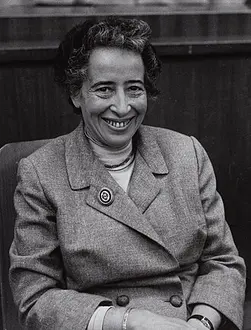
German-American political theorist (1906–1975)
Arendt was a political theorist who analyzed totalitarianism and defended a republican politics of plurality, public freedom and citizen participation. She favored federated councils over party rule, constitutional limits on majorities and the separation of powers, criticized both capitalism and state socialism for expropriating the masses, and opposed a sovereign Jewish state in favor of an Arab-Jewish federation.
Closest ideologies
Based on the 57 statements where Hannah Arendt has a known position.
- Pluralist democracy (91% match)
- Iberism (90% match)
- Liberal democracy (90% match)
- Rugged individualism (90% match)
- Social credit (89% match)
Similar people
- Rudolf Steiner (95% alike)
- Alexei Navalny (91% alike)
- Nandan Nilekani (88% alike)
- Harald V of Norway (87% alike)
- Arnold Schwarzenegger (87% alike)
Known positions
- Strongly: International criminal courts should try political leaders responsible for atrocities such as genocide, crimes against humanity and war crimes.
- Strongly: Having a human nature in common is not what gives people their rights.
- Strongly: Political power should be split among separate branches and levels that can each limit the others.
- Strongly: Society should follow a third course beyond capitalism and communism.
- Strongly: A country can get through deadlock among its institutions without a leader who overrides them.
- Strongly: People should have a direct role in making decisions where they work, live and study, rather than having those decisions made entirely for them.
- Strongly: Public institutions should have the power to constrain a national majority's decisions in a liberal democracy.
- Strongly: The government should let its political opponents organise, speak and compete for power.
- Strongly: Minority groups are not, as groups, secretly plotting to harm the nation.
- Strongly: No party's ideology should give it an exclusive right to lead the state.
- Strongly: The ruler should be subject to the country's laws.
- Strongly: Killing another person can be right in self-defence or in defence of others.
- Strongly: Public spaces such as schools and facilities should not be separated by race under the law.
- Strongly: The Holocaust happened as historians describe it.
- Leans: Having a shared national identity does not by itself entitle a people to its own self-governing state.
- Leans: The fact that something is law is not, by itself, a moral reason to obey it.
- Leans: Countries should hand part of their decision-making power to a union of nations, such as the European Union.
- Leans: Owners' rights to their property should almost never be overridden, even for public goals.
- Leans: Private businesses and markets should run most of the economy, while the government supports people who cannot meet their basic needs.
- Leans: Delegates selected by councils at one level should select officeholders at higher levels.
- Leans: Industries such as energy, rail and utilities do not need to be publicly owned.
- Leans: Communist one-party regimes should be condemned as severely as fascist regimes.
- Leans: Working together internationally should count at least as much as my country's own priorities.
- Leans: Religious values and institutions should not have a major part in shaping laws, schools and public life.
- Leans: Besides its directly elected parliament, a legislature should have a second chamber, such as a senate.
- Leans: Government should be bound by written guarantees of basic rights protected against easy amendment by ordinary majorities.
- Leans: Property should belong to many people in small holdings.
- Leans: Workers should not have democratic voting rights in the management of large companies.
- Leans: The worst crimes can be punished by death.
- Leans: Political decisions should rest with the smallest local community able to handle them, with wider authorities handling matters that need a wider reach.
- Leans: Citizens should have a legal right to see government information.
- Leans: Major laws should not be decided by direct votes of citizens.
- Leans: Civilization's main goals may lie elsewhere than in spreading into space.
- Leans: Some knowledge is neutral.
- Leans: A state of their own in the Land of Israel is not something Jews are owed as a people.
- Leans: Immigrants should not be expected to replace their original culture with the national culture.
- Leans: Taking part in politics is at least as good a way to live as living privately away from public affairs.
- Leans: People who became refugees during a conflict should be permitted to return to the homes they themselves left.
- Leans: You can't reach a free, fair society by unfree or unfair means.
- Leans: Workers are better off for having labor unions.
- Leans: The people who own the economy and hold power are not the ones the state mainly serves.
- Leans: A nation does not need one main ethnic group: it can be made up of people of many ancestries.
- Leans: Private owners' choice of whom they deal with should be subject to some restrictions.
- Leans: Constantly seeking additional possessions is harmful overall, despite any benefits it brings.
- Leans: No state may force a minority out of the country, however hostile it judges that minority to be.
- Leans: People of different races should not be discouraged from forming a family together, including through marriage and children.
- Leans: Restoring a lost social order does not matter more than pursuing progress.
- Leans: Rulers have a right to rule only because the people they rule have agreed to it.
- Leans: Other forces move history at least as much as conflict between classes does.
- Leans: Member states should keep the final decision on whether to follow UN decisions.
- Leans: An economy directed by a central plan is not capable of working better than one directed by market exchange.
- Leans: World power should be distributed among several independent major powers, without one dominant power.
- Leans: At least some revolutions have been justified.
- Leans: Political violence is sometimes justified.
- Leans: A government needs more than fair elections to be democratic.
- Leans: The law should treat everyone as an equal, whatever their birth, sex, race or status.