Political Ideology Atlas · All people · Take the test
South & Southeast Asia · born 1955
Nandan Nilekani
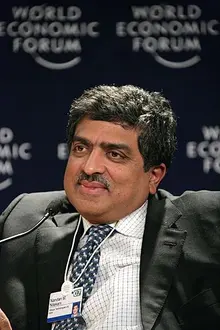
Infosys cofounder and former chair of India’s Unique Identification Authority
Nilekani favours competitive markets within public rules, technology-built public platforms for welfare and identity, and democratic, decentralised government with empowered cities. He opposes protectionism and draconian anti-terror laws, wants environmental costs priced, and argues for an equal society across religious, caste and language divisions.
Closest ideologies
Based on the 51 statements where Nandan Nilekani has a known position.
- Liberal internationalism (94% match)
- Pluralist democracy (93% match)
- Liberal democracy (93% match)
- Liberalism (92% match)
- Pro-Europeanism (92% match)
Similar people
- Arnold Schwarzenegger (93% alike)
- Reza Pahlavi (92% alike)
- Alexei Navalny (91% alike)
- Destiny (90% alike)
- Benazir Bhutto (89% alike)
Known positions
- Strongly: The public should receive official records showing how government decisions were reached.
- Strongly: Democracy is best even when voters make poor choices.
- Strongly: Citizens should have a legal right to see government information.
- Strongly: Ordinary legal protections, such as the right not to be held without trial, should stay in force even in a national emergency.
- Strongly: A country can get through deadlock among its institutions without a leader who overrides them.
- Strongly: Economic growth should not be limited for the sake of the environment.
- Strongly: Rapid economic development does not justify temporary restrictions on political freedom.
- Strongly: The law should treat everyone as an equal, whatever their birth, sex, race or status.
- Strongly: Poor countries should retain economic ties with rich countries.
- Strongly: Members of other ethnic groups should be free to stay in the country.
- Leans: Economic accounts should record ecosystems as assets whose depletion counts as a loss.
- Leans: Labor unions do not necessarily make workers better off.
- Leans: Prices and competition generally decide better than officials what gets made and who gets it.
- Leans: Speech that attacks groups for who they are can be punished by law.
- Leans: Fewer tariffs and trade barriers make all countries better off over time.
- Leans: Publicly funded services such as hospitals and schools should be run by private companies and charities as well as the state.
- Leans: Society should push new technology forward faster, even where it overturns established institutions.
- Leans: The government may leave it to investors to decide which industries receive investment.
- Leans: Private businesses and markets should run most of the economy, while the government supports people who cannot meet their basic needs.
- Leans: Judge policies by what they achieve, independently of whether they match an ideology.
- Leans: Science and technology will fix most of what goes wrong for people.
- Leans: Industries such as energy, rail and utilities do not need to be publicly owned.
- Leans: It is acceptable for the government to monitor people when that helps prevent terrorism.
- Leans: Living in a city does at least as much for a person's moral wellbeing as living in the countryside.
- Leans: Making polluters pay a tax protects the environment more than setting rules for them does.
- Leans: Tariffs should not be used to protect domestic industry from foreign competition.
- Leans: Governments may refuse permission for new oil, gas and coal extraction.
- Leans: Political decisions should rest with the smallest local community able to handle them, with wider authorities handling matters that need a wider reach.
- Leans: Governments should not borrow heavily, spending much more than they collect in taxes, to boost the economy.
- Leans: My country should stay neutral and join neither of the opposing great-power alliances.
- Leans: Capitalism built the productive power and wealth that later and better societies rest on.
- Leans: Society should take active steps to make up for the harm done by past racial injustices.
- Leans: Climate change calls for drastic action by governments.
- Leans: Parties and offices should cut across religious lines.
- Leans: The government should have the ability to identify the participants in every payment.
- Leans: Public institutions should help minority languages be used in public life, for example through teaching or services in those languages.
- Leans: Working for wages should remain a normal way for people to earn a living.
- Leans: The state should not make one language the only common language of government, schooling and public life at the cost of limiting others.
- Leans: Ethnic diversity does not weaken a society's ability to hold together.
- Leans: The slaughter of cattle should be legal.
- Leans: No state may force a minority out of the country, however hostile it judges that minority to be.
- Leans: In the long run people should still produce and share using money.
- Leans: Population growth does not mainly drive lasting poverty.
- Leans: Industrial society has done at least as much good as harm to humanity.
- Leans: Population growth may be left to run its course.
- Leans: An economy directed by a central plan is not capable of working better than one directed by market exchange.
- Leans: Belonging to the nation does not go with sharing its religion.
- Leans: Businesses gain too much influence over government policy from their lobbying.
- Leans: Governments should give no subsidies, licences or protections that favour firms close to them.