Political Ideology Atlas · All people · Take the test
South & Southeast Asia · born 1917, historical
Indira Gandhi
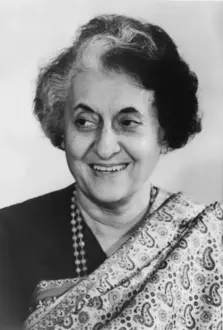
Prime Minister of India (1966-1977, 1980-1984); Congress leader
Gandhi led India as a dominant Congress prime minister who combined a state-led mixed economy and socialist rhetoric (bank nationalisation, privy purse abolition, Garibi Hatao) with strong centralisation, non-alignment tilted toward the Soviet Union, and a secular, plural-nation outlook. She declared the 1975-77 Emergency, ruling with censorship and mass detentions, then lost and regained power; the 42nd Amendment added 'socialist' and 'secular' to the Preamble while curbing courts and adding fundamental duties. Her stated views stress democracy and development, but her record on civil liberties and federal autonomy was authoritarian.
Closest ideologies
Based on the 104 statements where Indira Gandhi has a known position.
- African nationalism (89% match)
- Ujamaa (88% match)
- Chinese New Left (88% match)
- African Socialism (88% match)
- Third World socialism (87% match)
Similar people
- Jawaharlal Nehru (91% alike)
- Rajiv Gandhi (87% alike)
- Patrice Lumumba (87% alike)
- Frederick Douglass (87% alike)
- Maximilien Robespierre (87% alike)
Known positions
- Strongly: Population growth should be deliberately held down.
- Strongly: Once the national majority has decided, public institutions, including courts and independent bodies, should not limit its decision.
- Strongly: The representative legislature should have the final say on legislation.
- Strongly: A national emergency sometimes justifies temporarily withdrawing normal legal safeguards against people the government regards as internal enemies, such as protections against detention without trial.
- Strongly: Governments should set legal price ceilings on essential foods when supplies are scarce.
- Strongly: The state should not give families money to encourage them to have more children.
- Strongly: A country has the right to stop a region becoming independent by using its military.
- Strongly: Taxes on imports should shield domestic producers from foreign competition.
- Strongly: Countries should maintain only the weapons needed for national safety.
- Strongly: Defeating communism should not take priority over coexistence with it.
- Strongly: My country should stay neutral and join neither of the opposing great-power alliances.
- Strongly: The government should steer investment into industries it sees as key to the country's future.
- Strongly: Parties and offices should cut across religious lines.
- Strongly: Government should impose strict rules on how corporations operate.
- Strongly: The state should not make one language the only common language of government, schooling and public life at the cost of limiting others.
- Strongly: Direct action does not have to take the place of elections and parliament as the way to achieve political change.
- Strongly: A country may keep a region that wants to leave.
- Strongly: Private charity does not help people in poverty better than government programs do.
- Strongly: Nobody should hold a special rank by birth, such as a noble title, a hereditary crown or a caste position, or the special rights attached to one.
- Strongly: A nation does not need one main ethnic group: it can be made up of people of many ancestries.
- Strongly: Meeting poor people's needs should be the first consideration in public policy.
- Strongly: Other things drive humanity forward at least as much as rivalry and conflict between peoples.
- Strongly: Trade, finance and debt rules should be changed to give poorer countries a fairer share.
- Strongly: Foreign armies should not be based on the country's territory.
- Strongly: Economic growth should not be limited for the sake of the environment.
- Strongly: Whatever their circumstances, everyone should be able to count on the state for enough to live decently, through benefits, pensions or public services.
- Strongly: War does not strengthen a nation's character.
- Strongly: Being powerful does not mean a country should bring more land within its borders.
- Strongly: The law should treat everyone as an equal, whatever their birth, sex, race or status.
- Strongly: Belonging to the nation does not go with sharing its religion.
- Strongly: An armed minority's actions are incapable of bringing about the conditions for a broader revolutionary uprising.
- Strongly: Laws should not be required to follow religious texts.
- Strongly: Looking after your own interests is not a moral good in itself.
- Strongly: No party's ideology should give it an exclusive right to lead the state.
- Strongly: Some areas of life should remain outside state direction.
- Strongly: Private owners' choice of whom they deal with should be subject to some restrictions.
- Strongly: No society has the right to rule another for its supposed improvement, however advanced it is.
- Strongly: Each country should hold ultimate authority over its natural resources, without foreign interests controlling them.
- Strongly: Women should be able to vote and stand for office on the same terms as men.
- Strongly: A workers' state does not need to suppress the old ruling class, even for a time.
- Strongly: Society needs government of some kind.
- Strongly: Government should have other tasks besides protecting people from physical violence.
- Strongly: Collecting taxes does not in itself amount to stealing people's money.
- Strongly: Great powers should have no right to send troops against allied governments' wishes for the purpose of preserving those countries' political systems.
- Strongly: Voting should not be limited to members of one ethnic group.
- Strongly: Overseas territories need not be run mainly for the ruling country's economic benefit.
- Strongly: Public spaces such as schools and facilities should not be separated by race under the law.
- Strongly: Final authority over a state's laws need not belong to its most senior religious scholars.
- Strongly: Humanity would gain nothing by going back to living off hunting and gathering.
- Leans: A country can and should do without a standing military.
- Leans: The people in power should decide what the country's news media publish.
- Leans: Temporary limits on political freedom are justified to achieve rapid economic development.
- Leans: The government should stop its political opponents from organising, speaking or competing for power.
- Leans: Violence is never an acceptable way to pursue political goals.
- Leans: Society should aim for people to end up with broadly equal material conditions.
- Leans: My country should possess its own nuclear arsenal with independent authority over its use.
- Leans: There should be legal limits on strike action.
- Leans: Nature does not have value in itself, apart from its usefulness to humans.
- Leans: A country should not tie itself to other countries through lasting military alliances.
- Leans: Private businesses and markets should run most of the economy, while the government supports people who cannot meet their basic needs.
- Leans: Judge policies by what they achieve, independently of whether they match an ideology.
- Leans: Governments may spend well beyond their tax revenue to support a weak economy.
- Leans: Many political decisions should rest with national or wider authorities, even where a smaller community could handle them.
- Leans: The farmers who work large estates should take ownership from the landowners, with the transfer compulsory if owners refuse.
- Leans: Government should maintain a strict institutional separation from religion.
- Leans: Businesses should be legally barred from agreements with competitors to suppress competition, such as fixing prices.
- Leans: Religious values and institutions should not have a major part in shaping laws, schools and public life.
- Leans: Employees should have voting rights in the management of large companies.
- Leans: Government should support building nuclear power plants.
- Leans: Allied countries are free to decide for themselves whether to help one that is attacked.
- Leans: Property should belong to many people in small holdings.
- Leans: Government should not be bound by a written bill of rights protected against easy amendment by ordinary majorities.
- Leans: Farmers should get price floors, state buying or cheap credit to keep them secure.
- Leans: A country with nuclear weapons should keep them for as long as its rivals retain theirs.
- Leans: Society should follow a third course beyond capitalism and communism.
- Leans: High earners and the very rich should pay tax at a much higher rate than everyone else.
- Leans: Areas where an ethnic minority makes up most of the population should be able to run many of their own affairs within the state.
- Leans: Industries such as energy, rail and utilities should be owned by the state or public bodies, not private companies.
- Leans: Foreign powers sometimes have a right to intervene in a country's internal affairs.
- Leans: Military intervention abroad is sometimes necessary to protect human rights.
- Leans: A government should outlaw political parties that aim to do away with its constitutional order.
- Leans: Trade deals may leave out legally binding requirements protecting workers.
- Leans: Democracy is best even when voters make poor choices.
- Leans: What you owe your community matters more than your personal rights.
- Leans: A poor country should develop mainly with its own resources.
- Leans: Society may be changed in large, rapid steps.
- Leans: A region need not keep most of the tax money it raises for itself.
- Leans: Free trade does not benefit everyone in the long run.
- Leans: Owners' rights to their property need not be protected against being overridden for public goals.
- Leans: Employers and workers should treat each other as partners whose cooperation comes before conflict, even where their interests differ.
- Leans: Officials decide what gets made and who gets it at least as well as prices and competition do.
- Leans: Workers are better off for having labor unions.
- Leans: People should have a direct role in making decisions where they work, live and study, rather than having those decisions made entirely for them.
- Leans: Animals can suffer, and that suffering counts in how we treat them.
- Leans: Constantly seeking additional possessions is harmful overall, despite any benefits it brings.
- Leans: Population growth does not mainly drive lasting poverty.
- Leans: Industrial society has done at least as much good as harm to humanity.
- Leans: Private ownership is legitimate only insofar as it benefits society.
- Leans: Very large concentrations of wealth threaten a free society.
- Leans: Politics should support people's spiritual well-being.
- Leans: Keeping a nation's inherited culture alive, including its language, customs and traditions, matters.
- Leans: We have a duty to leave the planet in good condition for those who come after us.
- Leans: Daughters and widows should inherit and own land on the same terms as sons and husbands.
- Leans: A people with a shared national identity is entitled to its own self-governing state.