Political Ideology Atlas · All people · Take the test
South & Southeast Asia · born 1889, historical
Jawaharlal Nehru
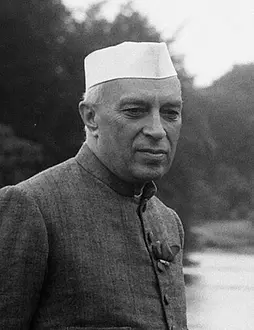
First Prime Minister of India (1947-1964)
Nehru led India as a parliamentary democrat committed to a secular state, a planned mixed economy with a dominant public sector in heavy industry, and a non-aligned foreign policy. He called himself a socialist but rejected class war and dictatorship, favouring peaceful, democratic change. He drove Hindu personal law reform, linguistic states, and military action over Hyderabad and Goa while working for disarmament.
Closest ideologies
Based on the 68 statements where Jawaharlal Nehru has a known position.
- Kirchnerism (91% match)
- Market Socialism (91% match)
- Liberalism in the United States (91% match)
- Irish republicanism (90% match)
- Ambedkarism (88% match)
Similar people
- Indira Gandhi (91% alike)
- Rajiv Gandhi (91% alike)
- Frederick Douglass (91% alike)
- François Mitterrand (90% alike)
- Luiz Inácio Lula da Silva (90% alike)
Known positions
- Strongly: An assembly elected by the people for that purpose should draft the constitution.
- Strongly: Countries should maintain only the weapons needed for national safety.
- Strongly: Defeating communism should not take priority over coexistence with it.
- Strongly: My country should stay neutral and join neither of the opposing great-power alliances.
- Strongly: Democracy is best even when voters make poor choices.
- Strongly: The government should steer investment into industries it sees as key to the country's future.
- Strongly: Parties and offices should cut across religious lines.
- Strongly: A nation does not need one main ethnic group: it can be made up of people of many ancestries.
- Strongly: My country can do without nuclear weapons that it alone controls.
- Strongly: Rulers have a right to rule only because the people they rule have agreed to it.
- Strongly: Economic growth should not be limited for the sake of the environment.
- Strongly: A people with a shared national identity is entitled to its own self-governing state.
- Strongly: A national development strategy should not accept some regions growing wealthy ahead of the rest.
- Strongly: The law should treat everyone as an equal, whatever their birth, sex, race or status.
- Strongly: Belonging to the nation does not go with sharing its religion.
- Strongly: Laws should not be required to follow religious texts.
- Strongly: No party's ideology should give it an exclusive right to lead the state.
- Strongly: Industrial society has done at least as much good as harm to humanity.
- Strongly: Private owners' choice of whom they deal with should be subject to some restrictions.
- Strongly: No society has the right to rule another for its supposed improvement, however advanced it is.
- Strongly: A workers' state does not need to suppress the old ruling class, even for a time.
- Strongly: Society needs government of some kind.
- Strongly: Countries should keep their armed forces.
- Strongly: Government should have other tasks besides protecting people from physical violence.
- Strongly: Overseas territories need not be run mainly for the ruling country's economic benefit.
- Strongly: Public spaces such as schools and facilities should not be separated by race under the law.
- Leans: An economy whose production is directed by a central plan is capable of working better than an economy directed by market exchange.
- Leans: The UN should have authority to compel member states to comply with its decisions.
- Leans: Population growth should be deliberately held down.
- Leans: Society should aim for people to end up with broadly equal material conditions.
- Leans: Where they conflict, evidence and reasoning should count for more than faith, God, revelation or scripture.
- Leans: A national emergency sometimes justifies temporarily withdrawing normal legal safeguards against people the government regards as internal enemies, such as protections against detention without trial.
- Leans: Judge policies by what they achieve, independently of whether they match an ideology.
- Leans: Those who inherit a large fortune should hand over a big share of it in tax.
- Leans: The farmers who work large estates should take ownership from the landowners, with the transfer compulsory if owners refuse.
- Leans: Science and technology will fix most of what goes wrong for people.
- Leans: Government should maintain a strict institutional separation from religion.
- Leans: A country has the right to stop a region becoming independent by using its military.
- Leans: Religious values and institutions should not have a major part in shaping laws, schools and public life.
- Leans: Capitalism is not bound to suffer a general collapse.
- Leans: Taxes on imports should shield domestic producers from foreign competition.
- Leans: Government should be bound by written guarantees of basic rights protected against easy amendment by ordinary majorities.
- Leans: High earners and the very rich should pay tax at a much higher rate than everyone else.
- Leans: Industries such as energy, rail and utilities should be owned by the state or public bodies, not private companies.
- Leans: Political decisions should rest with the smallest local community able to handle them, with wider authorities handling matters that need a wider reach.
- Leans: Armed forces may sometimes be used for purposes beyond defending the country against attack.
- Leans: A state of their own in the Land of Israel is not something Jews are owed as a people.
- Leans: Government should impose strict rules on how corporations operate.
- Leans: Free trade does not benefit everyone in the long run.
- Leans: Public institutions should help minority languages be used in public life, for example through teaching or services in those languages.
- Leans: The state should not make one language the only common language of government, schooling and public life at the cost of limiting others.
- Leans: Owners' rights to their property need not be protected against being overridden for public goals.
- Leans: Employers and workers should treat each other as partners whose cooperation comes before conflict, even where their interests differ.
- Leans: Today's nation is the same people as its ancient and medieval forebears.
- Leans: Officials decide what gets made and who gets it at least as well as prices and competition do.
- Leans: A country may keep a region that wants to leave.
- Leans: Being free requires having the practical resources to act on one's choices, such as an adequate livelihood.
- Leans: Political independence means little unless the economic and property system is also transformed.
- Leans: Nobody should hold a special rank by birth, such as a noble title, a hereditary crown or a caste position, or the special rights attached to one.
- Leans: Meeting poor people's needs should be the first consideration in public policy.
- Leans: A national language may keep the foreign loanwords it has.
- Leans: Private ownership is legitimate only insofar as it benefits society.
- Leans: Keeping a nation's inherited culture alive, including its language, customs and traditions, matters.
- Leans: Daughters and widows should inherit and own land on the same terms as sons and husbands.
- Leans: The government should let its political opponents organise, speak and compete for power.