Political Ideology Atlas · All people · Take the test
North America · born 1751, historical
James Madison
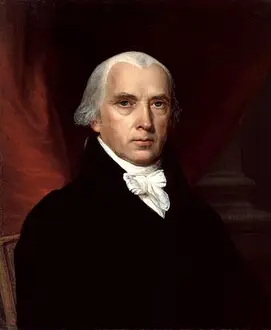
US president (1809-1817), principal drafter of the Constitution and the Bill of Rights
Virginia statesman who designed a large, separated-powers republic to restrain majority factions, helped write The Federalist, and introduced the Bill of Rights. A staunch defender of religious liberty, free press and enumerated federal powers, he drafted the Virginia Resolutions against the Sedition Act, later accepted a national bank and protective tariff, and held gradual emancipation with colonization while owning slaves.
Closest ideologies
Based on the 55 statements where James Madison has a known position.
- Fortuynism (90% match)
- Americanism (90% match)
- Ordoliberalism (89% match)
- Neoliberalism (89% match)
- Progressive conservatism (89% match)
Similar people
- Alexis de Tocqueville (90% alike)
- Scott Adams (90% alike)
- Elon Musk (90% alike)
- Herbert Hoover (90% alike)
- María Corina Machado (89% alike)
Known positions
- Strongly: Owners' rights to their property should almost never be overridden, even for public goals.
- Strongly: Government should maintain a strict institutional separation from religion.
- Strongly: Besides its directly elected parliament, a legislature should have a second chamber, such as a senate.
- Strongly: Government should be bound by written guarantees of basic rights protected against easy amendment by ordinary majorities.
- Strongly: Political power should be split among separate branches and levels that can each limit the others.
- Strongly: Large landed estates should not be compulsorily transferred to the people who farm them.
- Strongly: Major laws should not be decided by direct votes of citizens.
- Strongly: A country can get through deadlock among its institutions without a leader who overrides them.
- Strongly: An elected legislature must approve the government's budget before the government spends public money.
- Strongly: An electorate should choose the head of state, either directly or through elected representatives.
- Strongly: In law, a country's traditional national church should rank no higher than other religious bodies.
- Strongly: A country may keep a region that wants to leave.
- Strongly: Nobody should hold a special rank by birth, such as a noble title, a hereditary crown or a caste position, or the special rights attached to one.
- Strongly: Rulers must act under lasting, publicly known laws administered by recognised courts.
- Strongly: Inventions and creative works should remain legally ownable, as under patents and copyrights.
- Strongly: Public institutions should have the power to constrain a national majority's decisions in a liberal democracy.
- Strongly: Rulers have a right to rule only because the people they rule have agreed to it.
- Strongly: Even a purely ceremonial head of state should not hold the position by birth.
- Strongly: Art should not be censored for its effect on people's moral character.
- Strongly: The government should let its political opponents organise, speak and compete for power.
- Strongly: Someone who actually governs a state should not hand that power on to their own child.
- Strongly: Laws should not be required to follow religious texts.
- Strongly: News media should decide for themselves what they publish, whoever holds power.
- Strongly: Publicly insulting a religion's sacred beliefs should be left outside the criminal law.
- Strongly: Some decisions should bind people who have not consented to them.
- Strongly: Society needs government of some kind.
- Strongly: The ruler should be subject to the country's laws.
- Strongly: Collecting taxes does not in itself amount to stealing people's money.
- Leans: Only people who own property should have the right to vote.
- Leans: A powerful country should bring more land within its borders.
- Leans: Some people are better suited by nature to govern.
- Leans: The best government combines a governing role for a few with a governing role for the wider population.
- Leans: Voters themselves should elect the head of state, without an intermediary body selecting the officeholder.
- Leans: Believers can be excused from rules, such as dress or work-day rules, that conflict with their faith.
- Leans: An assembly elected by the people for that purpose should draft the constitution.
- Leans: The country may allow more immigration than strict limits would permit.
- Leans: A president should be free to stand for re-election as many times as they like.
- Leans: Politics should give compromises among competing groups at least as much weight as a single common good identified by reasoning.
- Leans: Taxes on imports should shield domestic producers from foreign competition.
- Leans: Property should belong to many people in small holdings.
- Leans: Living in the countryside does more for a person's moral wellbeing than living in a city.
- Leans: The state should treat all streams and interpretations of a religion equally under the law.
- Leans: People are entitled to resist a ruler's unconstitutional exercise of power.
- Leans: Defense should not rest with armed ordinary citizens in place of a standing force.
- Leans: Elected politicians should be able to serve any number of terms in any office.
- Leans: Owning a gun should not face strict legal limits.
- Leans: Very large concentrations of wealth threaten a free society.
- Leans: At least some revolutions have been justified.
- Leans: Political authority does not ultimately come from God.
- Leans: Naturalized citizens may hold public office as well as people born in the country.
- Leans: The law should treat everyone as an equal, whatever their birth, sex, race or status.
- Leans: Governments should give no subsidies, licences or protections that favour firms close to them.