Political Ideology Atlas · All people · Take the test
Europe · born 1754, historical
Charles-Maurice de Talleyrand-Périgord
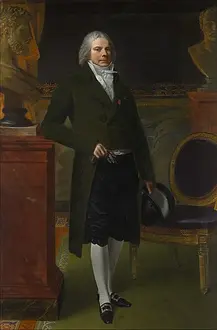
French diplomat and statesman (1754–1838)
Talleyrand favoured constitutional monarchy, commercial exchange and a European balance of power. His advocacy of civil liberties coexisted with women’s political exclusion and support for colonial settlement. He served successive regimes and opposed parts of Napoleon’s expansionist policy.
Closest ideologies
Based on the 46 statements where Charles-Maurice de Talleyrand-Périgord has a known position.
- Anglo-Saxonism (89% match)
- Monarchism (88% match)
- Cultural conservatism (88% match)
- Yellow socialism (88% match)
- Familialism (86% match)
Similar people
- Alexander Hamilton (91% alike)
- Arthur Balfour (87% alike)
- Andrew Johnson (87% alike)
- William Howard Taft (86% alike)
- Edmund Burke (86% alike)
Known positions
- Strongly: Women's political rights may differ from men's.
- Strongly: Someone who actually governs a state may hand that power on to their own child, whether as a king or as a republic's leader.
- Strongly: A person's sex should affect the public roles legally assigned to them.
- Strongly: It is acceptable for a monarch who inherits the throne to be the country's symbolic head while others govern.
- Strongly: Special ranks held by birth, such as noble titles and hereditary crowns, may continue to exist.
- Strongly: The best government combines a governing role for a few with a governing role for the wider population.
- Strongly: The government should have authority over religious institutions' internal affairs.
- Strongly: The head of state should not have to be chosen by election.
- Strongly: Fewer tariffs and trade barriers make all countries better off over time.
- Strongly: Changes to society should be introduced a little at a time.
- Strongly: Public higher education should not be universally tuition-free.
- Strongly: Besides its directly elected parliament, a legislature should have a second chamber, such as a senate.
- Strongly: Money creation should not be reserved exclusively to public institutions.
- Strongly: Political power should be split among separate branches and levels that can each limit the others.
- Strongly: State schools may teach pupils a religious faith, for example through lessons in its beliefs and practice.
- Strongly: The state should treat all streams and interpretations of a religion equally under the law.
- Strongly: Some things are right or wrong for everyone, in every culture and era.
- Strongly: Being free requires having the practical resources to act on one's choices, such as an adequate livelihood.
- Strongly: World power should be distributed among several independent major powers, without one dominant power.
- Strongly: A mother country and its colonies may trade with the outside world.
- Strongly: News media should decide for themselves what they publish, whoever holds power.
- Strongly: No state may force a minority out of the country, however hostile it judges that minority to be.
- Strongly: The ruler should be subject to the country's laws.
- Strongly: Collecting taxes does not in itself amount to stealing people's money.
- Leans: Colonies should be run mainly to supply markets, materials and outlets for the ruling country.
- Leans: A powerful country should bring more land within its borders.
- Leans: More democracies means fewer wars, so promoting democracy serves peace.
- Leans: A former empire may keep a special relationship with its old territories.
- Leans: Owners' rights to their property should almost never be overridden, even for public goals.
- Leans: Judge policies by what they achieve, independently of whether they match an ideology.
- Leans: My country's military strength should exceed that of its rivals.
- Leans: Government should be bound by written guarantees of basic rights protected against easy amendment by ordinary majorities.
- Leans: Firms and banks bear the cost of their own failures, with no rescue from taxpayers.
- Leans: A country may join permanent military alliances.
- Leans: Ideas of what men and women are like do not come mostly from culture.
- Leans: Another body may have the final say over what the legislature passes.
- Leans: People are entitled to resist a ruler's unconstitutional exercise of power.
- Leans: Government should have other tasks besides protecting people from physical violence.
- Leans: Meeting poor people's needs should be the first consideration in public policy.
- Leans: Rulers have a right to rule only because the people they rule have agreed to it.
- Leans: Political violence is sometimes justified.
- Leans: Political authority does not ultimately come from God.
- Leans: Lending money at interest should be legal.
- Leans: Governments should give no subsidies, licences or protections that favour firms close to them.