Political Ideology Atlas · All people · Take the test
Europe · born 1848, historical
Arthur Balfour
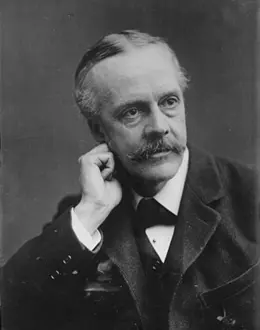
British prime minister (1902–1905), Irish chief secretary and foreign secretary
Balfour combined imperial unionism and coercive Irish administration with land reform and qualified constitutional adaptation. He supported a Jewish national home in Palestine, limited women’s enfranchisement, publicly aided religious education and conditional tariff reform; his philosophical writing defended theism.
Closest ideologies
Based on the 49 statements where Arthur Balfour has a known position.
- Japanese nationalism (90% match)
- Panhispanism (89% match)
- Religious nationalism (88% match)
- Religious Zionism (88% match)
- Integralism (87% match)
Similar people
- Charles-Maurice de Talleyrand-Périgord (87% alike)
- Muhammad (87% alike)
- Toussaint Louverture (87% alike)
- Santiago Peña Palacios (87% alike)
- Otto von Bismarck (86% alike)
Known positions
- Strongly: Temporary rule by a more developed society is justified when it helps the ruled to progress.
- Strongly: Special ranks held by birth, such as noble titles and hereditary crowns, may continue to exist.
- Strongly: A national emergency sometimes justifies temporarily withdrawing normal legal safeguards against people the government regards as internal enemies, such as protections against detention without trial.
- Strongly: Changes to society should be introduced a little at a time.
- Strongly: Industries such as energy, rail and utilities do not need to be publicly owned.
- Strongly: Besides its directly elected parliament, a legislature should have a second chamber, such as a senate.
- Strongly: State schools may teach pupils a religious faith, for example through lessons in its beliefs and practice.
- Strongly: Some institutional ties between government and religion are acceptable.
- Strongly: An ancestral bond to a land gives a people a claim that outweighs the claims of other peoples who now live there.
- Strongly: Employers and workers should treat each other as partners whose cooperation comes before conflict, even where their interests differ.
- Strongly: Where they conflict, religious faith should count for at least as much as evidence and reasoning.
- Strongly: Political institutions developed in the West are not a suitable model for every civilization.
- Strongly: Other things drive humanity forward at least as much as rivalry and conflict between peoples.
- Strongly: An economy directed by a central plan is not capable of working better than one directed by market exchange.
- Strongly: War does not strengthen a nation's character.
- Strongly: Countries may keep controls on who enters and settles, even in the long run.
- Leans: The government should stop its political opponents from organising, speaking or competing for power.
- Leans: The national church is recognised in law above other religions.
- Leans: The best government combines a governing role for a few with a governing role for the wider population.
- Leans: A society holds together less well when its members belong to different ethnic groups.
- Leans: The homeland should place its cultural role for people abroad above the aim of bringing the whole people to live there.
- Leans: Owners' rights to their property should almost never be overridden, even for public goals.
- Leans: Publicly funded services such as hospitals and schools should be run by private companies and charities as well as the state.
- Leans: Jews, as a people, are entitled to a country of their own in the Land of Israel.
- Leans: Major laws should be decided by citizens voting on them themselves.
- Leans: Judge policies by what they achieve, independently of whether they match an ideology.
- Leans: A national minority should run its own schools, language and cultural institutions inside the state it lives in.
- Leans: Many political decisions should rest with national or wider authorities, even where a smaller community could handle them.
- Leans: My country's military strength should exceed that of its rivals.
- Leans: Tax rates should not rise steeply with income.
- Leans: Taxes on imports should shield domestic producers from foreign competition.
- Leans: Property should belong to many people in small holdings.
- Leans: Political power should be split among separate branches and levels that can each limit the others.
- Leans: Emigrating to establish a homeland should take at least as much priority as seeking equal rights where persecuted minorities live.
- Leans: Heirs to large fortunes may keep most of what they inherit.
- Leans: Democracy is best even when voters make poor choices.
- Leans: The country should impose strict limits on immigration.
- Leans: Some cultures are superior to others.
- Leans: Officials decide what gets made and who gets it at least as well as prices and competition do.
- Leans: A country may keep a region that wants to leave.
- Leans: A country may keep all its decisions in its own hands rather than pooling them with other nations.
- Leans: Women should be able to vote and stand for office on the same terms as men.
- Leans: Keeping a nation's inherited culture alive, including its language, customs and traditions, matters.
- Leans: Looking after your own interests is not a moral good in itself.
- Leans: A mother country and its colonies may trade with the outside world.