Political Ideology Atlas · All ideologies · Take the test
Monarchism
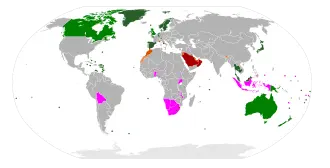
Monarchism holds that a hereditary monarch is the best or a legitimate head of state. Its classical defenders (Bodin, Filmer, James VI and I, Bossuet) ground royal power in paternal and divine authority and deny any right of resistance; counter-revolutionary and traditionalist writers (Maistre, Maurras, the Carlists) defend throne and altar, organic institutions and inherited legitimacy against popular sovereignty; and constitutional monarchists (Bagehot, Hegel, modern monarchist leagues) defend a crown above party that gives continuity and unity while elected ministers govern. It is mainly a doctrine about the form of the state and says little about economic policy.
What it stands for
- Someone who actually governs a state may hand that power on to their own child, whether as a king or as a republic's leader.
- Special ranks held by birth, such as noble titles and hereditary crowns, may continue to exist.
- The head of state should not have to be chosen by election.
- Changes to society should be introduced a little at a time.
- The nation's figurehead should be non-partisan and belong to everyone.
- Large landed estates should not be compulsorily transferred to the people who farm them.
Key figures
- Jacques-Bénigne Bossuet: Theorist of sacred, paternal and absolute royal authority under Louis XIV.
- Joseph de Maistre: Counter-revolutionary defender of hereditary monarchy, throne and altar.
- Walter Bagehot: Author of The English Constitution, the classic case for a constitutional crown above party.
Closest ideologies
- Monarchism in France (94% match)
- Familialism (90% match)
- Cultural conservatism (90% match)
- Ottomanism (89% match)
- Paternalistic Conservatism (89% match)
People closest to it
- Marcus Aurelius (89% alike)
- Charles-Maurice de Talleyrand-Périgord (88% alike)
- William Howard Taft (87% alike)
- Arthur Balfour (87% alike)
- Santiago Peña Palacios (86% alike)
Key positions
- Strongly: Someone who actually governs a state may hand that power on to their own child, whether as a king or as a republic's leader.
- Strongly: Special ranks held by birth, such as noble titles and hereditary crowns, may continue to exist.
- Strongly: The head of state should not have to be chosen by election.
- Strongly: Changes to society should be introduced a little at a time.
- Strongly: The nation's figurehead should be non-partisan and belong to everyone.
- Strongly: Large landed estates should not be compulsorily transferred to the people who farm them.
- Strongly: The head of state should not be elected directly by the voters.
- Strongly: Profit made from owning businesses does not come from exploiting the workers who produce it.
- Strongly: The people who own the economy and hold power are not the ones the state mainly serves.
- Strongly: Historical change does not come mainly from changes in how society produces and exchanges goods.
- Strongly: Being the law gives a rule a moral claim to be obeyed.
- Strongly: Equality of outcomes should not be society's goal.
- Strongly: The existing governing institutions should be retained, even if their personnel, policies or procedures change.
- Strongly: Other forces move history at least as much as conflict between classes does.
- Strongly: An armed minority's actions are incapable of bringing about the conditions for a broader revolutionary uprising.
- Strongly: Workers do not need a disciplined revolutionary party to lead them.
- Strongly: Religion does not offer illusory comfort for material suffering.
- Strongly: Political power may rest on something other than workplace-elected councils.
- Strongly: No party's ideology should give it an exclusive right to lead the state.
- Strongly: Keeping a nation's inherited culture alive, including its language, customs and traditions, matters.
- Strongly: The armed forces may be controlled by someone other than the governing party's leadership.
- Strongly: People of different races should not be discouraged from forming a family together, including through marriage and children.
- Strongly: Some areas of life should remain outside state direction.
- Strongly: A workers' state does not need to suppress the old ruling class, even for a time.
- Strongly: Society needs government of some kind.
- Strongly: Public spaces such as schools and facilities should not be separated by race under the law.
- Strongly: The Holocaust happened as historians describe it.
- Strongly: Suspected drug dealers should never be put to death without a trial.
- Strongly: Museums, libraries and other inherited culture should not be destroyed, even when they stand in the way of new creation.
- Strongly: Humanity would gain nothing by going back to living off hunting and gathering.
- Leans: God is the ultimate source of the right to exercise political authority.
- Leans: Consent of the governed is not the only basis of legitimate political authority.
- Leans: Recovering how society used to be matters more than moving forward.
- Leans: Some people are better suited by nature to govern.
- Leans: Specialists should have more weight in decisions than public opinion.
- Leans: People should gain political representation through social bodies such as families, local communities and occupational associations instead of political parties.
- Leans: The national church is recognised in law above other religions.
- Leans: Government should depend more on leaders setting a good example than on enforcing laws with penalties.
- Leans: Owners' rights to their property should almost never be overridden, even for public goals.
- Leans: A ruler's unconstitutional acts do not give people a right to resist.
- Leans: Real authority to command the military should rest with the head of state.
- Leans: Democracy is not the best form of government when voters choose badly.
- Leans: The political goal should be victory over communism ahead of accommodation with it.
- Leans: My country's military strength should exceed that of its rivals.
- Leans: People do not have full ownership of their own bodies.
- Leans: Rich people have an obligation to help those worse off than they are.
- Leans: Workers should not have democratic voting rights in the management of large companies.
- Leans: Religious values and institutions should shape laws, schools and public life.
- Leans: Politics should prioritise a single common good identified by reasoning over compromises among organised interests.
- Leans: When national priorities conflict with working together internationally, my country should choose its own priorities.
- Leans: Abortion should be illegal in most cases.
- Leans: Some institutional ties between government and religion are acceptable.
- Leans: Political decisions should rest with the smallest local community able to handle them, with wider authorities handling matters that need a wider reach.
- Leans: Belonging to the nation ties a person's life to a sacred community that goes on after their death.
- Leans: What you owe your community matters more than your personal rights.
- Leans: A constitution does not have to be drafted by an assembly elected for that purpose.
- Leans: Final authority over a state's laws need not belong to its most senior religious scholars.
- Leans: Recreational drugs should be illegal for adults.
- Leans: Courts need not be handed over to private businesses.
- Leans: Some things are right or wrong for everyone, in every culture and era.
- Leans: An elected legislature must approve the government's budget before the government spends public money.
- Leans: Voting should not be limited to members of one ethnic group.
- Leans: Employers and workers should treat each other as partners whose cooperation comes before conflict, even where their interests differ.
- Leans: Today's nation is the same people as its ancient and medieval forebears.
- Leans: Collecting taxes does not in itself amount to stealing people's money.
- Leans: Where they conflict, religious faith should count for at least as much as evidence and reasoning.
- Leans: A healthy society depends on the traditional family, such as a married mother and father raising their children.
- Leans: Rulers must act under lasting, publicly known laws administered by recognised courts.
- Leans: Women should be able to vote and stand for office on the same terms as men.
- Leans: Each country should hold ultimate authority over its natural resources, without foreign interests controlling them.
- Leans: Public institutions should have the power to constrain a national majority's decisions in a liberal democracy.
- Leans: An economy directed by a central plan is not capable of working better than one directed by market exchange.
- Leans: Political violence is sometimes justified.
- Leans: The government should let its political opponents organise, speak and compete for power.
- Leans: A people's connection to its ancestral land is spiritual, beyond practical interests or ordinary affection.
- Leans: Lending money at interest should be legal.
- Leans: Being the first to use force can be right, depending on what it is meant to achieve.
- Leans: Groups have rights of their own.