Political Ideology Atlas · All people · Take the test
North America · born 1757, historical
Alexander Hamilton
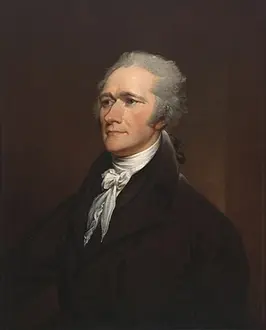
First U.S. Secretary of the Treasury (1789-1795) and Federalist leader
Hamilton argued for a strong national government with an energetic executive, an independent judiciary and a Senate and executive serving long terms. As Treasury Secretary he funded the national debt, founded a national bank on implied powers, and urged protective duties and bounties for manufactures. He opposed slavery, helped found the New York Manumission Society and welcomed immigration, while distrusting democratic excess and favoring British-style stability.
Closest ideologies
Based on the 73 statements where Alexander Hamilton has a known position.
- Yellow socialism (90% match)
- Cultural conservatism (87% match)
- Anglo-Saxonism (87% match)
- Post-fascism (87% match)
- Revisionist Zionism (86% match)
Similar people
- Charles-Maurice de Talleyrand-Périgord (91% alike)
- Lindsey Graham (87% alike)
- William Howard Taft (86% alike)
- Benjamin Netanyahu (86% alike)
- Arthur Balfour (86% alike)
Known positions
- Strongly: The best government combines a governing role for a few with a governing role for the wider population.
- Strongly: Owners' rights to their property should almost never be overridden, even for public goals.
- Strongly: At least some basic necessities should be subject to consumption taxes.
- Strongly: Elected officials should serve out their full terms.
- Strongly: Real authority to command the military should rest with the head of state.
- Strongly: Some of the foreign debts of poor countries should still be repaid.
- Strongly: A president should be free to stand for re-election as many times as they like.
- Strongly: Besides its directly elected parliament, a legislature should have a second chamber, such as a senate.
- Strongly: Political power should be split among separate branches and levels that can each limit the others.
- Strongly: When national priorities conflict with working together internationally, my country should choose its own priorities.
- Strongly: The government should be able to require citizens to serve in the military.
- Strongly: Major laws should not be decided by direct votes of citizens.
- Strongly: Some things are right or wrong for everyone, in every culture and era.
- Strongly: Elected representatives may serve out their terms without voters being able to remove them early.
- Strongly: Defense should not rest with armed ordinary citizens in place of a standing force.
- Strongly: Elected politicians should be able to serve any number of terms in any office.
- Strongly: The head of state should not be elected directly by the voters.
- Strongly: Rulers must act under lasting, publicly known laws administered by recognised courts.
- Strongly: Inventions and creative works should remain legally ownable, as under patents and copyrights.
- Strongly: Public institutions should have the power to constrain a national majority's decisions in a liberal democracy.
- Strongly: Being the law gives a rule a moral claim to be obeyed.
- Strongly: Rulers have a right to rule only because the people they rule have agreed to it.
- Strongly: Political violence is sometimes justified.
- Strongly: Political authority does not ultimately come from God.
- Strongly: Most of the average difference in ability between racial groups does not come from genes.
- Strongly: Lending money at interest should be legal.
- Strongly: At least some revolutions have been justified.
- Strongly: Central banks should keep a role in controlling the money supply.
- Strongly: Some decisions should bind people who have not consented to them.
- Strongly: Society needs government of some kind.
- Strongly: Countries should keep their armed forces.
- Strongly: The ruler should be subject to the country's laws.
- Strongly: Government should have other tasks besides protecting people from physical violence.
- Strongly: Collecting taxes does not in itself amount to stealing people's money.
- Leans: Women's political rights may differ from men's.
- Leans: Elected governments should leave central banks free to make monetary-policy decisions within their legal mandates.
- Leans: A powerful country should bring more land within its borders.
- Leans: It is acceptable for a monarch who inherits the throne to be the country's symbolic head while others govern.
- Leans: Some people are better suited by nature to govern.
- Leans: A society holds together less well when its members belong to different ethnic groups.
- Leans: The country would benefit from a strong leader with the power to act despite deadlock among its political institutions.
- Leans: Newcomers should adopt the host nation's culture in place of their original culture.
- Leans: A poor country should rely on foreign money at least as much as on its own resources.
- Leans: The country may allow more immigration than strict limits would permit.
- Leans: Democracy is not the best form of government when voters choose badly.
- Leans: Many political decisions should rest with national or wider authorities, even where a smaller community could handle them.
- Leans: Taxes on imports should shield domestic producers from foreign competition.
- Leans: Government borrowing should be subject to binding legal limits.
- Leans: Money creation should not be reserved exclusively to public institutions.
- Leans: Government should not be bound by a written bill of rights protected against easy amendment by ordinary majorities.
- Leans: Wealthy countries have no duty to give substantial aid to the world's poor abroad.
- Leans: Religious values and institutions should shape laws, schools and public life.
- Leans: Being a foreigner should not by itself bar someone from owning land in the country.
- Leans: Armed forces may sometimes be used for purposes beyond defending the country against attack.
- Leans: My country should stay neutral and join neither of the opposing great-power alliances.
- Leans: A law imposes no moral duty to obey it if the law is unjust.
- Leans: The government should steer investment into industries it sees as key to the country's future.
- Leans: Most of government should be funded by taxes other than a tax on the value of land.
- Leans: People are entitled to resist a ruler's unconstitutional exercise of power.
- Leans: An elected legislature must approve the government's budget before the government spends public money.
- Leans: An electorate should choose the head of state, either directly or through elected representatives.
- Leans: Officials decide what gets made and who gets it at least as well as prices and competition do.
- Leans: A country may keep a region that wants to leave.
- Leans: Nobody should hold a special rank by birth, such as a noble title, a hereditary crown or a caste position, or the special rights attached to one.
- Leans: Spreading democracy does not bring peace.
- Leans: Profit-making banks should not be replaced by user-owned banks charging only the costs of running the service.
- Leans: Keeping a nation's inherited culture alive, including its language, customs and traditions, matters.
- Leans: A mother country and its colonies may trade with the outside world.
- Leans: The law should treat everyone as an equal, whatever their birth, sex, race or status.