Political Ideology Atlas · All people · Take the test
Europe · born 1798, historical
Auguste Comte
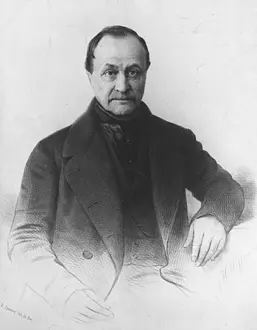
French philosopher and founder of positivism and sociology (1798-1857)
Comte sought to end the disorder of the post-revolutionary West by a science of society and a secular Religion of Humanity. He favoured a provisional progressive dictatorship with free speech, separation of an advisory priesthood from temporal power, small republics, a disbanded army and an end to colonial rule. He opposed popular sovereignty, equal rights and Communism, and wanted women kept in the family and property left in private hands under moral control.
Closest ideologies
Based on the 94 statements where Auguste Comte has a known position.
- Positivism (88% match)
- Dark Enlightenment (84% match)
- Gladstonian liberalism (83% match)
- Religious anti-Zionism (83% match)
- Christian corporatism (82% match)
Similar people
- John Adams (81% alike)
- Friedrich Nietzsche (80% alike)
- Marcus Aurelius (80% alike)
- Aristotle (80% alike)
- Henry Ford (80% alike)
Known positions
- Strongly: Women's political rights may differ from men's.
- Strongly: Laws may give daughters and widows different land rights from sons and husbands.
- Strongly: Most of the average difference in ability between racial groups comes from genes.
- Strongly: A free society can coexist with very large concentrations of wealth.
- Strongly: One spouse may have more authority than the other within a marriage.
- Strongly: Specialists should have more weight in decisions than public opinion.
- Strongly: A wife should not be able to end the marriage when her husband refuses.
- Strongly: People do not need a direct role in making decisions where they work, live and study.
- Strongly: The head of state should not have to be chosen by election.
- Strongly: The country would benefit from a strong leader with the power to act despite deadlock among its political institutions.
- Strongly: The government may leave it to investors to decide which industries receive investment.
- Strongly: Democracy is not the best form of government when voters choose badly.
- Strongly: Military service should always be voluntary.
- Strongly: Industries such as energy, rail and utilities do not need to be publicly owned.
- Strongly: Rich people have an obligation to help those worse off than they are.
- Strongly: Countries should maintain only the weapons needed for national safety.
- Strongly: Businesses need not belong to the people who work in them.
- Strongly: Workers should not have democratic voting rights in the management of large companies.
- Strongly: Religious values and institutions should shape laws, schools and public life.
- Strongly: Politics should prioritise a single common good identified by reasoning over compromises among organised interests.
- Strongly: Society should follow a third course beyond capitalism and communism.
- Strongly: The worst crimes can be punished by death.
- Strongly: Ending a marriage should not be possible without proving fault.
- Strongly: My country may keep a military no stronger than its rivals'.
- Strongly: Heirs to large fortunes may keep most of what they inherit.
- Strongly: What you owe your community matters more than your personal rights.
- Strongly: Major laws should not be decided by direct votes of citizens.
- Strongly: Ideas of what men and women are like do not come mostly from culture.
- Strongly: At least some religious leadership offices should have different eligibility rules for women than for men.
- Strongly: Another body may have the final say over what the legislature passes.
- Strongly: Defense should not rest with armed ordinary citizens in place of a standing force.
- Strongly: Some cultures are superior to others.
- Strongly: Employers and workers should treat each other as partners whose cooperation comes before conflict, even where their interests differ.
- Strongly: Religious institutions should be independent of government direction in their internal affairs.
- Strongly: Racial categories are not merely social constructs without a scientific basis.
- Strongly: Capitalism does not inevitably cause wars between great powers.
- Strongly: In law, a country's traditional national church should rank no higher than other religious bodies.
- Strongly: A healthy society depends on the traditional family, such as a married mother and father raising their children.
- Strongly: Rules need not set equal numbers of women and men on public bodies.
- Strongly: Historical change does not come mainly from changes in how society produces and exchanges goods.
- Strongly: Families may keep the main responsibility for housework and childcare.
- Strongly: Equality of outcomes should not be society's goal.
- Strongly: Restoring a lost social order does not matter more than pursuing progress.
- Strongly: Other forces move history at least as much as conflict between classes does.
- Strongly: Private ownership is legitimate only insofar as it benefits society.
- Strongly: War does not strengthen a nation's character.
- Strongly: Being powerful does not mean a country should bring more land within its borders.
- Strongly: Political authority does not ultimately come from God.
- Strongly: Laws should not be required to follow religious texts.
- Strongly: Looking after your own interests is not a moral good in itself.
- Strongly: News media should decide for themselves what they publish, whoever holds power.
- Strongly: Political power may rest on something other than workplace-elected councils.
- Strongly: Industrial society has done at least as much good as harm to humanity.
- Strongly: Some areas of life should remain outside state direction.
- Strongly: Marriage should retain legal recognition.
- Strongly: Society needs government of some kind.
- Strongly: Overseas territories need not be run mainly for the ruling country's economic benefit.
- Strongly: State schools need not steer pupils away from belief in God.
- Strongly: Final authority over a state's laws need not belong to its most senior religious scholars.
- Leans: A country can and should do without a standing military.
- Leans: A workers' state must suppress the old ruling class for a time.
- Leans: The law may treat people differently according to such things as birth, sex, race and status.
- Leans: A person's sex should affect the public roles legally assigned to them.
- Leans: Population growth should be deliberately held down.
- Leans: A region should be entitled to leave its current country.
- Leans: People should work mainly out of responsibility to society and a shared purpose, with personal material rewards playing a secondary role.
- Leans: Dividing politics into left and right no longer makes sense.
- Leans: Government should maintain a strict institutional separation from religion.
- Leans: Political power may be concentrated in one body.
- Leans: Property need not be spread among many small owners.
- Leans: A country does not have the right to stop a region becoming independent by using its military.
- Leans: Technology will not solve most of humanity's problems.
- Leans: One worker's pay should cover the living needs of that worker's family, including the worker.
- Leans: Countries within one civilization may remain politically separate.
- Leans: Some things are right or wrong for everyone, in every culture and era.
- Leans: People are entitled to resist a ruler's unconstitutional exercise of power.
- Leans: Public policy should not be used to reduce the passing on of inherited disabilities.
- Leans: Workers are better off for having labor unions.
- Leans: Meeting poor people's needs should be the first consideration in public policy.
- Leans: No society has the right to rule another for its supposed improvement, however advanced it is.
- Leans: In the long run people should still produce and share using money.
- Leans: Even a purely ceremonial head of state should not hold the position by birth.
- Leans: At least some revolutions have been justified.
- Leans: Political violence is sometimes justified.
- Leans: Islam is compatible with Western values.