Political Ideology Atlas · All people · Take the test
Russia & Central Asia · born 1918, historical
Aleksandr Solzhenitsyn
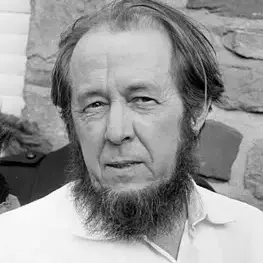
Russian novelist, Soviet dissident and critic of communism and of Western materialism
Solzhenitsyn condemned communism as irredeemable and urged the West to resist it rather than coexist. He rejected violence and revolution in favour of refusing to take part in lies, wanted the Soviet empire dissolved and non-Russian republics free to leave, and pressed for local self-government, private farms and small property with limits on monopoly. He distrusted party-list democracy and unlimited progress, preached duty and self-limitation over rights, and held that politics needs a religious, Orthodox moral base. He criticised the West for weak will, legalism and consumerism.
Closest ideologies
Based on the 108 statements where Aleksandr Solzhenitsyn has a known position.
- Christian democracy (91% match)
- Christian corporatism (90% match)
- Distributism (89% match)
- Zionism (89% match)
- Person Dignity Theory (89% match)
Similar people
- Simone Weil (90% alike)
- Imran Khan (90% alike)
- G. K. Chesterton (89% alike)
- Santiago Peña Palacios (88% alike)
- Mahmoud Ahmadinejad (88% alike)
Known positions
- Strongly: Protecting nature can mean accepting less economic growth.
- Strongly: Voters themselves should elect the head of state, without an intermediary body selecting the officeholder.
- Strongly: The political goal should be victory over communism ahead of accommodation with it.
- Strongly: Land stays in the hands of citizens; foreigners may not buy it.
- Strongly: Communist one-party regimes should be condemned as severely as fascist regimes.
- Strongly: Being part of the nation gives a person's life meaning beyond their own lifetime through a bond held sacred across generations.
- Strongly: Working for wages should remain a normal way for people to earn a living.
- Strongly: A business owner can earn a profit without taking unfair advantage of employees.
- Strongly: The state has no single leading function, or its leading function is something other than preserving the ruling class's power.
- Strongly: A country does not have the right to stop a region becoming independent by using its military.
- Strongly: Property should belong to many people in small holdings.
- Strongly: The world's most powerful countries can avoid going to war with one another under capitalism.
- Strongly: What you owe your community matters more than your personal rights.
- Strongly: People should want as few material things as possible.
- Strongly: Technology will leave most of humanity's problems unsolved.
- Strongly: Religious values and institutions should shape laws, schools and public life.
- Strongly: Political decisions should rest with the smallest local community able to handle them, with wider authorities handling matters that need a wider reach.
- Strongly: Where they conflict, religious faith should count for at least as much as evidence and reasoning.
- Strongly: The people living in a disputed territory should choose by voting which country it joins.
- Strongly: A poor country should develop mainly with its own resources.
- Strongly: Society relies for its well-being on longstanding family arrangements, such as a married mother and father raising their children.
- Strongly: Religious institutions should be independent of government direction in their internal affairs.
- Strongly: Some things are right or wrong for everyone, in every culture and era.
- Strongly: One worker's pay should cover the living needs of that worker's family, including the worker.
- Strongly: At least one other influence has shaped history as much as conflict between economic classes has.
- Strongly: Being powerful does not mean a country should bring more land within its borders.
- Strongly: Workers do not need a disciplined revolutionary party to lead them.
- Strongly: Minority groups are not, as groups, secretly plotting to harm the nation.
- Strongly: Individual farms should not give way to joint cultivation by groups of farmers.
- Strongly: Rulers must act under lasting, publicly known laws administered by recognised courts.
- Strongly: Families may keep the main responsibility for housework and childcare.
- Strongly: Political institutions developed in the West are not a suitable model for every civilization.
- Strongly: The government should let its political opponents organise, speak and compete for power.
- Strongly: You can't reach a free, fair society by unfree or unfair means.
- Strongly: People should have a way to vote an officeholder out between regular elections.
- Strongly: An economy directed by a central plan is not capable of working better than one directed by market exchange.
- Strongly: Constantly seeking additional possessions is harmful overall, despite any benefits it brings.
- Strongly: No party's ideology should give it an exclusive right to lead the state.
- Strongly: Politics should support people's spiritual well-being.
- Strongly: Very large concentrations of wealth threaten a free society.
- Strongly: The reassurance people draw from faith in the face of material hardship need not be founded on false hopes.
- Strongly: News media should decide for themselves what they publish, whoever holds power.
- Strongly: A workers' state does not need to suppress the old ruling class, even for a time.
- Strongly: Looking after your own interests is not a moral good in itself.
- Strongly: We have a duty to leave the planet in good condition for those who come after us.
- Strongly: Keeping a nation's inherited culture alive, including its language, customs and traditions, matters.
- Strongly: Some areas of life should remain outside state direction.
- Strongly: Society needs government of some kind.
- Strongly: Each country should hold ultimate authority over its natural resources, without foreign interests controlling them.
- Strongly: The ruler should be subject to the country's laws.
- Strongly: Government should have other tasks besides protecting people from physical violence.
- Strongly: State schools need not steer pupils away from belief in God.
- Leans: Industrial society has done more harm than good to humanity.
- Leans: The ideal system gives both a small group and the wider public a share of governing power.
- Leans: Staying out of other countries' internal affairs should not be the default for foreign policy.
- Leans: The presence of people belonging to the same nation gives a state a legitimate territorial claim outside its borders.
- Leans: Owners' rights to their property should almost never be overridden, even for public goals.
- Leans: A region should be entitled to leave its current country.
- Leans: Changes to society should be introduced a little at a time.
- Leans: Prices and competition generally decide better than officials what gets made and who gets it.
- Leans: Industries such as energy, rail and utilities do not need to be publicly owned.
- Leans: Major laws should be decided by citizens voting on them themselves.
- Leans: Legal limits on getting pornography should apply even to adults who want to view it privately.
- Leans: At its core, politics is a struggle between spiritual good and evil.
- Leans: My country's military strength should exceed that of its rivals.
- Leans: Peoples who share an ethnic heritage, such as the Slavic, Arab or Turkic peoples, should come together in one state, even across present borders.
- Leans: Political power may be concentrated in one body.
- Leans: Private businesses and markets should run most of the economy, while the government supports people who cannot meet their basic needs.
- Leans: Besides its directly elected parliament, a legislature should have a second chamber, such as a senate.
- Leans: To keep their political freedoms, people need the freedom to own property, trade and choose their work.
- Leans: Countries within one civilization should unite politically.
- Leans: Governments should answer in law for past abuses by their security forces, including unlawful killings.
- Leans: Businesses should be legally barred from agreements with competitors to suppress competition, such as fixing prices.
- Leans: A national minority should run its own schools, language and cultural institutions inside the state it lives in.
- Leans: Trade unions should control their own affairs without state direction.
- Leans: Society should follow a third course beyond capitalism and communism.
- Leans: Society may hold back technological change that would overturn established institutions.
- Leans: A healthy democracy does not need a clash of opposing political positions.
- Leans: Those who elected someone should be able to remove them before their term ends, whenever they choose.
- Leans: Some institutional ties between government and religion are acceptable.
- Leans: High earners and the very rich should pay tax at a much higher rate than everyone else.
- Leans: The people who run the press, universities and other cultural institutions have more real power than the people voters elect.
- Leans: Living in the countryside does more for a person's moral wellbeing than living in a city.
- Leans: Politics should prioritise a single common good identified by reasoning over compromises among organised interests.
- Leans: Seats may be allocated in ways that do not follow parties' shares of the vote closely.
- Leans: Government should impose strict rules on how corporations operate.
- Leans: The state should stop foreign buyers from taking over key national businesses.
- Leans: An electorate should choose the head of state, either directly or through elected representatives.
- Leans: A nation can be made up of several ethnic groups with none forming most of its people.
- Leans: The nation has decayed and must be reborn.
- Leans: The state should not make one language the only common language of government, schooling and public life at the cost of limiting others.
- Leans: A government may leave the political systems of other countries to their own people.
- Leans: The spread of democratic government does not lower the risk of war between countries.
- Leans: Public institutions should help minority languages be used in public life, for example through teaching or services in those languages.
- Leans: A government needs more than fair elections to qualify as democratic.
- Leans: Income-tax percentages may differ between income levels.
- Leans: Workers are better off for having labor unions.
- Leans: Most people in political office look after themselves first and the public second.
- Leans: Rulers have a right to rule only because the people they rule have agreed to it.
- Leans: Member states should keep the final decision on whether to follow UN decisions.
- Leans: A people's connection to its ancestral land is spiritual, beyond practical interests or ordinary affection.
- Leans: People should have a direct role in making decisions where they work, live and study, rather than having those decisions made entirely for them.
- Leans: A people with a shared national identity is entitled to its own self-governing state.
- Leans: Art should not be censored for its effect on people's moral character.
- Leans: Meeting poor people's needs should be the first consideration in public policy.
- Leans: Owning things privately is justified only if it benefits society as a whole.