Political Ideology Atlas · All ideologies · Take the test
Zapatismo
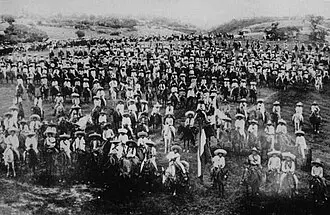
Zapatismo is the agrarian revolutionary outlook of Emiliano Zapata and the Liberation Army of the South in the Mexican Revolution. It held that land, water and woods taken by haciendas must be restored to the villages and that great estates must be broken up so every family can farm its own plot, communally or as small property. Around that core its intellectuals drafted a social state: recognition of unions and strikes, labour protections, public assistance as justice, municipal self-government, popular juries, plebiscites on laws and an armed people in place of a standing army.
What it stands for
- Defense should rest with armed ordinary citizens, not a standing force.
- Major laws should be decided by citizens voting on them themselves.
- The farmers who work large estates should take ownership from the landowners, with the transfer compulsory if owners refuse.
- Property should belong to many people in small holdings.
- Prisons should mainly help offenders rejoin society.
- The directly elected parliament should be a legislature's only chamber.
Key figures
- Emiliano Zapata: Leader of the Liberation Army of the South and namesake of the ideology; signer of the Plan of Ayala.
- Otilio Montaño: Co-author of the Plan of Ayala and the movement's main early intellectual; later in charge of public instruction.
- Manuel Palafox: Zapatista secretary of agriculture who directed the Morelos land reform and drafted the 1915 Agrarian Law.
Closest ideologies
- Irish republican legitimism (89% match)
- Guild socialism (88% match)
- Irish republicanism (88% match)
- New Democracy (88% match)
- Black nationalism (88% match)
People closest to it
- Frantz Fanon (91% alike)
- George Orwell (90% alike)
- Aurobindo Ghosh (89% alike)
- Maximilien Robespierre (89% alike)
- Frederick Douglass (88% alike)
Key positions
- Strongly: Defense should rest with armed ordinary citizens, not a standing force.
- Strongly: Major laws should be decided by citizens voting on them themselves.
- Strongly: The farmers who work large estates should take ownership from the landowners, with the transfer compulsory if owners refuse.
- Strongly: Property should belong to many people in small holdings.
- Strongly: Prisons should mainly help offenders rejoin society.
- Strongly: The directly elected parliament should be a legislature's only chamber.
- Strongly: People outside state forces should also be allowed to bear arms.
- Strongly: A president should be limited in how many times he or she may stand for re-election.
- Strongly: Society may be changed in large, rapid steps.
- Strongly: Purchases of basic necessities should carry no consumption tax.
- Strongly: People are entitled to resist a ruler's unconstitutional exercise of power.
- Strongly: How someone turns out is shaped more by upbringing, society and experience than by the traits they are born with.
- Strongly: Owners' rights to their property need not be protected against being overridden for public goals.
- Strongly: The law should impose no restrictions on strikes.
- Strongly: An electorate should choose the head of state, either directly or through elected representatives.
- Strongly: Workers are better off for having labor unions.
- Strongly: People should have a direct role in making decisions where they work, live and study, rather than having those decisions made entirely for them.
- Strongly: Being free requires having the practical resources to act on one's choices, such as an adequate livelihood.
- Strongly: Private charity does not help people in poverty better than government programs do.
- Strongly: Political independence means little unless the economic and property system is also transformed.
- Strongly: Meeting poor people's needs should be the first consideration in public policy.
- Strongly: Most people in political office look after themselves first and the public second.
- Strongly: Private ownership is legitimate only insofar as it benefits society.
- Strongly: Very large concentrations of wealth threaten a free society.
- Strongly: Whatever their circumstances, everyone should be able to count on the state for enough to live decently, through benefits, pensions or public services.
- Strongly: Political violence is sometimes justified.
- Strongly: Income from useful work should be rewarded ahead of income from merely owning property.
- Strongly: Protecting the constitution should be left to civilian institutions, not the armed forces.
- Strongly: The law should treat everyone as an equal, whatever their birth, sex, race or status.
- Strongly: Being the first to use force can be right, depending on what it is meant to achieve.
- Strongly: At least some revolutions have been justified.
- Strongly: News media should decide for themselves what they publish, whoever holds power.
- Strongly: Population growth does not mainly drive lasting poverty.
- Strongly: Society needs government of some kind.
- Strongly: Government should have other tasks besides protecting people from physical violence.
- Strongly: Killing another person can be right in self-defence or in defence of others.
- Strongly: A weaker state need not formally treat a stronger power as its superior.
- Strongly: Farmers should have the legal freedom to leave the estates they work.
- Leans: A country can and should do without a standing military.
- Leans: Farms, factories and utilities belong to the town or city that uses them.
- Leans: History is mainly driven by conflict between economic classes.
- Leans: People should lose their right to a plot of land when they no longer use it.
- Leans: Laws, police and government mainly serve the interests of whoever owns the economy and holds power.
- Leans: People seeking political change should act directly—for example, with strikes, boycotts or occupations—instead of pursuing change through elections and parliaments.
- Leans: Elected politicians should serve only a small number of terms.
- Leans: The representative legislature should have the final say on legislation.
- Leans: Government should maintain a strict institutional separation from religion.
- Leans: Either spouse can leave a marriage without showing wrongdoing by the other.
- Leans: The state should be barred from executing people convicted of the gravest crimes, such as terrorism.
- Leans: State schools should not teach religion.
- Leans: Those who hold public office should be paid no more than an average worker.
- Leans: Businesses should belong to the people who work in them, for example as cooperatives.
- Leans: Having wealth does not by itself create a duty to help those who are worse off.
- Leans: Farmers should get price floors, state buying or cheap credit to keep them secure.
- Leans: Full-time work at the legal wage floor should pay enough to meet basic living costs.
- Leans: Political decisions should rest with the smallest local community able to handle them, with wider authorities handling matters that need a wider reach.
- Leans: Indigenous peoples should control their traditional territories.
- Leans: Democracy is best even when voters make poor choices.
- Leans: The government should steer investment into industries it sees as key to the country's future.
- Leans: One worker's pay should cover the living needs of that worker's family, including the worker.
- Leans: Government should impose strict rules on how corporations operate.
- Leans: A country can get through deadlock among its institutions without a leader who overrides them.
- Leans: Some things are right or wrong for everyone, in every culture and era.
- Leans: Collecting taxes does not in itself amount to stealing people's money.
- Leans: Profit made from owning businesses does not come from exploiting the workers who produce it.
- Leans: The general public should have at least as much say in policy as experts.
- Leans: Each country should hold ultimate authority over its natural resources, without foreign interests controlling them.
- Leans: Work may stay divided into separate specialized jobs held by different people.
- Leans: Central banks should keep a role in controlling the money supply.
- Leans: Rulers have a right to rule only because the people they rule have agreed to it.
- Leans: Groups have rights of their own.