Political Ideology Atlas · All ideologies · Take the test
Revisionist Zionism
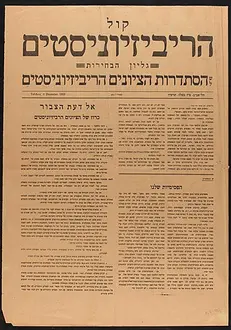
Revisionist Zionism, founded by Ze'ev Jabotinsky in the 1920s, demanded an openly stated Jewish state with a Jewish majority on both banks of the Jordan, to be secured by military strength behind an iron wall of force. It rejected socialism and class struggle in favour of national unity, private enterprise and compulsory arbitration, and was institutionally embodied in Betar, the Irgun, Herut and later Likud. Its mainstream favoured liberal parliamentary government and civil rights for Arabs as a minority, while an Irgun wing was harder-line.
What it stands for
- The state should encourage people of the majority group to move into areas where minority groups are in the majority.
- Young people should belong to uniformed, drilled organisations that prepare them to serve the nation.
- A country should be ready to use military force abroad on its own judgment, even if the UN Security Council has not authorized it.
- There should be legal limits on strike action.
- Land that a state declares its own against its people's will is not illegally occupied by that state.
- Workers' solidarity with their own nation should take priority over solidarity with workers across borders.
Key figures
- Ze'ev Jabotinsky: Founder and leader of Revisionist Zionism and author of the Iron Wall.
- Menachem Begin: Irgun commander, Herut leader and first Likud prime minister.
Closest ideologies
- American nationalism (91% match)
- Venizelism (91% match)
- Megali Idea (89% match)
- German nationalism in Austria (88% match)
- Make America Great Again (88% match)
People closest to it
- Benjamin Netanyahu (93% alike)
- Andrew Jackson (88% alike)
- Kristi Noem (87% alike)
- Dick Cheney (87% alike)
- Max Weber (87% alike)
Key positions
- Strongly: The state should encourage people of the majority group to move into areas where minority groups are in the majority.
- Strongly: Young people should belong to uniformed, drilled organisations that prepare them to serve the nation.
- Strongly: A country should be ready to use military force abroad on its own judgment, even if the UN Security Council has not authorized it.
- Strongly: There should be legal limits on strike action.
- Strongly: Land that a state declares its own against its people's will is not illegally occupied by that state.
- Strongly: Workers' solidarity with their own nation should take priority over solidarity with workers across borders.
- Strongly: Jews, as a people, are entitled to a country of their own in the Land of Israel.
- Strongly: A country should press its neighbour to give back land taken from it in an old war.
- Strongly: My country's military strength should exceed that of its rivals.
- Strongly: What things are worth does not come from the work put into them.
- Strongly: Armaments need not be limited to the minimum needed for national safety.
- Strongly: Elected officials may receive a salary above what an average worker earns.
- Strongly: Emigrating to establish a homeland should take at least as much priority as seeking equal rights where persecuted minorities live.
- Strongly: When national priorities conflict with working together internationally, my country should choose its own priorities.
- Strongly: Land claimed as the historic homeland should not be traded away, even for peace.
- Strongly: A national language that people no longer use every day should be brought back as the state's official language.
- Strongly: A nation need not wait for a cultural revival before building its state.
- Strongly: An ancestral bond to a land gives a people a claim that outweighs the claims of other peoples who now live there.
- Strongly: Employers and workers should treat each other as partners whose cooperation comes before conflict, even where their interests differ.
- Strongly: Gathering all the people in the homeland should have at least as much priority as supporting diaspora culture.
- Strongly: People belonging to a nation but living abroad should be entitled to settle in that nation's ancestral homeland.
- Strongly: Profit made from owning businesses does not come from exploiting the workers who produce it.
- Strongly: Capitalism does not inevitably cause wars between great powers.
- Strongly: People who give their lives for the nation deserve to be remembered as martyrs, with reverence beyond ordinary thanks.
- Strongly: The people who own the economy and hold power are not the ones the state mainly serves.
- Strongly: A country may keep all its decisions in its own hands rather than pooling them with other nations.
- Strongly: People may live and work outside communities that own their property together.
- Strongly: The existing governing institutions should be retained, even if their personnel, policies or procedures change.
- Strongly: Other forces move history at least as much as conflict between classes does.
- Strongly: Member states should keep the final decision on whether to follow UN decisions.
- Strongly: An economy directed by a central plan is not capable of working better than one directed by market exchange.
- Strongly: At most half of workers in wealthy countries benefit from the exploitation of poorer countries.
- Strongly: Class struggle does not continue under socialism.
- Strongly: Political violence is sometimes justified.
- Strongly: A people with a shared national identity is entitled to its own self-governing state.
- Strongly: The government should let its political opponents organise, speak and compete for power.
- Strongly: Being the first to use force can be right, depending on what it is meant to achieve.
- Strongly: Lending money at interest should be legal.
- Strongly: Workers do not need a disciplined revolutionary party to lead them.
- Strongly: Local community ownership of the means of production should not replace private or state ownership.
- Strongly: Soldiers and conscripts need not refuse to fight when their state goes to war.
- Strongly: News media should decide for themselves what they publish, whoever holds power.
- Strongly: Political power may rest on something other than workplace-elected councils.
- Strongly: Countries may keep controls on who enters and settles, even in the long run.
- Strongly: A state with a state-owned planned economy should not be defended against capitalist restoration under a ruling bureaucracy.
- Strongly: Keeping a nation's inherited culture alive, including its language, customs and traditions, matters.
- Strongly: Small, informal, trust-based groups should not take the place of lasting parties, unions and federations in political action.
- Strongly: In a war between great powers, workers need not seek their own government's defeat.
- Strongly: Work may stay divided into separate specialized jobs held by different people.
- Strongly: In the long run people should still produce and share using money.
- Strongly: Some areas of life should remain outside state direction.
- Strongly: A market economy is incompatible with socialism under communist-party leadership.
- Strongly: A workers' state does not need to suppress the old ruling class, even for a time.
- Strongly: Public offices may be filled by methods other than drawing lots.
- Strongly: Society needs government of some kind.
- Strongly: Countries should keep their armed forces.
- Strongly: The ruler should be subject to the country's laws.
- Strongly: Renting out housing should be permitted in at least some circumstances.
- Strongly: Political authority need not rest on oaths of loyalty sworn to a lord.
- Strongly: Voting should not be limited to members of one ethnic group.
- Strongly: Killing another person can be right in self-defence or in defence of others.
- Strongly: Taking part in politics is at least as good a way to live as living privately away from public affairs.
- Strongly: Public spaces such as schools and facilities should not be separated by race under the law.
- Strongly: Courts need not be handed over to private businesses.
- Strongly: Final authority over a state's laws need not belong to its most senior religious scholars.
- Strongly: Museums, libraries and other inherited culture should not be destroyed, even when they stand in the way of new creation.
- Strongly: Humanity would gain nothing by going back to living off hunting and gathering.
- Strongly: Farmers should have the legal freedom to leave the estates they work.
- Leans: A powerful country should bring more land within its borders.
- Leans: War develops virtues in a nation, such as courage and discipline.
- Leans: Officially recognized bodies representing employers and workers should negotiate wages together.
- Leans: A nation should be mainly one ethnic people.
- Leans: Political independence means a great deal even without economic transformation.
- Leans: Labor unions do not necessarily make workers better off.
- Leans: Prices and competition generally decide better than officials what gets made and who gets it.
- Leans: Which country a disputed territory belongs to may be settled without a vote of its inhabitants.
- Leans: Owners' rights to their property should almost never be overridden, even for public goals.
- Leans: The country would benefit from a strong leader with the power to act despite deadlock among its political institutions.
- Leans: A party with a fifth of the votes should get about a fifth of the seats.
- Leans: Free citizens need the freedom to own property, trade and choose work, or political freedom cannot last.
- Leans: Workers' pay need not be set through negotiations between their union and their employer.
- Leans: A society can be socialist without the working class itself holding political power.
- Leans: Decisions about indigenous peoples' traditional lands may rest with the wider state, not with those peoples.
- Leans: Countries that feel dominated by Western powers may handle their relations with them separately.
- Leans: Industries such as energy, rail and utilities do not need to be publicly owned.
- Leans: Production should not be reorganised around what people need in place of what yields a profit.
- Leans: Living in a city does at least as much for a person's moral wellbeing as living in the countryside.
- Leans: Businesses need not belong to the people who work in them.
- Leans: Trade unions may be subject to state direction of their affairs.
- Leans: Workers should not have democratic voting rights in the management of large companies.
- Leans: A state founded by settlers who displaced the existing population need not be counted as a colonial project.
- Leans: The state need not guarantee work to everyone who wants a job.
- Leans: The worst crimes can be punished by death.
- Leans: The nation has decayed and must be reborn.
- Leans: Government should serve people's good while respecting each person as more than an instrument of the state or community.
- Leans: Belonging to the nation ties a person's life to a sacred community that goes on after their death.
- Leans: Armed forces may sometimes be used for purposes beyond defending the country against attack.
- Leans: Democracy is best even when voters make poor choices.
- Leans: What you owe your community matters more than your personal rights.
- Leans: A country may join permanent military alliances.
- Leans: Workers may be represented through the parties already in place.
- Leans: After members debate and adopt a party decision, every member should have to help implement it, including those who opposed it.
- Leans: Society may be changed in large, rapid steps.
- Leans: A national church need not be ruled by its bishops.
- Leans: Some things are right or wrong for everyone, in every culture and era.
- Leans: Firms in a market economy need not be owned by the people who work in them.
- Leans: In the society we should aim for, a person's share of goods may depend on things besides their needs.
- Leans: Government should rely at least as much on legal enforcement as on its rulers' moral example.
- Leans: It is not true that communities should be free to choose their own economic arrangements with no fixed blueprint for a free society's economy.
- Leans: A country may keep a region that wants to leave.
- Leans: Political representation should not come through social bodies such as families, local communities and occupational associations instead of political parties.
- Leans: A people split by an imposed border should be brought together in a single state.
- Leans: A state should take responsibility for the welfare of its national communities across neighbouring borders.
- Leans: No society has the right to rule another for its supposed improvement, however advanced it is.
- Leans: No state may force a minority out of the country, however hostile it judges that minority to be.
- Leans: Historical change does not come mainly from changes in how society produces and exchanges goods.
- Leans: Population growth does not mainly drive lasting poverty.
- Leans: Lasting socialism in one country does not require socialist revolutions abroad.
- Leans: Equality of outcomes should not be society's goal.
- Leans: Restoring a lost social order does not matter more than pursuing progress.
- Leans: Rulers have a right to rule only because the people they rule have agreed to it.
- Leans: Population growth may be left to run its course.
- Leans: The armed forces may be controlled by someone other than the governing party's leadership.
- Leans: No party's ideology should give it an exclusive right to lead the state.
- Leans: Laws should not be required to follow religious texts.
- Leans: Descendants of settlers need not be led politically by the country's original peoples.
- Leans: Naturalized citizens may hold public office as well as people born in the country.
- Leans: A country may leave other nations to choose their own political systems.
- Leans: Groups have rights of their own.
- Leans: The law should treat everyone as an equal, whatever their birth, sex, race or status.
- Leans: Individual farms should not give way to joint cultivation by groups of farmers.