Political Ideology Atlas · All ideologies · Take the test
Megali Idea
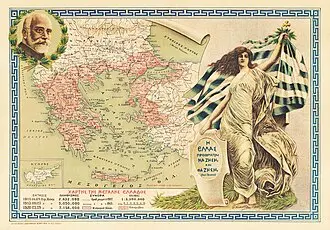
The Megali Idea (Great Idea) is the Greek irredentist programme of uniting the Greeks still outside the kingdom, in the Ottoman Empire and elsewhere, in one state centred on Constantinople. It joined a modern constitutional nation with the memory of classical Athens and the Orthodox Byzantine Empire. It guided Greek foreign policy from 1844 until the defeat in Asia Minor in 1922.
What it stands for
- A powerful country should bring more land within its borders.
- The presence of people belonging to the same nation gives a state a legitimate territorial claim outside its borders.
- Peoples who share an ethnic heritage, such as the Slavic, Arab or Turkic peoples, should come together in one state, even across present borders.
- A former empire may keep a special relationship with its old territories.
- The national church is recognised in law above other religions.
- A country should press its neighbour to give back land taken from it in an old war.
Key figures
- Ioannis Kolettis: Prime minister who introduced the term Megali Idea in the 1844 constitutional debates
- Eleftherios Venizelos: Greek prime minister and leading advocate who pursued the idea at the Paris Peace Conference
Closest ideologies
- Akhand Bharat (90% match)
- Pan-Finnicism (90% match)
- Revisionist Zionism (89% match)
- American nationalism (88% match)
- Venizelism (88% match)
People closest to it
- Niccolò Machiavelli (89% alike)
- Viktor Orbán (88% alike)
- Napoleon III (88% alike)
- Giorgia Meloni (87% alike)
- Benjamin Netanyahu (87% alike)
Key positions
- Strongly: A powerful country should bring more land within its borders.
- Strongly: The presence of people belonging to the same nation gives a state a legitimate territorial claim outside its borders.
- Strongly: Peoples who share an ethnic heritage, such as the Slavic, Arab or Turkic peoples, should come together in one state, even across present borders.
- Strongly: A former empire may keep a special relationship with its old territories.
- Strongly: The national church is recognised in law above other religions.
- Strongly: A country should press its neighbour to give back land taken from it in an old war.
- Strongly: When national priorities conflict with working together internationally, my country should choose its own priorities.
- Strongly: The nation has decayed and must be reborn.
- Strongly: The government should be able to require citizens to serve in the military.
- Strongly: Belonging to the nation ties a person's life to a sacred community that goes on after their death.
- Strongly: Armed forces may sometimes be used for purposes beyond defending the country against attack.
- Strongly: A country may join permanent military alliances.
- Strongly: At least some religious leadership offices should have different eligibility rules for women than for men.
- Strongly: An ancestral bond to a land gives a people a claim that outweighs the claims of other peoples who now live there.
- Strongly: Today's nation is the same people as its ancient and medieval forebears.
- Strongly: Gathering all the people in the homeland should have at least as much priority as supporting diaspora culture.
- Strongly: Profit made from owning businesses does not come from exploiting the workers who produce it.
- Strongly: Capitalism does not inevitably cause wars between great powers.
- Strongly: The people who own the economy and hold power are not the ones the state mainly serves.
- Strongly: A people split by an imposed border should be brought together in a single state.
- Strongly: A state should take responsibility for the welfare of its national communities across neighbouring borders.
- Strongly: The existing governing institutions should be retained, even if their personnel, policies or procedures change.
- Strongly: Other forces move history at least as much as conflict between classes does.
- Strongly: Political violence is sometimes justified.
- Strongly: A people with a shared national identity is entitled to its own self-governing state.
- Strongly: Individual farms should not give way to joint cultivation by groups of farmers.
- Strongly: Being the first to use force can be right, depending on what it is meant to achieve.
- Strongly: Workers do not need a disciplined revolutionary party to lead them.
- Strongly: Religion does not offer illusory comfort for material suffering.
- Strongly: Soldiers and conscripts need not refuse to fight when their state goes to war.
- Strongly: News media should decide for themselves what they publish, whoever holds power.
- Strongly: Political power may rest on something other than workplace-elected councils.
- Strongly: Countries may keep controls on who enters and settles, even in the long run.
- Strongly: Keeping a nation's inherited culture alive, including its language, customs and traditions, matters.
- Strongly: In a war between great powers, workers need not seek their own government's defeat.
- Strongly: The armed forces may be controlled by someone other than the governing party's leadership.
- Strongly: Work may stay divided into separate specialized jobs held by different people.
- Strongly: There is no deliberate plan behind immigration aimed at replacing the native population.
- Strongly: In the long run people should still produce and share using money.
- Strongly: The vote keeps a government in check at least as well as being able to leave the country does.
- Strongly: A workers' state does not need to suppress the old ruling class, even for a time.
- Strongly: Public offices may be filled by methods other than drawing lots.
- Strongly: Society needs government of some kind.
- Strongly: Countries should keep their armed forces.
- Strongly: The state should not be managed the way a well-run business is.
- Strongly: Government should have other tasks besides protecting people from physical violence.
- Strongly: Collecting taxes does not in itself amount to stealing people's money.
- Strongly: Renting out housing should be permitted in at least some circumstances.
- Strongly: Political authority need not rest on oaths of loyalty sworn to a lord.
- Strongly: State schools need not steer pupils away from belief in God.
- Strongly: Public spaces such as schools and facilities should not be separated by race under the law.
- Strongly: Courts need not be handed over to private businesses.
- Strongly: Museums, libraries and other inherited culture should not be destroyed, even when they stand in the way of new creation.
- Strongly: Humanity would gain nothing by going back to living off hunting and gathering.
- Strongly: Farmers should have the legal freedom to leave the estates they work.
- Leans: A state may force a minority it sees as hostile to leave the country.
- Leans: The state should encourage people of the majority group to move into areas where minority groups are in the majority.
- Leans: Someone who actually governs a state may hand that power on to their own child, whether as a king or as a republic's leader.
- Leans: Belonging to the nation goes with sharing its religion.
- Leans: Recovering how society used to be matters more than moving forward.
- Leans: A nation should be mainly one ethnic people.
- Leans: Political independence means a great deal even without economic transformation.
- Leans: The national church should have episcopal government, with its bishops holding governing authority.
- Leans: Religious communities may be a basis for political life, as when parties represent one faith and top offices are shared out between faiths.
- Leans: Workers' solidarity with their own nation should take priority over solidarity with workers across borders.
- Leans: Countries within one civilization should unite politically.
- Leans: An assembly elected by the people for that purpose should draft the constitution.
- Leans: My country may join a military alliance led by one of the great powers.
- Leans: Many political decisions should rest with national or wider authorities, even where a smaller community could handle them.
- Leans: My country's military strength should exceed that of its rivals.
- Leans: Only children of citizens should be citizens at birth: being born in the country should not be enough.
- Leans: Speaking a common language is sufficient for people to constitute one nation.
- Leans: Government should be bound by written guarantees of basic rights protected against easy amendment by ordinary majorities.
- Leans: Armaments need not be limited to the minimum needed for national safety.
- Leans: Political power should be split among separate branches and levels that can each limit the others.
- Leans: The public should receive official records showing how government decisions were reached.
- Leans: Emigrating to establish a homeland should take at least as much priority as seeking equal rights where persecuted minorities live.
- Leans: A state founded by settlers who displaced the existing population need not be counted as a colonial project.
- Leans: State schools may teach pupils a religious faith, for example through lessons in its beliefs and practice.
- Leans: Religious values and institutions should shape laws, schools and public life.
- Leans: Some institutional ties between government and religion are acceptable.
- Leans: Foreign powers sometimes have a right to intervene in a country's internal affairs.
- Leans: Military intervention abroad is sometimes necessary to protect human rights.
- Leans: Cultural life inside a state should not be placed under the control of each national minority.
- Leans: Democracy is best even when voters make poor choices.
- Leans: What you owe your community matters more than your personal rights.
- Leans: Major laws should not be decided by direct votes of citizens.
- Leans: Land claimed as the historic homeland should not be traded away, even for peace.
- Leans: A national language that people no longer use every day should be brought back as the state's official language.
- Leans: Final authority over a state's laws need not belong to its most senior religious scholars.
- Leans: Society may be changed in large, rapid steps.
- Leans: A nation need not wait for a cultural revival before building its state.
- Leans: People who became refugees during a conflict should be permitted to return to the homes they themselves left.
- Leans: University-educated people are not especially out of touch with the realities of ordinary life.
- Leans: Defense should not rest with armed ordinary citizens in place of a standing force.
- Leans: Direct action does not have to take the place of elections and parliament as the way to achieve political change.
- Leans: Some cultures are superior to others.
- Leans: Employers and workers should treat each other as partners whose cooperation comes before conflict, even where their interests differ.
- Leans: The people living in a disputed territory should choose by voting which country it joins.
- Leans: People belonging to a nation but living abroad should be entitled to settle in that nation's ancestral homeland.
- Leans: Where they conflict, religious faith should count for at least as much as evidence and reasoning.
- Leans: The slaughter of cattle should be legal.
- Leans: A country may keep all its decisions in its own hands rather than pooling them with other nations.
- Leans: Political representation should not come through social bodies such as families, local communities and occupational associations instead of political parties.
- Leans: It is legitimate to take pride in the racial group one belongs to.
- Leans: Rulers must act under lasting, publicly known laws administered by recognised courts.
- Leans: Wages need not be set through negotiating bodies that the state officially recognizes.
- Leans: Some areas of life should remain outside state direction.
- Leans: People of different races should not be discouraged from forming a family together, including through marriage and children.
- Leans: Rulers have a right to rule only because the people they rule have agreed to it.
- Leans: Politics should support people's spiritual well-being.
- Leans: No party's ideology should give it an exclusive right to lead the state.
- Leans: At least some revolutions have been justified.
- Leans: Laws should not be required to follow religious texts.
- Leans: Most of the average difference in ability between racial groups does not come from genes.
- Leans: Groups have rights of their own.
- Leans: The law should treat everyone as an equal, whatever their birth, sex, race or status.